Introduction
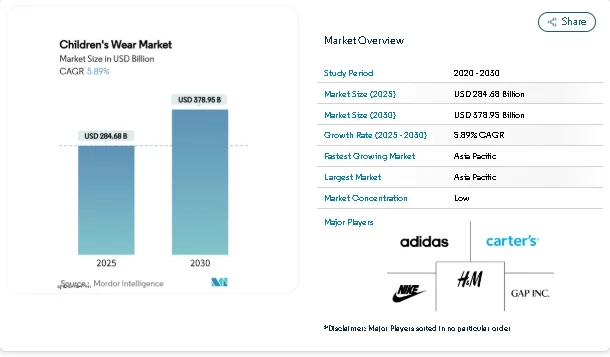
The global children’s wear market, currently worth US$ 284.68 billion in 2025, is projected to grow to US$ 378.95 billion by 2030, expanding at a compound annual growth rate (CAGR) of 5.89%. This steady growth underscores the fundamental demand in the children’s apparel and footwear segments, driven by frequent replacement cycles, rising safety expectations, and a growing shift toward sustainable and digital-first solutions.
Key Trends in the Children’s Wear Market
Frequent Replacement Cycle and Safety Focus
One of the strongest drivers of this market is the biological reality: children outgrow their clothes very quickly. This rapid growth forces a frequent replenishment of apparel—a cycle much more intense than in adult fashion. At the same time, parents’ safety concerns are rising. Regulatory bodies, especially in markets like the United States, are enforcing stricter safety standards for children’s garments, which is pushing manufacturers to invest more in quality assurance and compliance. Together, these forces sustain consistent demand even in uncertain economic times.
Shift toward Durability, Comfort, and Quality
Parents increasingly prioritize garments that go the distance — not just in terms of size, but in longevity, wash resilience, and comfort. As awareness of safety standards and the environmental impact of clothing grows, many are willing to pay more for materials that are safer, longer-lasting, and gentle on sensitive skin. In response, brands are innovating with moisture-wicking fabrics, hypoallergenic materials, and seamless construction, especially for infants and toddlers.
Rising Demand for Sustainable and Eco-Friendly Materials
Environmental consciousness among modern parents is translating directly into their purchasing behavior. There is increasing demand for eco-friendly children’s wear — made from organic cotton, recycled textiles, or manufactured through closed-loop systems. However, sourcing and certifying such materials raise production costs. Brands that manage to integrate sustainability across their value chain—in a transparent way—are gaining strong favor, especially in regions with stringent environmental regulations.
Material Innovation and Production Technology
To meet evolving needs, manufacturers are investing in technological upgrades in production. These include automated cutting, 3D knitting, and digital printing, which help in reducing waste and increasing customization. On the material side, performance-oriented textiles with features like UV protection, antimicrobial finishes, or even conductive yarns are entering the children’s wear space. These innovations allow brands to deliver real functional benefits while meeting the high safety bar expected for kids.
Volatile Fashion Trends and Seasonality Risks
Children’s fashion trends are no longer strictly seasonal. The influence of social media, celebrity endorsements, and viral digital trends is accelerating fashion cycles in kids wear. That results in unpredictable demand and challenging inventory management. Brands and retailers face the risk of overstock or costly markdowns when micro-trends fade faster than traditional forecasting models account for.
Cost Pressures from Safe and Sustainable Materials
While sustainable and safety-compliant materials are in high demand, they also come with higher costs. Certified organic textiles, recycled fibers, and rigorous safety testing inflate manufacturing expenses. This cost burden is especially felt in price-sensitive markets, forcing brands to balance affordability with quality and compliance.
Children’s Wear Market Segmentation
The global children’s wear market can be understood through several key segments: product type, age group, distribution channel, and price category.
-
By Product Type
-
Apparel: This is the dominant segment, accounting for about 73.47% of market revenue in 2024.
-
Footwear: Projected to grow at a 6.28% CAGR through 2030, driven by rising participation in sports and athleisure trends.
-
Others: Includes accessories and other children’s wear items.
-
By Age Group
-
Infant / Toddler (below 2 years): Forecasted to grow at 6.53% CAGR through 2030, with parents focusing more on comfort, safety, and quality.
-
Kids / Children (2–14 years): Accounts for around 76.58% of the market in 2024.
-
By Category (Price)
-
Mass Market: Holds the majority share at 67.58%, reflecting parents’ sensitivity to pricing given the fast replacement cycles.
-
Premium: Growing at a 6.93% CAGR through 2030, supported by consumer willingness to invest in higher-quality, safe, and sustainable garments.
-
By Distribution Channel
-
Offline Stores: The largest channel with 81.43% share in 2024, largely because parents prefer to physically assess fit, fabric, and quality.
-
Online Stores: Expected to grow strongly at a 7.34% CAGR through 2030, helped by convenience, wider choice, and digital innovations.
-
By Geography
-
Asia-Pacific: Leads the global market with 39.69% share in 2024 and is on track for robust growth (CAGR of 7.65%) through 2030.
-
Other regions include North America, Europe, South America, and Middle East & Africa, but Asia-Pacific stands out because of its strong manufacturing base and growing consumer base.
Key Players in the Children’s Wear Market
The global children’s wear space is highly fragmented, with a mix of established global brands and regional players. Some of the major names include:
-
Carter’s Inc. — A leading brand in the infant and toddler segments, with deep retail penetration and strong brand recognition.
-
Nike Inc. & Adidas Group — Dominant in the youth sportswear and athleisure categories, leveraging their global scale and technological innovation.
-
The Gap Inc. — Offers a diverse kids wear line across casual and school wear, combining affordability with style.
-
H&M Group — Known for fast fashion and value-oriented collections; actively working on sustainability in its kids wear lines.
These players are strengthening their positions by combining traditional retail with digital channels, investing in eco-materials, and adopting efficient manufacturing processes to stay competitive.
Conclusion
The children’s wear market is charting a path of steady expansion, expected to reach US$ 378.95 billion by 2030, backed by a 5.89% CAGR from 2025.This growth is underwritten by the biological demand for frequent wardrobe refreshes, increasing safety and sustainability considerations, and a consumer base that is digitally savvy and quality-conscious. While challenges like cost pressures and volatile fashion trends exist, market leaders and new entrants who prioritize efficient production, eco-friendly materials, and omnichannel access are well-positioned to benefit. As parents continue to demand better — safer, greener, and smarter clothing for their children — the global children’s wear market looks strong and resilient for the years ahead.
About Mordor Intelligence:
Mordor Intelligence is a trusted partner for businesses seeking comprehensive and actionable market intelligence. Our global reach, expert team, and tailored solutions empower organizations and individuals to make informed decisions, navigate complex markets, and achieve their strategic goals.
With a team of over 550 domain experts and on-ground specialists spanning 150+ countries, Mordor Intelligence possesses a unique understanding of the global business landscape. This expertise translates into comprehensive syndicated and custom research reports covering a wide spectrum of industries, including aerospace & defense, agriculture, animal nutrition and wellness, automation, automotive, chemicals & materials, consumer goods & services, electronics, energy & power, financial services, food & beverages, healthcare, hospitality & tourism, information & communications technology, investment opportunities, and logistics.