Introduction: India Agriculture Market Overview
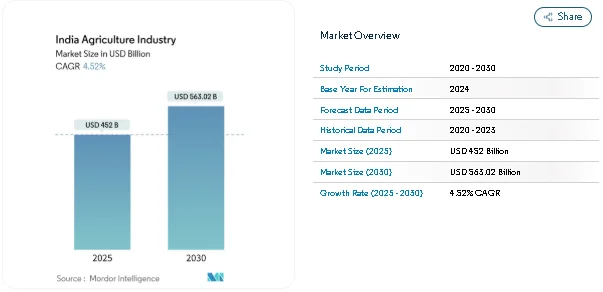
The India agriculture market continues to play a major role in national growth, supplying food, raw materials, and rural livelihoods for a large share of the population. According to industry estimates, the market value stood at USD 452 billion in 2025 and is projected to reach USD 563.02 billion by 2030, recording a 4.52% CAGR during the forecast period.
Steady government interventions, wider access to credit, and the steady shift toward digital platforms are supporting higher productivity across key crop categories. The number of farmers linked to online subsidy portals, advisory tools, and weather-based updates has grown rapidly, reducing delays in payments and improving production planning.
A strong supply cycle for cereals, grains, pulses, and horticulture crops, reinforced by supportive policies and improved irrigation coverage, continues to shape the long-term strength of the India agriculture industry.
Key Trends Shaping the India Agriculture Market
1. Strengthening Farmer Support Through Policies and Subsidies
Government spending continues to form the backbone of the India agriculture market. The expanded Kisan Credit Card (KCC) limit now allows smallholders to access higher credit for seeds, fertilizers, and machinery. District-level schemes that combine irrigation projects, crop training, and risk-mitigation tools are improving outcomes in regions that previously faced chronic yield gaps.
Revised minimum support prices (MSPs) for 2024–25 have encouraged diversification into oilseeds and other high-value crops. With input subsidies covering a large part of fertilizer and energy costs, growers are able to reinvest in soil health and better-quality seeds, supporting long-term productivity and farm incomes.
2. Steady Expansion of Agri-tech and Mechanization
Digital tools have gained acceptance across states, improving decision-making at the farm level. Investments in digital agriculture infrastructure—including crop surveys, remote sensing, and mobile-based credit scoring—are reducing approval times for loans and promoting accurate yield assessments.
Mechanization levels now average around 47%, with northern states leading adoption. Demand for tractors, harvesters, sprayers, and other equipment remains strong, especially in regions facing labor gaps. Better access to machinery helps farmers save time, reduce losses, and improve crop quality, contributing to the expansion of the India agriculture market size.
3. Rising Focus on Organic and Sustainable Farming
Changing food preferences in urban India are driving demand for chemical-free, traceable, and responsibly sourced products. Certified organic produce is expanding quickly, encouraging farmers to adopt low-chemical farming models, bio-inputs, and soil-friendly practices.
States promoting natural farming and regenerative models are witnessing faster enrollment in certification programmes. Community seed banks and resilience-focused initiatives are preserving indigenous varieties, helping farms withstand climate-linked stresses while creating niche export opportunities.
4. Export Momentum Supported by Trade Reforms
Agricultural exports continue to show healthy year-on-year growth, with cereals, spices, fruits, and plantation crops contributing significantly. Simplified export processes, digital documentation, and improved warehousing support the industry’s ability to access high-value global markets.
Partnerships with global agencies and bilateral cooperation on irrigation, seed quality, and crop management are creating new opportunities for growers. States specializing in premium horticulture crops—such as mangoes, pomegranates, and grapes—are particularly benefiting from consistent overseas demand.
Market Segmentation: India Agriculture Market Breakdown
By Commodity Type
The India agriculture market is segmented into:
-
Cereals & Grains
-
Pulses & Oilseeds
-
Fruits & Vegetables
-
Plantation Crops
-
Others (including livestock-linked categories)
Cereals & Grains Maintain the Largest Share
Cereals and grains held over 49% share of the market in 2024, supported by strong foodgrain production and improved irrigation reach. Steady MSP adjustments and access to modern seed varieties continue to enhance yield stability.
Pulses & Oilseeds Require Greater Yield Support
Pulses and oilseeds face seasonal fluctuations, making them more dependent on targeted interventions. Programs focused on balanced nutrient management, improved seed distribution, and regional self-sufficiency aims are expected to stabilize output.
Fruits & Vegetables Show Strong Growth Potential
Fruits and vegetables represent the fastest-growing category, projected at nearly 7.8% CAGR through 2030. Rising urban consumption, improved cold-chain projects, and expanding horticulture clusters are fueling this growth. With horticulture output surpassing 355 million tons, this segment will continue to attract investment and export demand.
Key Players in the India Agriculture Market
The India agriculture market consists of a mix of farmer cooperatives, government bodies, agri-tech platforms, seed companies, input manufacturers, and export-driven enterprises. These players support the ecosystem through advisory services, high-quality seeds, storage solutions, digital platforms, credit facilitation, and market linkages.
State-run agencies maintain strong involvement in procurement, extension services, and price support systems. Private-sector companies contribute through machinery sales, crop protection inputs, and supply-chain partnerships. Together, these stakeholders ensure smoother market access, reduced post-harvest losses, and better income opportunities for growers.
Conclusion: Outlook for the India Agriculture Industry
The India agriculture industry stands at a key growth stage, with steady improvements in output, crop diversification, and digital integration. Rising horticulture demand, expanded credit access, and continuous policy support will help the market maintain healthy momentum through 2030.
Challenges such as fragmented landholdings, soil imbalances, and limited cold-chain coverage remain, but ongoing investment and state-specific initiatives are gradually addressing these concerns. With stronger value chains, improved farmer access to information, and increasing export activity, the India agriculture market is expected to remain one of the most resilient and evolving sectors of the economy.
About Mordor Intelligence:
Mordor Intelligence is a trusted partner for businesses seeking comprehensive and actionable market intelligence. Our global reach, expert team, and tailored solutions empower organizations and individuals to make informed decisions, navigate complex markets, and achieve their strategic goals.
With a team of over 550 domain experts and on-ground specialists spanning 150+ countries, Mordor Intelligence possesses a unique understanding of the global business landscape. This expertise translates into comprehensive syndicated and custom research reports covering a wide spectrum of industries, including aerospace & defense, agriculture, animal nutrition and wellness, automation, automotive, chemicals & materials, consumer goods & services, electronics, energy & power, financial services, food & beverages, healthcare, hospitality & tourism, information & communications technology, investment opportunities, and logistics.