Introduction | Polypropylene Market Outlook
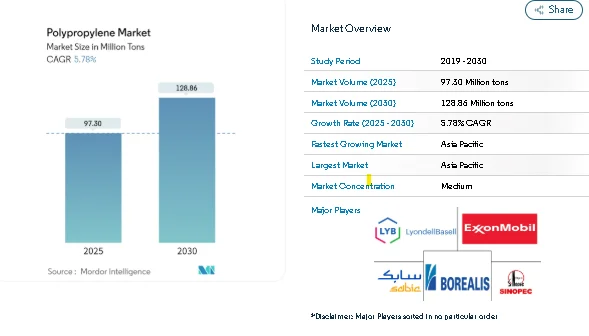
The global polypropylene market is set for steady expansion, driven by rising use across packaging, automotive, consumer goods, and electrical applications. In 2025, the market is valued at 97.30 million tons and is forecast to reach 128.86 million tons by 2030, reflecting a 5.78% CAGR.
The polypropylene market continues to gain traction due to its strong performance-to-cost ratio, heat resistance, and recyclability—key qualities supporting its broad adoption in industrial and commercial sectors.
Emerging Trends | Polypropylene Market Growth Drivers
Growing Focus on Lightweight Automotive Components
Automotive manufacturers continue adopting polypropylene for interior panels, trims, bumpers, and under-hood components due to its lighter density compared to metals and other engineering plastics. The push to improve fuel efficiency and enhance electric vehicle range encourages the use of thinner, stronger polypropylene parts. High-melt-strength grades are gaining traction for foamed structures that cut part weight without sacrificing rigidity.
Surge in Mono-Material Flexible Packaging
Global packaging companies are transitioning toward structures made entirely from polypropylene to meet recyclability targets and reduce regulatory fees. This shift is most visible in food pouches, ready-to-eat packaging, and household product sachets. Polypropylene films offer good barrier performance and heat sealability, making them suitable replacements for multi-layer laminates.
PDH Capacity Expansions Lowering Production Costs
New PDH units in Asia-Pacific, the Middle East, and North America are improving access to cost-efficient on-purpose propylene. This has helped stabilize polypropylene margins, particularly in regions where naphtha-based production remains vulnerable to crude oil fluctuations. The addition of high-purity propylene streams also enhances the consistency of specialty polypropylene grades.
Rise of High-Melt-Strength and Specialty Grades
Producers are investing in catalyst systems that yield grades suitable for foaming, thermoforming, and structural applications. These specialty grades reduce material consumption and improve processing efficiency, making them attractive across automotive, appliance, and industrial segments. Users benefit from lighter parts, improved dimensional stability, and reduced scrap rates.
Market Pressure from Alternate Materials
While polypropylene retains a cost-to-performance advantage, materials like polyethylene, ABS, and polyester compete in segments such as packaging films, electronics housings, and beverage closures. Material selection teams increasingly balance mechanical properties, clarity, and sustainability claims, creating pockets of substitution in niche applications.
Get expert-backed research and strategic insights with complete analysis here - http://mordorintelligence.com/industry-reports/polypropylene-market?utm_source=globbook
Market Breakdown | Polypropylene Market Breakdown
By Type
Homopolymer remains the most widely used grade due to its stiffness and clarity, accounting for the largest share of consumption. It is common in caps, closures, fibers, and household goods.
Copolymers—including random and impact grades—are favored where added flexibility or toughness is required, such as automotive bumpers, appliances, and medical disposables.
Key points:
-
Homopolymer expected to maintain majority share through 2030
-
Copolymers gaining interest in applications needing improved impact strength
-
Catalyst innovations helping narrow performance differences between the two types
By Processing Technology
Injection molding continues to dominate due to high demand for rigid parts across packaging, automotive, and consumer products.
Blow molding is used for containers, bottles, and industrial packaging.
Extrusion molding supports film, sheet, and fiber production.
Key points:
-
Injection molding benefits from thin-wall and fast-cycle applications
-
Extrusion grades critical for flexible packaging and non-wovens
-
Blow molding remains strong in household and personal-care bottles
By End-User Industry
-
Packaging leads the polypropylene market due to demand for food-grade containers, films, and pouches
-
Automotive is expanding rapidly with the industry’s push for lighter components
-
Consumer goods rely on polypropylene for durable, low-cost household products
-
Electrical & electronics employ polypropylene for its dielectric strength and moisture resistance
Stay informed with expert-backed research-now including translations and local insights for Japan and other key markets - https://www.mordorintelligence.com/ja/industry-reports/polypropylene-market?utm_source=globbook
Leading Companies | Polypropylene Market Competitive Landscape
Companies such as ExxonMobil, SABIC, Sinopec, LyondellBasell, and Borealis remain central to global supply, supported by established technologies and large-scale production facilities. Their focus includes developing specialty copolymers, improving recyclate quality for food contact, and expanding chemical-recycling partnerships. Regional producers in Asia and the Middle East continue adding capacity to meet domestic demand and strengthen export capability.
Conclusion | Polypropylene Market Future Outlook
The polypropylene market is positioned for sustained growth through 2030, with packaging, automotive, and consumer product segments shaping demand. The rise of mono-material packaging, increased consumption of non-woven products, and continuous improvements in catalyst systems are enhancing the material’s competitiveness.
About Mordor Intelligence:
With a team of over 550 domain experts and on-ground specialists spanning 150+ countries, Mordor Intelligence possesses a unique understanding of the global business landscape. This expertise translates into comprehensive syndicated and custom research reports covering a wide spectrum of industries, including aerospace & defense, agriculture, animal nutrition and wellness, automation, automotive, chemicals & materials, consumer goods & services, electronics, energy & power, financial services, food & beverages, healthcare, hospitality & tourism, information & communications technology, investment opportunities, and logistics.
For any inquiries, please contact: