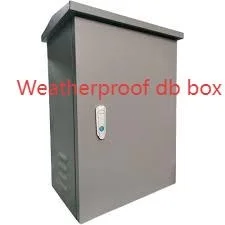
Outdoor electrical distribution must balance protection, accessibility, and long-term serviceability — in many installations engineers place a Weatherproof db box in accessible mid-run locations so inspection and temporary connections are simple, and specifiers expect the Weatherproof db box to deliver reliable sealing, clear circuit labeling, and straightforward access for testing without compromising ingress protection. Choosing the correct enclosure up front reduces field rework, prevents moisture-related failures, and makes lifecycle planning predictable for maintenance teams.
Match enclosure class to the environment
Begin by identifying the specific stresses the enclosure will face: direct rainfall, UV exposure, industrial washdowns, salt spray, or airborne particulates. IP and IK ratings should be selected to meet those threats — higher IP numbers for immersion-prone areas, and higher IK values where mechanical impact is likely. Consider also chemical exposure from cleaning agents or fertilizers; gasket and housing materials must tolerate local chemical conditions to avoid early degradation.
Materials, gaskets, and coating considerations
Material choice drives longevity. Thermoplastics with UV stabilizers resist embrittlement and color fading, while powder-coated aluminum and stainless steel provide superior mechanical and corrosion resistance. Gasket chemistry (silicone, EPDM, or nitrile) should be chosen to match temperature variation and exposure to detergents. For coastal or corrosive sites, specify marine-grade fasteners and sacrificial anodes where appropriate. Finishes and coatings should complement maintenance practices and local aesthetic requirements.
Installation best practices to preserve sealing
Correct installation preserves ingress protection. Ensure mounting surfaces are flat and corrosion-free, and use the manufacturer’s recommended torque values on cover screws and cable glands. Provide proper drip loops on incoming conduits so water cannot track into the enclosure, and route entries to avoid direct runoff. Where conduit enters through a wall, use appropriate external weather collars and flameproof sealing compounds if required. A disciplined installation avoids most moisture ingress failures.
Modular interiors and accessory strategies (featuring Fly-Dragon kits)
Modular interior design reduces downtime. Look for enclosures that accept removable mounting plates, DIN rails, and swappable inserts so a single faulty module can be exchanged quickly. Supplier accessory kits — such as Fly-Dragon compatible mounting plates, surge modules, or prewired terminal blocks — shorten repair times and simplify spare-part management. Standardized accessory ecosystems cut spare inventories and let technicians complete repairs on one visit.
Thermal and condensation management techniques
Even sealed boxes can trap heat or suffer condensation. Place heat-generating devices on dedicated plates and separate them from sensitive electronics. If condensation is a risk, incorporate filtered breathers, desiccant holders, or thermostatically controlled low-wattage heaters that preserve IP performance while controlling moisture. For high-current applications, oversize busbars and terminals to limit temperature rise; consider thermal monitoring if loads are variable or mission-critical.
Grounding, surge protection, and electrical integrity
Proper grounding and bonding are essential for safety and EMI control. Ensure equipotential bonding between metallic parts and establish a reliable grounding conductor path. For exposed or long-run feeders, integrate transient surge protective devices close to the incoming supply to reduce the risk of lightning- or switching-related damage. Use color-coded terminals and clear labeling to speed troubleshooting and minimize human error during maintenance.
Security, tamper resistance, and public installations
Public-facing installations may require additional security measures. Use tamper-proof fasteners, lockable covers, and recessed mounting to deter vandalism. Consider monitored tamper switches or integrated alarms for high-value or safety-critical locations. A discreet finish and careful placement can reduce temptation while retaining accessibility for authorized personnel.
Maintenance planning, inspection checklists, and lifecycle management
Create a short, repeatable inspection checklist: verify gasket condition and compression, confirm gland torque, inspect internal wiring for abrasion, and measure contact resistance on critical circuits. Log all replacements and observed wear to refine lifecycle projections and forecast spare needs. Maintain a small on-site kit with common gaskets, glands, and modular inserts to enable single-visit repairs and reduce downtime.
Specification tips to avoid surprises
Include clear requirements in purchase documents: IP/IK ratings, gasket material, fastener type, internal mounting options, and compatible accessory lists. Require vendor-supplied wiring diagrams and spare-part matrices. Specify testing or certification evidence as needed for regulatory compliance. Clear, prescriptive specs reduce variation between suppliers and make installations more predictable.
A well-chosen Weatherproof DB enclosure that matches materials to the site, enforces installation discipline, and supports modular maintenance will provide years of dependable service. For product data sheets, accessory compatibility, and installation guidance from Nante, visit www.nante.com