If you're an adult living with amblyopia, or "lazy eye," you’ve likely heard a familiar story. You were probably told that the "window" for treatment closed sometime in your childhood. That you were "too old to fix it," and you should just learn to live with the eye strain, the headaches, and the flat, 2D vision.
For decades, this was the accepted medical wisdom. But what if that wisdom is simply... outdated?
The truth is, our understanding of the human brain has exploded. The science has evolved, and with it, the entire approach to treatment. The methods used for a 7-year-old are completely different from those used for a 37-year-old, and it's all thanks to one powerful concept: neuroplasticity.
Let's explore what a lazy eye is and why the journey to correct it changes so dramatically over a lifetime.
First, What Exactly Is a "Lazy Eye"?
Before we talk about treatment, let's clear up a major misconception. A lazy eye is almost never a problem with the eye itself. The physical eye is often perfectly healthy. Amblyopia is a brain-eye connection problem. A functional lazy eye cure for adults isn't about fixing the eyeball; it's about rewiring the brain.
It’s a neuro-developmental condition where the brain, early in life, learns to ignore the information from one eye. This happens for several reasons maybe one eye had a much stronger prescription, or perhaps it was slightly turned (strabismus). To avoid a confusing, blurry, or doubled picture, the brain does a simple, powerful thing: it hits the "mute" button on the weaker eye. This is called suppression. You grow up relying on your "good" eye, and the neural pathways for true two-eyed (binocular) vision simply don't get built.
The "Classic" Approach: Treating Amblyopia in Childhood
When you're a child, your brain is like a construction site, rapidly building and paving new neural roads. This is called neuroplasticity, and it's why kids can learn languages and skills so quickly.
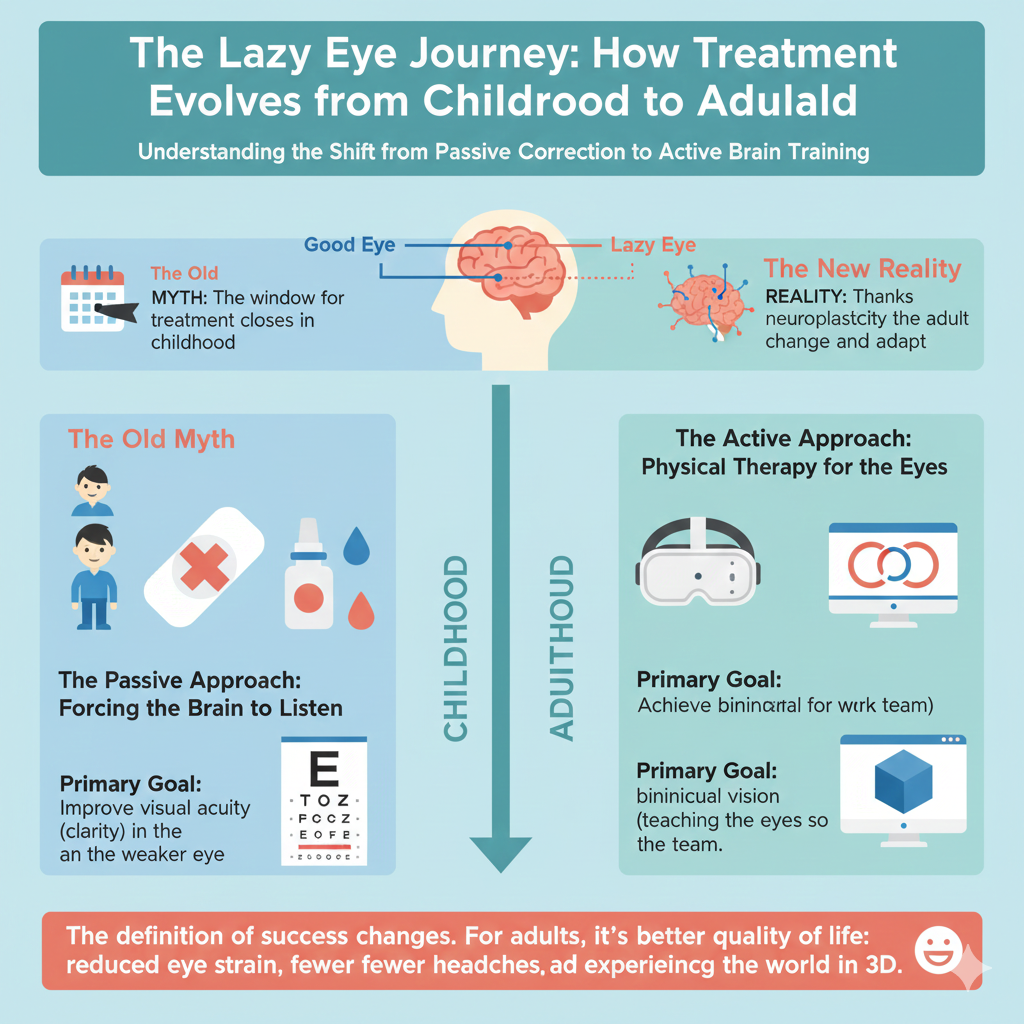
Childhood treatment takes advantage of this high plasticity. The goal is simple: force the brain to use the weaker eye.
This is done with two main "passive" methods:
-
Patching: This is the one we all know. By covering the strong, dominant eye for several hours a day, the brain is left with no choice but to start using (and building pathways for) the weaker eye.
-
Atropine Drops: These medicated eye drops are used to temporarily blur the vision in the strong eye, which accomplishes the same goal as a patch without the visible patch.
The goal here isn't to teach the eyes to work together. The primary goal is to "turn on" the weaker eye and strengthen its connection to the brain to improve its clarity (visual acuity).
The Old Myth: "The Window is Closed"
For generations, it was believed that this high level of neuroplasticity vanished after childhood. The "construction site" was closed, and the neural roads were set in stone.
This is why adults were told, "It's too late."
Doctors believed that the brain's suppression was too hard-wired and that the visual system was no longer adaptable enough to make a change. Adults were told to just "live with" the headaches, the poor depth perception, and the visual fatigue.
The New Reality: How Neuroplasticity Changed Everything
This is where the story gets exciting. In the last few decades, neuroscience has proven that the "critical window" idea isn't entirely true. While the brain is more plastic in childhood, it never fully loses its ability to change, adapt, and create new connections.
The adult brain is still plastic.
This discovery has completely revolutionized the field. It’s the entire foundation for modern lazy eye treatment for adults. It means the brain can be retrained. It can build new pathways.
This has shifted the entire goal. We're no longer just chasing 20/20 vision in the weaker eye. The search for a functional lazy eye cure for adults is about something far more profound: binocular vision. It's about retraining the brain to do what it never learned in childhood use both eyes as a team.
What Does Modern Adult Treatment Look Like?
So, if patching isn't the answer, what is?
You can't just put a patch on an adult and expect results. The adult brain is too smart; its habit of suppression is too deeply ingrained. It will just "wait" for the patch to come off.
Instead, modern lazy eye treatment for adults is an active process. Think of it as physical therapy, but for your visual system. The goal is to break suppression and teach the brain to fuse the two images.
This is often done with:
-
Specialized Vision Therapy: This is a guided program with a vision specialist. You perform a series of exercises using special lenses, prisms, and activities designed to challenge your brain and teach it to use both eyes together.
-
Digital & VR-Based Programs: This is a high-tech solution that is incredibly effective. By using a computer or a virtual reality headset, doctors can present slightly different images to each eye (this is called dichoptic viewing). The only way to play the game or complete the task is for your brain to stop suppressing and start fusing the two images into one 3D picture.
This active training essentially rewires your visual system, building the neural roads that were never paved in childhood.
Evolving Goals: What "Success" Means at Different Ages
The "win" for a child is very different from the "win" for an adult.
-
Childhood Goal: The primary goal is visual acuity. Can we get the weaker eye to see 20/40, 20/30, or even 20/20 on an eye chart?
-
Adult Goal: The goal is functional vision. While acuity often improves, the real-life benefits are the main prize. A lazy eye cure for adults is measured by:
-
Gaining 3D Vision (Stereopsis): For many adults, this is the "wow" moment seeing the world in 3D for the first time.
-
Reducing Symptoms: A dramatic decrease in the headaches, eye strain, and visual fatigue that come from relying on one eye.
-
Improving Quality of Life: Better reading speed and comprehension (words stop "jiggling"), improved hand-eye coordination, and more confidence in sports or even just driving.
-
Conclusion
The evolution of lazy eye treatment is a story of hope. It's a shift from a passive approach (forcing an eye) to an active one (retraining a brain).
If you're an adult with amblyopia, the most important thing to know is that the window is not closed. The science has moved on, and you are no longer "stuck." You don't have to just "live with" the symptoms. A more comfortable, functional, and vibrant visual world is possible.
Frequently Asked Questions (FAQs)
Q: Is a lazy eye the same as a turned eye (strabismus)?
A: Not exactly, but they are very related. A turned eye (strabismus) is often the cause of a lazy eye. Because the eye is turned, the brain ignores its image to avoid double vision, which then leads to amblyopia. You can also have amblyopia without an obvious eye turn.
Q: Can adults really get 3D vision if they've never had it?
A: Yes! This is one of the most exciting outcomes of modern therapy. Because of neuroplasticity, the adult brain can be trained to fuse the two images from the eyes, allowing many patients to experience stereopsis (3D vision) for the first time.
Q: What's the first step if I'm an adult with a lazy eye?
A: The first step is to get a comprehensive evaluation from an optometrist or ophthalmologist who specializes in binocular vision, neuro-optometry, or vision therapy. They can perform the specific tests to measure your suppression and determine if you are a good candidate for treatment.
Q: Is patching effective for adults?
A: Patching alone is generally not effective for adults. The brain's suppression is too strong. Modern adult therapy focuses on active training (like vision therapy or digital programs) to teach the eyes to work together, rather than just passive patching to strengthen one eye.
Q: Will my lazy eye get worse as I get older?
A: The underlying amblyopia itself is usually stable. However, as we age, we tend to spend more time on visually demanding tasks (like computers and phones). This can make the symptoms like eye strain, headaches, and fatigue feel much worse.