Introduction: Growing Opportunities in the Global Almond Market
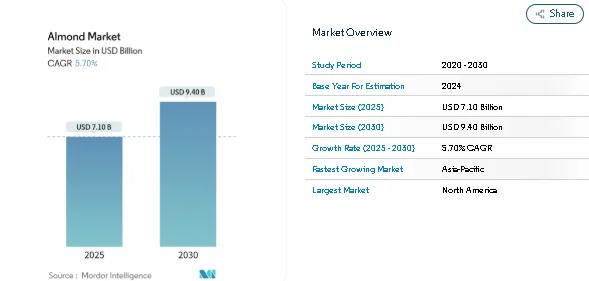
The global almond market continues to gain momentum as consumers adopt healthier eating habits and shift toward nutrient-rich foods. According to industry estimates, the market is expected to grow from USD 7.1 billion in 2025 to USD 9.4 billion by 2030, expanding at a CAGR of 5.70% during the forecast period. This steady growth is anchored in expanding almond consumption across snacks, plant-based dairy, bakery, confectionery, and specialty ingredient categories.
California remains the world’s largest almond-producing region, supported by a deep-rooted cultivation and processing ecosystem. Growing consumption in India, China, the Middle East, and parts of Europe continues to create strong import demand, while producers focus on boosting yield efficiency, optimizing water use, and improving post-harvest quality. At the same time, rising interest in clean-label foods, high-protein plant ingredients, and almond-based drinks is expanding the market’s addressable customer base.
With almonds now firmly positioned as a versatile ingredient for both consumers and manufacturers, the global market is entering a period marked by supply adjustments, new product development, and evolving trade patterns.
Key Trends Shaping the Almond Market
1. Rising Adoption of Almond-Based Dairy Alternatives
Almond milk has become one of the most widely consumed dairy substitutes, supported by its mild taste, low calorie content, and high nutrient value. Its rising popularity has encouraged food companies to explore additional almond-derived formats such as almond creamers, almond yogurt, and almond-based coffee blends.
Manufacturers are also incorporating higher-protein almond ingredients, giving plant-based beverages and snacks better functional stability and improved nutritional claims. The growing appeal of lactose-free, low-sugar, and vegan lifestyle choices continues to push almond milk ahead of several other dairy alternative segments.
2. Increased Demand for Healthy, On-the-Go Snacks
The global shift toward healthier snacking has strengthened almond consumption across retail and foodservice channels. Almonds offer natural protein, fiber, healthy fats, and antioxidants—attributes strongly favored by consumers looking for clean, minimally processed snacks.
Flavored and seasoned almond snack lines—ranging from chili-roasted to honey-coated variants—are gaining visibility on supermarket shelves. Convenience stores and e-commerce channels further extend market reach, enabling almond brands to tap into impulse purchases and subscription-based snack formats.
3. Expansion of Mechanized and Data-Driven Orchards
Although cultivation practices vary by region, growers worldwide are gradually upgrading their orchard management strategies. Data-backed irrigation scheduling, orchard monitoring systems, and improved harvesting tools help growers enhance kernel quality, reduce waste, and maintain consistency across production seasons.
Some producers in water-challenged regions are adopting micro-irrigation techniques to optimize usage while preserving yield. These adjustments help address environmental concerns, support long-term sustainability, and maintain stable supply for major import markets.
4. Growing Use of Almond Protein in Sports and Functional Nutrition
Almond-derived proteins are gaining traction in sports nutrition, fortified foods, energy bars, and high-protein beverages. The neutral taste profile and natural emulsification properties of almond protein make it a preferred choice for formulators looking to create smooth, clean-label products.
As fitness-oriented consumers gravitate toward plant-based protein sources, almond protein blends—often paired with oat or pea protein—are experiencing growing demand across North America, Europe, and emerging Asia-Pacific markets.
Market Segmentation in the Almond Market
By Form
-
In-shell Almonds
-
Popular in regions like India and the Middle East, where consumers prefer traditional roasting and snacking practices.
-
Shelled Almonds
Extensively used by food processors, bakeries, confectioners, and snack manufacturers.
-
Blanched & Processed Almonds
Cater to the bakery, ice cream, and dessert industries.
-
Almond Ingredients (Slices, Flour, Meal, Protein)
Growing rapidly in sports nutrition, gluten-free baking, and plant-based product lines.
By Application
-
Snacks & Retail Packs
-
Bakery & Confectionery
-
Dairy Alternatives
-
Sports Nutrition
-
Foodservice & HoReCa
By Geography
-
North America
Strong domestic consumption and large-scale processing infrastructure.
-
Europe
Stable demand driven by Mediterranean diets and artisanal confectionery.
-
Asia-Pacific
Fastest-growing region supported by rising disposable incomes and expanding import volumes.
-
Middle East & Africa
High consumption during festive seasons and strong retail penetration.
-
South America
Increasing interest in healthy snacking and specialty ingredients.
Key Players in the Almond Market
The global almond market consists of a diverse mix of grower cooperatives, export-oriented producers, ingredient suppliers, and food companies. Major players focus on expanding orchard productivity, strengthening traceability systems, and developing value-added almond formats to meet rising consumer expectations.
Companies are also investing in improved post-harvest processing, grading, and cold storage capabilities to maintain kernel quality and minimize losses. Partnerships with food and beverage manufacturers help suppliers broaden their reach into plant-based products, snack innovation pipelines, and functional food categories.
Conclusion
The global almond market is set for steady growth through 2030, supported by rising consumer interest in healthy foods, expanding use of plant-based ingredients, and sustained demand from emerging markets. While challenges such as water scarcity, fluctuating prices, and shifting production dynamics continue to influence the sector, the long-term outlook remains positive.
As almond consumption widens across dairy alternatives, snacks, bakery, and sports nutrition, both producers and processors are adapting to new preferences and long-term sustainability needs. With evolving trade flows and growing adoption of almond-derived ingredients, the market is poised to remain a vital part of the global nut and plant-based food industry.
About Mordor Intelligence:
Mordor Intelligence is a trusted partner for businesses seeking comprehensive and actionable market intelligence. Our global reach, expert team, and tailored solutions empower organizations and individuals to make informed decisions, navigate complex markets, and achieve their strategic goals.
With a team of over 550 domain experts and on-ground specialists spanning 150+ countries, Mordor Intelligence possesses a unique understanding of the global business landscape. This expertise translates into comprehensive syndicated and custom research reports covering a wide spectrum of industries, including aerospace & defense, agriculture, animal nutrition and wellness, automation, automotive, chemicals & materials, consumer goods & services, electronics, energy & power, financial services, food & beverages, healthcare, hospitality & tourism, information & communications technology, investment opportunities, and logistics.