Introduction | Growing Demand Supports Strong Avocado Market Outlook
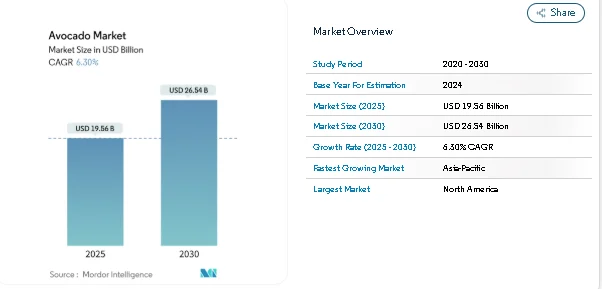
The global avocado market continues to show stable progress as consumers worldwide increasingly seek nutrient-rich foods. According to industry estimates, the avocado market size is expected to rise from USD 19.56 billion in 2025 to USD 26.54 billion by 2030, supported by a 6.3% CAGR. This growth reflects a steady shift in consumer habits, stronger fresh-produce supply chains, and wider access to commercial varieties in developed and emerging markets.
The fruit’s association with healthy fats, vitamins, and versatile culinary uses has kept consumption resilient even during price fluctuations. Established consumption levels in North America and Europe, combined with rapid uptake across Asia-Pacific, continue to influence production planning, trade relationships, and investment in new orchards. While water usage, climate-related pressures, and regulatory barriers remain ongoing challenges, the overall demand trend continues to favor long-term expansion.
Key Trends Shaping the Avocado Market
1. Rising Preference for Healthy and Convenient Foods
The avocado market benefits heavily from its strong health perception. Consumers in the United States and Europe increasingly associate avocados with clean eating, plant-based diets, and nutrient-dense meals. Retailers have responded by expanding their product lines to include ready-to-eat packs, ripeness-labeled bags, and organic options. In many countries, education campaigns and social-media adoption have also helped bring the fruit into mainstream meal planning. This shift has strengthened price stability and widened demographic reach.
2. Improved Year-Round Availability Through Advanced Logistics
The global avocado supply has become more dependable thanks to better cold-chain infrastructure and controlled-atmosphere shipping. These logistics improvements help maintain fruit quality during long-distance transport and reduce losses during peak export seasons. Countries such as Guatemala and Peru now fill seasonal supply gaps for major importers including the United States, Europe, and parts of Asia-Pacific. Enhanced packaging materials and firmness-monitoring tools also support longer shelf-life, making avocados more viable for retailers that rely on steady weekly availability.
3. Mainstream Retail Branding and Strong Marketing Support
Retail and food-service brands have shifted avocados from a niche tropical fruit to an everyday household item. Supermarkets use sustainability messaging, origin labeling, and convenience-driven marketing to increase turnover. Bagged formats, ripeness indicators, and eco-friendly packaging have shown strong consumer acceptance, especially in urban markets. With consistent promotional support across digital and in-store channels, avocados have become a core category for produce aisles worldwide.
4. Expansion of Cultivated Acreage and New Growing Regions
The market has seen notable increases in planted acreage as producers respond to growing domestic and export demand. Mexico and Peru continue to lead global shipments, while Colombia, South Africa, and parts of Asia are expanding their orchards. These moves aim to diversify sourcing and reduce dependency on any single region. However, expansion must balance environmental concerns, as land conversion and water usage are closely monitored by regulators and trade partners.
Market Segmentation | Avocado Market Segments and Growth Outlook
By Variety
The avocado market is segmented into several varieties, with Hass remaining the dominant choice across global markets.
-
Hass Avocado
-
Holds the largest share due to its long shelf-life and consumer familiarity.
-
Maintains stable demand across retail and food-service channels.
-
Fuerte
-
Popular in select regions and valued for its flavor profile, though less common in long-distance trade.
-
Bacon, Zutano, Lamb Hass, and Others
-
Serve niche markets and culinary applications.
-
Often face limitations related to smaller shelf-life windows and lower export suitability.
Breeding programs continue to explore new cultivars that perform better under heat and water stress while preserving taste and texture that consumers prefer. These developments are expected to support future market resilience.
By Geography
The market is broadly segmented into:
-
North America
-
Largest consumption region with strong infrastructure and continuous retail demand.
-
Europe
-
Second-largest market with strong import reliance and rising penetration across both Western and Eastern regions.
-
Asia-Pacific
-
Fastest-growing region, driven by rising middle-income populations, urbanization, and increased exposure to global cuisines.
-
South America
-
Major production hub with strong export orientation.
-
Middle East & Africa
-
Steadily developing market supported by premium retail formats and hospitality demand.
Each region shows distinct consumption patterns shaped by income levels, culinary trends, and supply access.
Key Players in the Avocado Market
Major companies active in the avocado market include growers, packers, distributors, and vertically integrated brands. These players focus on orchard expansion, cold-chain investments, sustainability certifications, and stronger relationships with importers and retailers. Many are also investing in packaging improvements and ready-to-eat product formats to meet shifting consumer expectations.
Well-established producers in Mexico, Peru, Chile, and Colombia continue to shape export volumes, while brands in the United States, Europe, and Asia support retail distribution and promotional activities. Collaborative efforts between growers, logistics providers, and retailers help ensure consistent quality and year-round availability across global markets.
Conclusion | Stable Growth Expected as Demand Strengthens
The avocado market is set for continued expansion as consumers maintain their interest in nutritious and versatile foods. Reliable cold-chain networks, expanding acreage, and improved supply diversity indicate a long-term growth path. While water usage, environmental compliance, and price swings present ongoing challenges, industry responses suggest steady improvement in sustainable practices and production planning.
With strong retail adoption, rising awareness in emerging markets, and continued product innovation, the avocado market is positioned to maintain momentum through 2030 and beyond.
About Mordor Intelligence:
Mordor Intelligence is a trusted partner for businesses seeking comprehensive and actionable market intelligence. Our global reach, expert team, and tailored solutions empower organizations and individuals to make informed decisions, navigate complex markets, and achieve their strategic goals.
With a team of over 550 domain experts and on-ground specialists spanning 150+ countries, Mordor Intelligence possesses a unique understanding of the global business landscape. This expertise translates into comprehensive syndicated and custom research reports covering a wide spectrum of industries, including aerospace & defense, agriculture, animal nutrition and wellness, automation, automotive, chemicals & materials, consumer goods & services, electronics, energy & power, financial services, food & beverages, healthcare, hospitality & tourism, information & communications technology, investment opportunities, and logistics.