Introduction – Global Butter Market Outlook
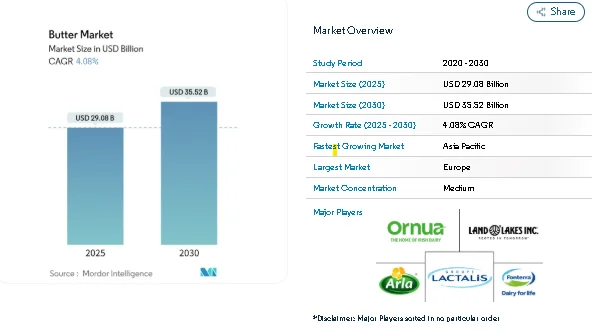
The global butter market, valued at USD 29.08 billion in 2025, is projected to reach USD 35.52 billion by 2030, supported by steady household consumption, premium product expansion, and rising demand from bakery, foodservice, and home-cooking segments. Stable interest in traditional dairy ingredients, combined with new artisanal formats and origin-based claims, continues to strengthen market visibility across retail and commercial channels. This balanced growth places the butter market in a strong position compared to other dairy categories where supply volatility and price swings remain more frequent.
Key Trends in the Butter Market
Rising Preference for Natural and Organic Butter
Consumers are increasingly selecting butter products with minimal ingredients, transparent sourcing, and simple processing methods. Organic and clean-label varieties are gaining attention among households that associate natural dairy with better taste and perceived wellness benefits. This aligns with wider packaged food patterns favoring transparent ingredient lists, creating new opportunities for brands that can demonstrate sustainable farming practices and high ingredient quality.
Growth in Premium and Artisanal Butter
Premium artisanal variants are expanding quickly as bakeries, professional chefs, and home cooks search for specific flavor notes and texture qualities. This includes cultured formats, small-batch butters, region-specific products, and high-fat or low-moisture compositions designed for pastry applications. The trend signals that butter is no longer just a commodity ingredient but a category where craftsmanship and storytelling improve market value.
Foodservice and QSR Menu Innovation
Quick-service restaurants and bakery chains are incorporating higher-quality butter into recipes to differentiate menu items. Butter’s role in breakfast items, pastries, biscuits, and specialty baked goods has become more central as brands respond to consumer interest in flavor quality and ingredient authenticity. Dedicated foodservice formulations tailored for consistency and performance are supporting this momentum.
Home Baking and Cooking Momentum
Home cooking remains a major driver of butter demand, supported by consumers who view cooking from scratch as healthier and more cost-efficient. Baking content on social media also boosts experimentation with butter-based recipes, encouraging frequent purchases across retail channels.
Sustainability Pressure and Plant-Based Alternatives
Environmental concerns around dairy production are pushing manufacturers to adopt more sustainable farming, packaging, and supply-chain practices. Alongside this, plant-based butter analogs are gaining interest among consumers looking for environmentally conscious or allergen-friendly options. Although still a smaller segment, these alternatives reflect an important shift in consumer priorities.
Butter Market Segmentation
Butter Market Segmentation Overview
Segmentation insight is essential for understanding product performance across consumer groups, retail environments, and regional markets. Key segmentation categories include:
• By Product Type
-
Cultured butter gaining traction among culinary-focused consumers
-
Uncultured butter retaining wide acceptance in households and foodservice
• By Source
-
Animal-based butter remains the standard option for most markets
-
Plant-based analogs expanding in response to sustainability and lifestyle trends
• By Salt Content
-
Salted butter widely used for general cooking and flavor enhancement
-
Unsalted butter popular for baking and low-sodium diets
• By Packaging Type
-
Blocks/cubes for conventional retail demand
-
Lightweight and resealable formats improving convenience
• By Distribution Channel
-
Off-trade dominating sales due to retail availability
-
On-trade benefiting from bakery, café, and QSR menu development
This structured segmentation supports clear market visibility and helps manufacturers align product strategies with changing preferences.
Key Players in the Butter Market
Large dairy cooperatives, regional processors, and emerging specialty brands shape the competitive landscape. These players maintain strong production capacity, wide distribution networks, and established relationships with foodservice and retail partners. Many are investing in expanded manufacturing capabilities, improved supply-chain systems, and specialty butter lines to meet rising demand in premium, organic, and foodservice categories.
Key global players continue to explore opportunities in sustainability, flavor development, convenient packaging, and plant-based analogs. Their ongoing improvements in processing efficiency and product consistency help ensure reliable supply despite challenging dairy-sector conditions. These strategic actions contribute to market stability while supporting innovation across multiple butter categories.
Conclusion
The butter market is steadily expanding as households, bakeries, and foodservice operators rely on butter for flavor, texture, and recipe performance. The mix of traditional consumption and fresh interest in premium and clean-label products ensures ongoing relevance across developed and emerging regions. Sustainability considerations and the rise of plant-based alternatives also encourage diversification within the category, offering consumers more choices without displacing conventional demand.
As the market continues to grow, butter remains a foundational dairy product supported by culinary traditions, consistent usage patterns, and expanding specialty segments. Its linkages with other food markets, including the beverages market, introduce added opportunities for cross-category product development. With strong global presence and increasing consumer engagement, the butter market holds solid momentum for the coming years, providing valuable insights for stakeholders conducting beverages market analysis, beverages market industry analysis, reviewing a beverages market industry report, or evaluating beverages market size as part of broader food-and-beverage trends.
About Mordor Intelligence:
Mordor Intelligence is a trusted partner for businesses seeking comprehensive and actionable market intelligence. Our global reach, expert team, and tailored solutions empower organizations and individuals to make informed decisions, navigate complex markets, and achieve their strategic goals.
With a team of over 550 domain experts and on-ground specialists spanning 150+ countries, Mordor Intelligence possesses a unique understanding of the global business landscape. This expertise translates into comprehensive syndicated and custom research reports covering a wide spectrum of industries, including aerospace & defense, agriculture, animal nutrition and wellness, automation, automotive, chemicals & materials, consumer goods & services, electronics, energy & power, financial services, food & beverages, healthcare, hospitality & tourism, information & communications technology, investment opportunities, and logistics.