
Introduction | North America Food Colorants Market Outlook
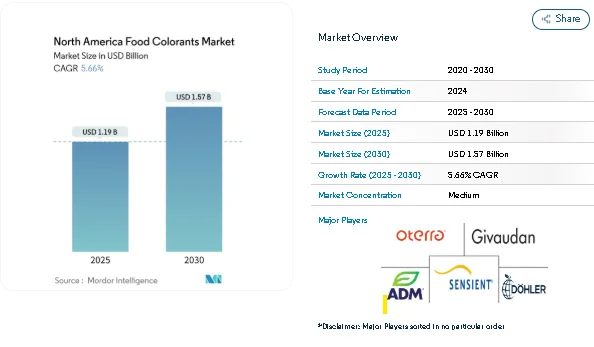
The North America food colorants market, valued at USD 1.19 billion in 2025, is projected to reach USD 1.57 billion by 2030, supported by changing regulatory conditions, strong demand for natural ingredients, and continuous application growth across major food and beverage categories. As the FDA moves toward the phase-out of petroleum-based synthetic dyes by 2026, natural colorants are shifting from niche usage to mainstream acceptance. This trend is reinforced by the growing preference for clean-label products and the widespread expansion of processed foods, beverages, and plant-based alternatives. New formulations—such as heat-stable spirulina, corn-based anthocyanins, and fermentation-derived pigments—are helping manufacturers maintain visual quality while meeting stricter labeling expectations.
Key Trends in the North America Food Colorants Market
1. Growing Preference for Natural and Clean-Label Colorants
Consumer interest in cleaner ingredient lists has intensified the shift toward naturally derived color solutions. Natural extracts from spirulina, turmeric, annatto, microalgae, berries, and beetroot are increasingly selected for their visual appeal and association with health and wellness. Manufacturers are also adopting natural pigments that offer functional benefits, such as antioxidant properties, meeting the expectations of health-conscious buyers. This shift is particularly visible in bakery, dairy, snacks, and beverage launches, where natural color consistency and stability are becoming essential product development considerations.
2. Increasing Role of Color in Food Aesthetics and Social Media Marketing
Color now plays a strategic role in food branding, especially in visually driven categories like confectionery, bakery, and beverages. With the rise of social media marketing and digital-first food campaigns, visually striking products have gained an advantage in consumer attention and shelf appeal. The beverages segment—supported by beverages market trends, beverages market analysis, and beverages market industry report insights—is leveraging enhanced natural pigmentation to strengthen product identity, influence taste perception, and maintain high visual standards across shelf-stable formats.
3. Regulatory Shifts Strengthening the Move Toward Natural Alternatives
FDA decisions to restrict and phase out synthetic dyes have reshaped reformulation efforts across the United States. State-level restrictions, particularly in schools, are also accelerating industry-wide transitions. These regulatory changes are encouraging investments in natural pigment technologies and local supply chain expansion. Collaborative efforts between color suppliers and biotechnology companies are addressing historical performance challenges, paving the way for stable, vibrant alternatives compatible with high-heat, acidic, and long-shelf-life applications.
4. Consistent Demand from Processed Foods and Convenience Categories
Processed food consumption continues to expand across North America, reinforcing the importance of color consistency and product differentiation. Leading brands are adopting natural solutions to replace synthetic dyes in snacks, dairy products, beverages, and ready-to-eat foods. As consumer expectations rise for fresher, more attractive products, manufacturers are emphasizing long-term contracts with natural pigment suppliers to ensure uninterrupted availability during the ongoing ingredient transition.
Market Segmentation | North America Food Colorants Market Breakdown
Product Type
-
Natural Color
-
Synthetic Color
Natural colorants continue to gain traction due to regulatory momentum and clean-label demand, becoming a preferred choice across bakery, dairy, beverages, and snack applications.
Color
-
Blue
-
Red
-
Green
-
Yellow
-
Others
Red remains widely used in confectionery and beverages, while blue is expanding quickly due to approvals of natural blue sources such as spirulina and butterfly pea flower extract.
Application
-
Bakery and Confectionery
-
Dairy-Based Products
-
Beverages
-
Alcoholic Beverages
-
Non-Alcoholic Beverages
-
Nutraceuticals
-
Snacks and Cereals
-
Other Applications
The beverages market size expansion is strengthening demand for stable liquid colorants, supported by beverages market industry analysis and broader category diversification.
Form
-
Powder
-
Liquid
Liquid formats dominate in beverage and dairy use due to ease of dispersion, while advancements in encapsulated powders are increasing adoption in snacks, bakery, and nutraceutical applications.
Geography
-
United States
-
Canada
-
Mexico
-
Rest of North America
The United States leads the regional market, while Canada demonstrates early adoption of natural solutions and Mexico shows strong growth potential as manufacturers align with U.S. and Canadian industry standards.
Key Players in the North America Food Colorants Market
The competitive environment includes global ingredient leaders alongside natural color specialists and biotechnology-driven entrants. Companies invest in application-specific formulations, sustainable sourcing partnerships, and fermentation-based color development to strengthen supply resilience. Strategic acquisitions are increasingly shaping the market, enabling players to expand natural portfolios and address emerging application needs in beverages, dairy, snacks, and plant-based foods.
Major companies operating in the region include:
-
Sensient Technologies Corporation
-
Oterra A/S
-
Archer Daniels Midland Company
-
Givaudan SA
-
Dohler Group SE
These companies are focusing on consistent coloration, improved heat and pH stability, and enhanced suitability for bakery, nutraceuticals, and shelf-stable beverages.
Conclusion
The North America food colorants market is entering a pivotal transition period shaped by regulatory changes, natural ingredient demand, and rapid reformulation across major food and beverage categories. As clean-label expectations continue to rise, natural pigments are expanding their presence in bakery, snacks, dairy, nutraceuticals, and beverages. The United States remains the largest market driver, while Canada and Mexico contribute through progressive regulations and expanding processed food industries. With growing consumer awareness, ongoing supply chain adjustments, and new color technologies, the region is well-positioned for sustained growth through 2030. The integration of natural, stable, and application-specific color solutions will continue to define competitive advantage across the broader North American food and beverages ecosystem.
About Mordor Intelligence:
Mordor Intelligence is a trusted partner for businesses seeking comprehensive and actionable market intelligence. Our global reach, expert team, and tailored solutions empower organizations and individuals to make informed decisions, navigate complex markets, and achieve their strategic goals.
With a team of over 550 domain experts and on-ground specialists spanning 150+ countries, Mordor Intelligence possesses a unique understanding of the global business landscape. This expertise translates into comprehensive syndicated and custom research reports covering a wide spectrum of industries, including aerospace & defense, agriculture, animal nutrition and wellness, automation, automotive, chemicals & materials, consumer goods & services, electronics, energy & power, financial services, food & beverages, healthcare, hospitality & tourism, information & communications technology, investment opportunities, and logistics.



