
Introduction: Rising Demand Shapes the Global Food Enzymes Market
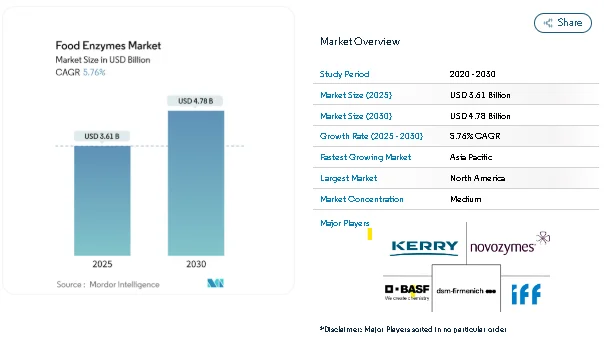
The food enzymes market continues to gain relevance in the global food processing landscape, supported by the shift toward clean-label products, efficient manufacturing, and improved shelf-life requirements. Valued at USD 3.61 billion in 2025, the market is projected to reach USD 4.78 billion by 2030, registering a healthy CAGR of around 5.7%.
Food manufacturers are increasingly turning to enzymes as natural processing aids that help streamline production, enhance taste and texture, and reduce waste. Their use has expanded from bakery and beverages to dairy, plant-based foods, and emerging functional categories. As consumers pay closer attention to ingredients and product quality, enzymes have become an important tool for brands aiming to meet both regulatory expectations and market preferences.
North America remains the leading region due to its large food manufacturing base, while the Asia-Pacific market is growing the fastest. This expansion is supported by urbanization, rising disposable incomes, and a steady shift toward packaged food consumption.
Key Trends Shaping the Food Enzymes Market
1. Growing Use of Enzymes in Bakery and Confectionery Products
The bakery sector continues to be one of the largest users of food enzymes. Bakers rely on amylases, proteases, and other enzyme blends to improve dough stability, enhance softness, and extend product freshness. With the rising demand for packaged bread, cakes, pastries, and gluten-free variants, enzyme usage has become a standard practice in commercial bakeries. The steady consumer shift toward convenient foods ensures that this trend will remain strong through 2030.
2. Rising Need for Efficiency and Better Yield in Food Manufacturing
Food manufacturers face pressure to optimize energy, materials, and time. Enzymes assist in achieving smoother processing, improved yield, and reduced waste—key priorities for large-scale operations. Their ability to improve texture, flavor release, and shelf-life keeps them central to modern food production. This need for process efficiency continues to support enzyme adoption across dairy, meat, beverages, and ready-to-eat categories.
3. Growing Adoption in Plant-Based and Specialty Diets
As plant-based diets gain traction, enzymes play an essential role in improving the taste, texture, and nutritional quality of plant-derived ingredients. In protein alternatives, enzymes help reduce unwanted flavors, improve solubility, and enhance mouthfeel. Their versatility makes them valuable tools for manufacturers aiming to formulate vegan, high-protein, and clean-label foods that mimic traditional dairy or meat products more closely.
4. Increasing Demand for Carbohydrase in Beverages and Sugar Syrups
Carbohydrases hold the largest share of the food enzymes market due to their widespread use in sweeteners, juices, and brewing. Beverage producers rely on these enzymes to break down starches into fermentable or functional sugars, streamline processing, and achieve consistent flavor. As low-sugar and reduced-calorie drinks grow popular, enzymes help producers align with evolving consumer expectations.
Market Segmentation: Food Enzymes Market Breakdown
By Enzyme Type: Carbohydrase Leads Market Share
Carbohydrase holds the largest share of the food enzymes market due to its critical role in bakery, brewing, and sweetener production.
Key applications include:
-
Starch conversion
-
Texture modification
-
Sugar syrup processing
-
Fruit and plant-based product enhancement
Proteases are also expanding as demand rises for improved digestibility, flavor development, and tenderization in meat and dairy applications. Lipase use is growing steadily, particularly in cheese, flavor modification, and plant-based fat alternatives.
By Form: Powder Enzymes Gain Wider Acceptance
Powder-based enzymes dominate due to longer shelf life, ease of transportation, and better compatibility with automated manufacturing systems.
Powders remain preferred because they:
-
Offer stable activity
-
Require minimal cold storage
-
Blend easily with dry ingredients
Liquid enzymes hold strong adoption in dairy and beverage processing where rapid dispersion is required.
By Source: Microbial Enzymes Strengthen Market Position
Microbial fermentation remains the leading source of food enzymes because it delivers consistent yield, scalability, and reliability.
Growing preference for vegan, kosher, and halal-friendly formulations also supports microbial enzyme production. Plant-based enzymes are expanding gradually as clean-label and natural positioning gain importance.
By Application: Bakery Holds the Largest Share; Dairy Shows Fastest Growth
Bakery and confectionery account for the largest portion of enzyme usage, supported by high bread consumption and demand for quality consistency.
Meanwhile, the dairy category is set to grow the fastest due to rising demand for:
-
Lactose-free milk and yogurt
-
Improved cheese textures
-
Enzyme-aided fermentation
Beverages, meat processing, and sauces also remain important application sectors.
Key Players in the Food Enzymes Market
The competitive landscape includes global leaders and mid-size companies offering specialized enzyme solutions. Major players focus on improving enzyme efficiency, expanding their product portfolios, and strengthening their presence across growing markets.
Key companies include:
-
Novozymes A/S
-
International Flavors & Fragrances (IFF)
-
DSM-Firmenich
-
BASF SE
-
Kerry Group PLC
These companies invest in advanced fermentation techniques, optimized enzyme blends, and customer-specific solutions tailored to bakery, dairy, beverages, and emerging plant-based categories.
Conclusion
The food enzymes market is set for steady growth through 2030, driven by evolving consumer expectations, clean-label trends, and the wide adoption of natural processing aids in modern manufacturing. As manufacturers look for ways to improve efficiency, reduce waste, and enhance product quality, enzymes offer practical and adaptable solutions. While regulatory complexities and formulation challenges remain, advancements in fermentation and enzyme development are expected to support broader market penetration.
With strong regional growth led by Asia-Pacific and continuous product innovation from global manufacturers, the food enzymes market will remain a key contributor to the future of food processing and ingredient development.
About Mordor Intelligence:
Mordor Intelligence is a trusted partner for businesses seeking comprehensive and actionable market intelligence. Our global reach, expert team, and tailored solutions empower organizations and individuals to make informed decisions, navigate complex markets, and achieve their strategic goals.
With a team of over 550 domain experts and on-ground specialists spanning 150+ countries, Mordor Intelligence possesses a unique understanding of the global business landscape. This expertise translates into comprehensive syndicated and custom research reports covering a wide spectrum of industries, including aerospace & defense, agriculture, animal nutrition and wellness, automation, automotive, chemicals & materials, consumer goods & services, electronics, energy & power, financial services, food & beverages, healthcare, hospitality & tourism, information & communications technology, investment opportunities, and logistics.




