Introduction | Growing Demand for Biological Seed Treatment Market Solutions
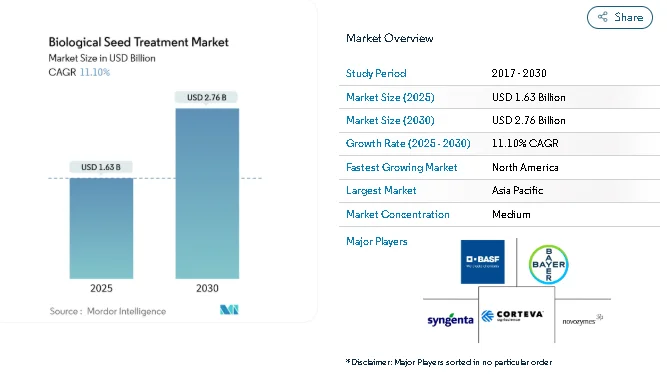
The biological seed treatment market is entering a phase of strong global expansion as growers shift toward safer, residue-free, and sustainable crop input solutions. Valued at USD 1.63 billion in 2025, the market is projected to reach USD 2.76 billion by 2030, supported by an 11.1% CAGR during the forecast period.
This growth is driven by increasing adoption of organic farming practices, pressure to reduce chemical residues, and the need for healthier crop establishment. Governments across major agricultural regions are creating favorable regulatory environments that encourage biological inputs, while seed companies and agri-biotech firms are investing heavily to improve microbial performance, stability, and shelf life.
Biological seed treatments—comprising microbial strains, botanical extracts, and natural derivatives—play a key role in helping farmers protect seeds from pathogens, improve germination, and enhance stress tolerance. With climate variability and soil degradation becoming recurring challenges, growers are leaning toward biological solutions that support long-term soil health while improving yield reliability.
Key Trends | Market Drivers Strengthening the Biological Seed Treatment Market
1. Shift Toward Organic and Sustainable Cultivation
The global movement toward residue-free and organic food production has brought biological seed treatments into mainstream agriculture. As more farmlands transition to certified organic operations, biological solutions become essential because conventional synthetic treatments are often restricted in organic systems. Many greenhouse and controlled-environment farms also prefer biological seed protectants to maintain clean growing systems without chemical contamination.
2. Supportive Regulations and Incentives
Regulatory frameworks in several high-growth markets are now designed to fast-track biological product approvals. Shorter registration timelines, reduced evaluation fees, and simplified safety assessments enable faster commercialization of bio-based seed treatments compared to conventional chemicals. Countries in Asia, Europe, and South America are also encouraging domestic production of biological inputs, further strengthening supply availability.
3. Proven Performance Under Stress Conditions
Biological seed treatments are gaining adoption due to their ability to improve early root development and help plants withstand drought, salinity, and temperature fluctuations. Trials across multiple crop types show improvement in germination and vigor when seeds are treated with beneficial microbes. These benefits are particularly valuable in regions experiencing unpredictable weather patterns and declining soil fertility.
4. Rising R&D Focus from Seed and Biotech Companies
Large agricultural companies are expanding their biological portfolios through investments in microbial discovery, fermentation, and formulation technologies. New seed treatment centers, pilot plants, and bio-innovation labs are being launched to meet growing demand from seed producers and farmers. Many companies are also developing partnerships to combine biological actives with existing seed genetics for better early-stage plant performance.
Market Segmentation | Biological Seed Treatment Market Breakdown
By Type
-
Microbial (Dominant Segment)
-
Microbial seed treatments—including beneficial bacteria and fungi—hold the largest share due to their strong efficacy against soil-borne diseases and ability to boost early-stage growth.
-
Botanicals (Fastest Growing)
Plant-based extracts are gaining traction among organic and residue-sensitive growers who prefer natural solutions.
-
Others
Includes natural polymers, algae extracts, and fermentation-derived compounds used for coating, protection, and nutrient enhancement.
By Function
-
Seed Protection (Largest Share)
Widely used to prevent fungal infections, bacterial diseases, and insect damage during germination.
-
Seed Enhancement (Fast-Growing)
Focuses on improving vigor, nutrient uptake, and stress tolerance.
-
Other Functions
Includes specialized products developed for niche crops and targeted soil conditions.
By Crop Type
-
Grains & Cereals – Highest adoption due to large cultivation areas and established seed treatment practices.
-
Oilseeds – Increasing use to maintain seedling uniformity in challenging climates.
-
Vegetables – Fastest-growing demand led by high-value crops and greenhouse production.
-
Others – Includes pulses, fiber crops, and specialty crops.
By Geography
-
North America – Largest share due to advanced seed treatment technology and strong commercial seed markets.
-
Europe – High adoption supported by restrictions on chemical pesticides and rapid shift toward sustainable inputs.
-
Asia-Pacific – Fastest-growing regional market, driven by policy reforms, expanding seed production hubs, and rising grower awareness.
-
South America & Middle East/Africa – Emerging regions adopting biologicals in both export-oriented and climate-stressed farming systems.
Key Players | Leading Companies in the Biological Seed Treatment Market
The competitive landscape includes established agricultural corporations and specialized biological companies. Major players focus on expanding microbial strain collections, improving formulation stability, and strengthening regional distribution networks.
Key companies include:
-
BASF SE
-
Bayer AG
-
Syngenta AG
-
Corteva Agriscience
-
Novozymes A/S
These companies continue to introduce advanced formulations for major crops, while emerging firms target niche segments such as vegetables, pulses, and climate-sensitive regions.
Recent industry activities include expansions in seed treatment laboratories, new microbial product launches, and collaborations between seed companies and biotech startups to co-develop biological-based coating and protection solutions.
Conclusion | Outlook for the Biological Seed Treatment Market
The global biological seed treatment market is set for steady growth as agriculture shifts toward safer, sustainable, and residue-free crop inputs. Rising organic farming area, tighter chemical regulations, and the need for climate-resilient crop establishment continue to influence buyer behavior. With increased investment from major seed producers and agri-biotech firms, biological treatments are becoming a standard component of modern seed technology.
As farmers seek reliable yield improvements while reducing chemical dependency, biological seed treatments offer a practical balance between performance and sustainability. The next decade will likely see broader adoption across major crops, stronger regional production capacity, and enhanced technologies that improve consistency and shelf life of microbial and botanical products.
About Mordor Intelligence:
Mordor Intelligence is a trusted partner for businesses seeking comprehensive and actionable market intelligence. Our global reach, expert team, and tailored solutions empower organizations and individuals to make informed decisions, navigate complex markets, and achieve their strategic goals.
With a team of over 550 domain experts and on-ground specialists spanning 150+ countries, Mordor Intelligence possesses a unique understanding of the global business landscape. This expertise translates into comprehensive syndicated and custom research reports covering a wide spectrum of industries, including aerospace & defense, agriculture, animal nutrition and wellness, automation, automotive, chemicals & materials, consumer goods & services, electronics, energy & power, financial services, food & beverages, healthcare, hospitality & tourism, information & communications technology, investment opportunities, and logistics.