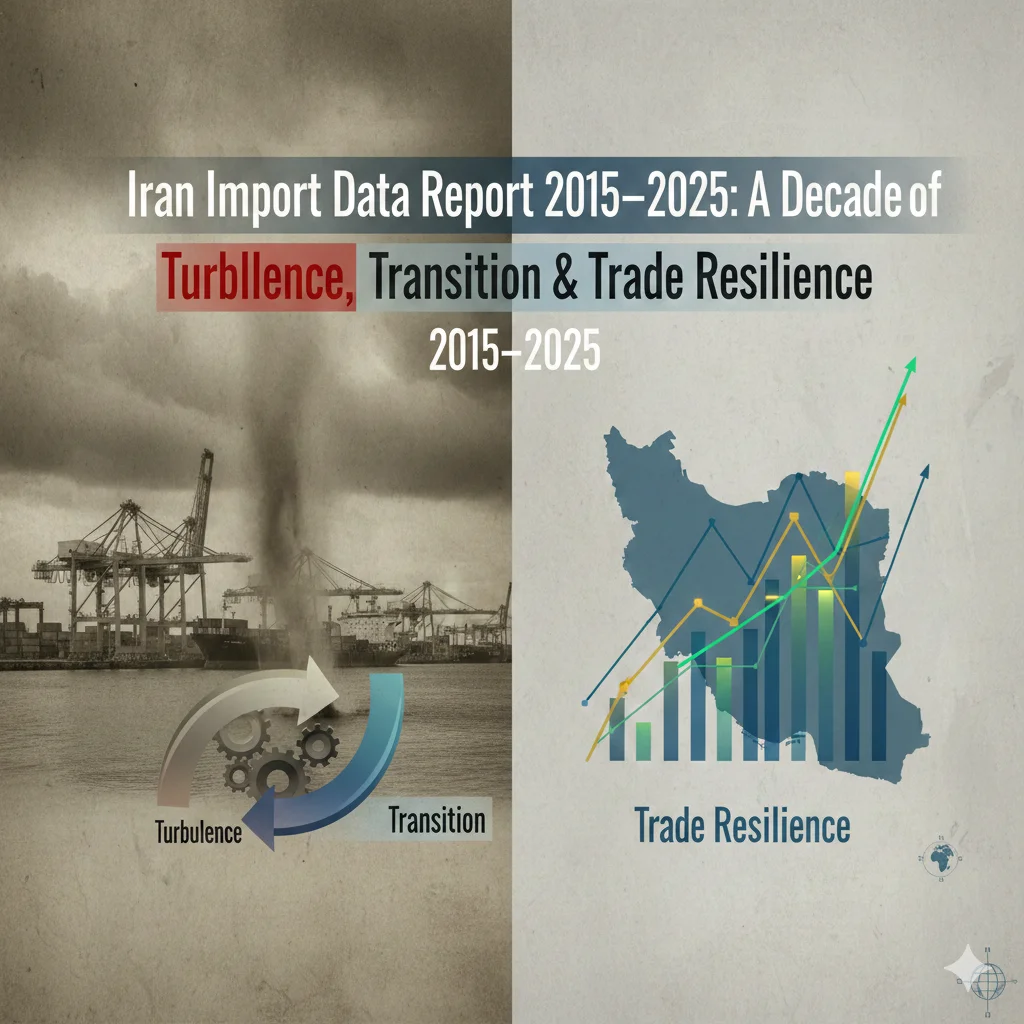
Over the past decade, Iran’s import landscape has mirrored its complex economic and geopolitical trajectory—shaped by sanctions, currency crises, shifting alliances, and global disruptions such as COVID-19. Between 2015 and 2025, the country experienced deep contractions followed by periods of recovery, with data revealing a story of resilience under constraints and structural vulnerabilities that persist despite policy efforts.
According to Iran import data and customs statistics, the country imported $69.4 billion worth of goods in 2024, marking a 4.5% increase from the previous year. This positions Iran as the 51st-largest importer globally. In the first six months of 2025 alone, Iran imported $28.4 billion worth of goods.
This comprehensive report provides a deeply analytical, data-driven overview of Iran’s trade performance over ten years, exploring shifts in import value, volume, product categories, trade partners, and structural pressures shaping the outlook for 2025–2026.
Overview: Iran’s Imports at a Glance (2015–2024)
From 2015 to 2024, Iran’s imports fluctuated sharply, ranging from a low of $64 billion in 2020 to a high of $117 billion in 2024. The most severe contractions were in 2019–2020 due to renewed US sanctions and pandemic disruptions, while the 2021–2024 period saw strong nominal rebounds driven by inflation and adjustments to new trade routes.
Broad Phases of Iran’s Import Journey
2015–2017 – Recovery under JCPOA optimism
Moderate growth supported by improved access to markets after the nuclear agreement.
2018–2020 – Collapse due to sanctions + COVID-19
The reinstatement of US sanctions in 2018 triggered immediate declines which deepened during COVID.
2021–2024 – High-value rebound
Imports rose sharply in USD terms due to inflation, FX depreciation, and diversification toward Asian partners.
2025 (early data) – Value up, volume down
Import value continues growing modestly, but physical volume has slightly contracted—a clear sign of price inflation outweighing real trade expansion.
Top 10 Imports of Iran (2024–2025)
Iran’s leading imports are dominated by machinery, vehicles, food products, medical supplies, and industrial materials. According to Iran customs data and the Iran import product list, the top categories include:
-
Nuclear reactors & machinery (HS 84) – $13.4B (21.1%)
-
Electrical machinery (HS 85) – $9.4B (14.8%)
-
Vehicles (HS 87) – $7.35B (11.6%)
-
Pharmaceutical products (HS 30) – $5.77B (9.1%)
-
Cereals (HS 10) – $4.63B (7.3%)
-
Plastics & articles (HS 39) – $4.25B (6.7%)
-
Iron & steel (HS 72) – $3.67B (5.8%)
-
Optical & medical instruments (HS 90) – $2.78B (4.4%)
-
Paper & paperboard (HS 48) – $1.96B (3.1%)
-
Animal or vegetable fats & oils (HS 15) – $1.64B (2.6%)
These categories highlight Iran’s structural import dependency on industrial equipment, medical goods, and food commodities.
Top 10 Countries Exporting to Iran (2024–2025)
Iran’s trade partners remain concentrated heavily in Asia and the Middle East, reflecting geopolitical realignments and sanctions-driven reorientation.
-
China – $18.2B (28.7%)
-
UAE – $9.6B (15.1%)
-
India – $5.45B (8.6%)
-
Turkey – $4.3B (6.8%)
-
Germany – $3.6B (5.7%)
-
Russia – $3.05B (4.8%)
-
Italy – $2.66B (4.2%)
-
South Korea – $2.47B (3.9%)
-
Brazil – $2.22B (3.5%)
-
France – $2.03B (3.2%)
More than 70% of Iran’s imports come from China, UAE, and Turkey—a sign of asymmetric dependency.
Iran Imports in the Last 10 Years: Historical Goods Import Data (2015–2025)
| Year | Imports (Goods) |
|---|---|
| 2015 | $40.04B |
| 2016 | $42.70B |
| 2017 | $51.61B |
| 2018 | $41.23B |
| 2019 | $41.89B |
| 2020 | $38.91B |
| 2021 | $48.98B |
| 2022 | $58.92B |
| 2023 | $65.55B |
| 2024 | $69.40B |
| 2025 (first 2 quarters) | $28.40B |
Goods & Services Import Trend Analysis (2015–2024)
| Year | Imports (G&S) | Trend |
|---|---|---|
| 2015 | $84.7B | Stable |
| 2016 | $88.3B | Slight rise |
| 2017 | $107.7B | Major rebound |
| 2018 | $109.5B | Peak before sanctions return |
| 2019 | $90.9B | Sanctions-driven fall |
| 2020 | $63.9B | Pandemic collapse |
| 2021 | $82.6B | Partial recovery |
| 2022 | $97.7B | Inflation-driven rise |
| 2023 | $113.2B | Strong expansion |
| 2024 | $117.2B | Highest in the decade |
Key Insight:
The surge in nominal import values from 2021 onwards is driven not by increased physical imports—but by global inflation and a collapsing rial.
Structural Forces Shaping Iran’s Import Trajectory
1. Sanctions & Financial Isolation
-
US sanctions reimposed in 2018 restricted banking channels.
-
Import financing costs surged.
-
Western suppliers withdrew, forcing Iran toward regional intermediaries (UAE, Turkey).
2. Currency Depreciation
-
Rial fell from 32,000 per USD (2015) to ~600,000 per USD (2024) on the parallel market.
-
Rapid inflation magnified import costs.
3. COVID-19 Shock (2020)
-
Imports of goods fell to $38.9B; goods & services to $63.9B.
-
Sharpest contraction in the decade.
4. Global Inflation (2021–2023)
Higher global prices for grains, metals, electronics, and shipping inflated Iran’s import bill.
5. Unusual Rise in Gold Imports
-
Over $8B in 2024–25.
-
Used as a hedge against inflation and currency risk.
What Iran Imports: Sectoral Composition
Food and Agriculture
-
Cereals (wheat, corn, rice) dominate.
-
Annual food imports often exceed $7–9B.
Machinery & Industrial Equipment
-
Critical for manufacturing and infrastructure.
-
Around $7–8B annually.
Electronics & Components
-
Driven by telecom and household demand.
Pharmaceuticals & Medical Equipment
-
Imports remain essential despite domestic production.
Vehicles & Parts
-
Vehicle parts are significant even if car imports are restricted.
Metals, Plastics & Industrial Inputs
-
Support petrochemicals, construction, and factory production.
Non-Oil Trade Balance
In FY ending March 2025:
-
Non-oil exports: $57.8B
-
Imports: $72.4B
-
Non-oil deficit: $14.6B (widening)
-
Import weight: 39.3M tonnes (down 0.8%)
Nominal import growth is driven entirely by inflation, not volume expansion.
Volume vs Value Divergence (2023–2025)
-
Import value: +8%
-
Import volume: –1%
This indicates Iran is paying more for fewer goods due to:
-
Sanctions premiums
-
Global inflation
-
Rial depreciation
-
Shift to high-value items (gold, electronics)
Imports as a Share of GDP
-
Imports accounted for 26–27% of Iran’s GDP in 2024.
-
Higher than the long-term average (~20% in the 2000s).
-
Reflects structural dependence on foreign inputs.
Recent Developments (2024–2025)
-
Total non-oil trade reached $130B, up 11%.
-
Imports: $72.4B, exports: $57.8B.
-
Major imported items: gold, animal feed, rice, cooking oil, mobile phones, machinery.
-
Imports from UAE, China, Turkey > 70% of total.
-
First-half 2025 trends show continued value growth but declining tonnage.
Outlook for 2025–2026
Import Value Forecast:
Expected to reach $80–90B (non-oil) due to inflation + FX effects.
Import Volume:
Likely flat or slightly declining as purchasing power falls.
Trade Partners:
China, UAE, Turkey will remain dominant; minor shifts toward Russia and Central Asia.
Risks:
-
New sanctions
-
Exchange rate shocks
-
Commodity price spikes
Expect import dependence to remain high, particularly for food, medicine, and machinery.
Key Policy Recommendations
-
Simplify currency regimes and stabilize the rial.
-
Prioritize essential and productive imports.
-
Diversify suppliers via regional currency swaps.
-
Modernize ports and logistics to reduce costs.
-
Expand domestic capacity in machinery, pharma, and agro-processing.
Final Summary: Iran’s 10-Year Import Story
From 2015 to 2025, Iran’s import dynamics trace a clear arc:
2015–2017
Renewed trade optimism under JCPOA.
2018–2020
Sharp contraction due to sanctions + pandemic.
2021–2024
Inflation-driven rebound; high nominal import values.
2025
Value growth without real volume expansion—structural imbalances persist.
Iran’s trade system has proven remarkably resilient, but the economy remains heavily dependent on costly imports, vulnerable to sanctions, and exposed to global price shocks.
Until structural reforms, FX stability, and geopolitical normalization occur, Iran’s import patterns will continue reflecting crisis management rather than sustainable growth.