

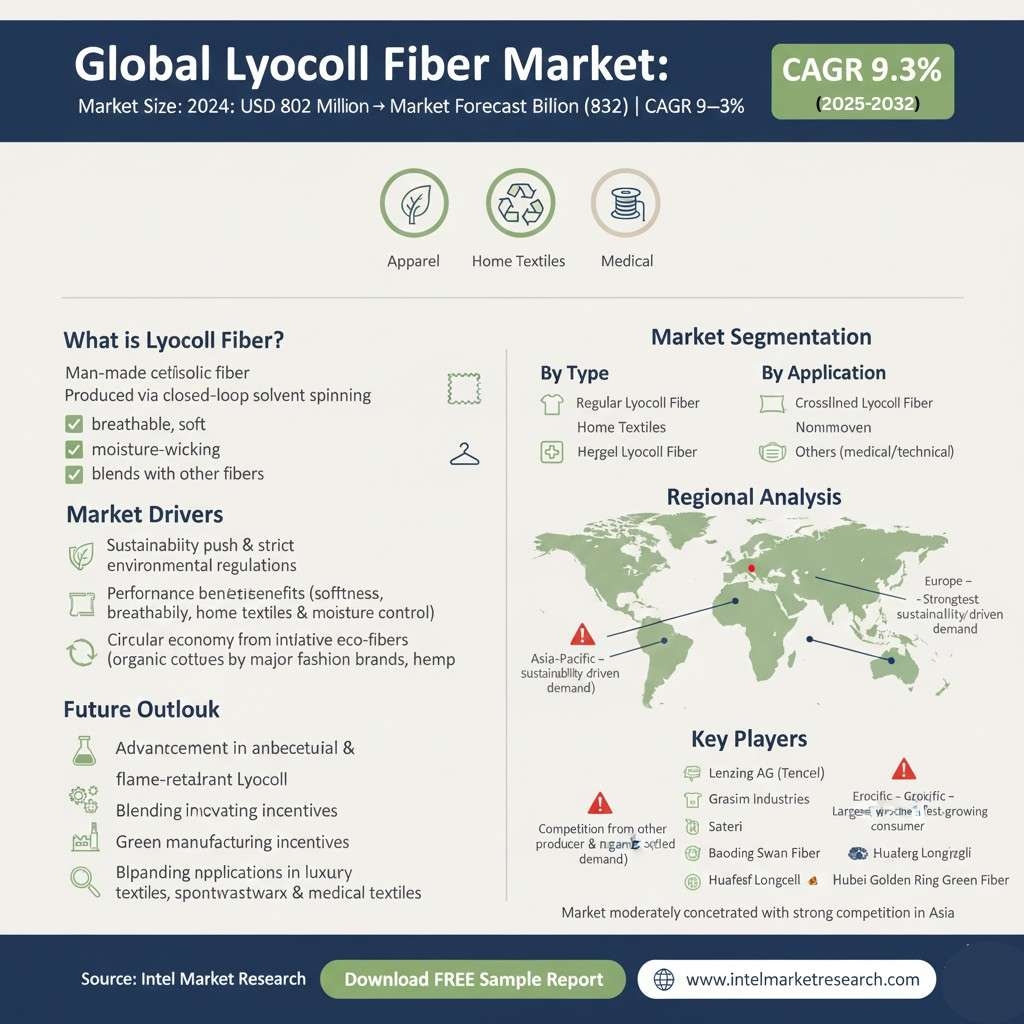
According to a new report from Intel Market Research, the global Lyocell Fiber market was valued at USD 802 million in 2024 and is projected to reach USD 1475 million by 2032, growing at a CAGR of 9.3% during the forecast period (2025–2032).
What is Lyocell Fiber?
Lyocell, derived from cellulose, is known as a man-made fiber. It is popularly known by the brand name Tencel. Lyocell, a type of rayon fiber, is manufactured in a closed-loop method through a solvent spinning technique, wherein the cellulose undergoes a limited chemical change. Lyocell fibers are widely used in the textile industry in a broad range of apparels and home textiles. These fibers are also used in the medical industry in the production of medical equipment and surgical products.
With increasing environmental awareness, both consumers and manufacturers are seeking sustainable alternatives to conventional fibers like cotton and polyester. Lyocell is seen as an eco-friendly solution because of its production process, which uses closed-loop technology that recycles water and solvents, reducing waste and pollution. Unlike synthetic fibers such as polyester, Lyocell is biodegradable, aligning with the growing demand for materials that minimize environmental impact at the end of their life cycle. This makes it appealing to brands focusing on circular economy models.
Moreover, Lyocell's adoption in diverse applications are increasing. Lyocell's versatility allows it to be used in a variety of textiles, from casual wear to high-end fashion. It blends well with other fibers such as cotton, wool, and silk, expanding its application in various fabric compositions. In addition, the fiber's breathability, moisture control, and softness have made it popular in bedding, upholstery, and other home textiles.
We have surveyed the Lyocell Fiber manufacturers, suppliers, distributors, and industry experts on this industry, involving the sales, revenue, demand, price change, product type, recent development and plan, industry trends, drivers, challenges, obstacles, and potential risks.
Download Sample Report: Lyocell Fiber Market - Detailed Research Report
Market Drivers
1. Sustainability and Environmental Regulations
The increasing stringency of environmental regulations worldwide is a major factor driving the adoption of Lyocell fibers. Unlike traditional synthetic fibers that are petroleum-based and non-biodegradable, Lyocell is made from sustainably sourced wood pulp and is fully biodegradable. This aligns with the global push towards circular economy models, where products are designed to have minimal environmental impact throughout their lifecycle. Major fashion brands and retailers are increasingly committing to sustainable sourcing, creating a steady demand for Lyocell fibers.
2. Performance and Versatility
Lyocell fibers offer a unique combination of properties that make them suitable for a wide range of applications. They are soft, breathable, and have excellent moisture-wicking properties, making them ideal for activewear, intimate apparel, and everyday clothing. Additionally, their strength and durability make them suitable for home textiles and technical textiles. The fiber's ability to blend seamlessly with other materials like cotton, wool, and polyester further expands its application scope.
3. Growing Demand in Medical and Technical Applications
Beyond apparel, Lyocell fibers are increasingly used in medical textiles due to their hypoallergenic and biodegradable properties. They are used in surgical gowns, drapes, and other medical textiles where sterility and comfort are crucial. Furthermore, the ongoing research into enhancing Lyocell's properties for specific technical applications presents new growth avenues.
Download Sample Report: Lyocell Fiber Market - Detailed Research Report
Market Challenges
- High production costs: The closed-loop manufacturing process, while environmentally friendly, is more expensive than conventional fiber production. This results in a higher price point for Lyocell products, which can be a barrier in price-sensitive markets.
- Limited consumer awareness: While industry professionals are familiar with Lyocell, the average consumer is less aware of its benefits compared to natural fibers like cotton or synthetics like polyester. Educating the end-user remains a challenge.
- Competition from other sustainable fibers: Lyocell faces competition from other eco-friendly fibers like recycled polyester, organic cotton, and hemp, which are also vying for market share in the sustainable textile segment.
Opportunities Ahead
The global push for sustainability is not a passing trend but a fundamental shift in manufacturing and consumption. Several factors indicate a positive future for Lyocell fibers:
- Innovation in blending and finishing: Advances in textile engineering allow Lyocell to be blended with other fibers more effectively, enhancing its properties while reducing costs. New finishing techniques can also make Lyocell fabrics more durable and versatile.
- Expansion into new geographies: As developing economies grow, their middle class expands, and with it the demand for quality textiles. Regions like Asia-Pacific and Latin America are becoming significant markets not just for production but for consumption as well.
- Government support and subsidies: In many countries, governments are providing subsidies and tax benefits for companies adopting green technologies, including the production and use of sustainable fibers like Lyocell.
Regional Market Insights
- Europe: Europe has been an early adopter of sustainable practices, and its stringent regulations make it a major market for Lyocell. Countries like Germany, France, and the UK have a high demand for sustainable textiles. The presence of major fashion brands also drives innovation.
- North America: The US and Canada have a strong market for eco-friendly products, and the presence of a large retail sector makes North America a key consumer of Lyocell products, both in apparel and home textiles.
- Asia-Pacific: This region is the largest producer of Lyocell fibers, with China being a major manufacturer. However, consumption is also growing rapidly in countries like India, Japan, and South Korea, driven by urbanization and rising disposable incomes.
Download Sample Report: Lyocell Fiber Market - Detailed Research Report
Market Segmentation
By Type
- Regular Lyocell Fiber
- Crosslinked Lyocell Fiber
By Application
- Apparels
- Home Textiles
- Nonwoven
- Others (including medical and technical textiles)
By Region
- North America (USA, Canada, Mexico)
- Europe (Germany, France, UK, Italy, Russia, Nordic countries, Benelux, Rest of Europe)
- Asia (China, Japan, South Korea, Southeast Asia, India, Rest of Asia)
- South America (Brazil, Argentina, Rest of South America)
- Middle East & Africa (Turkey, Israel, Saudi Arabia, UAE, Rest of Middle East & Africa)
Competitive Landscape
The market for Lyocell fibers is relatively concentrated, with a few key players holding significant market share. However, the growing demand has encouraged new entrants, particularly in Asia.
Key players include:
- Lenzing AG: The Austrian company is the global leader, known for its Tencel brand. They have a wide range of Lyocell products and a strong distribution network.
- Grasim Industries (Grascell): Part of the Indian Aditya Birla Group, Grasim is a major producer with a focus on cost-competitive production.
- Baoding Swan Fiber: A Chinese manufacturer that has been expanding its capacity.
- Sateri: Another significant player with a strong presence in Asia.
- Other players include Shandong Jinyingli New Material Technology, Hubei Golden Ring Green Fiber, and Huafeng Longcell Fiber, among others.
Competition is based on:
- Product quality and specialization: Some manufacturers focus on specific types of Lyocell, such as those for technical applications.
- Pricing: Cost leadership is crucial in this market, especially for applications in developing countries.
- Sustainability credentials: As a product that is marketed as eco-friendly, the actual environmental footprint of production becomes a competitive factor.
Future Outlook
The future of the Lyocell fiber market looks promising, driven by the following factors:
- R&D investments: Companies are investing in research to improve the properties of Lyocell, making it suitable for even more applications. For instance, flame-retardant or antibacterial Lyocell fibers are under development.
- Circular economy initiatives: Brands and retailers are increasingly looking at the full lifecycle of their products. Lyocell, being biodegradable and produced sustainably, fits well into these initiatives.
- Collaborations: Partnerships between fiber producers and fashion brands or technical textile manufacturers are helping to create new applications and markets.
While the market is growing, challenges remain, especially in making Lyocell cost-competitive with established fibers. However, with scale and technological advancements, the cost is expected to decrease, making it accessible to a broader market.
For a more in-depth look, you can download the full report which includes market size by type and application, regional breakdowns, and profiles of key players.
Download Sample Report: Lyocell Fiber Market - Detailed Research Report
About Intel Market Research
Intel Market Research is a leading provider of market intelligence, delivering accurate and actionable data across various sectors. Our reports are used by Fortune 500 companies, startups, and governments for strategic decision-making.
For more information, visit our website or contact us directly.
🌐 Website: https://www.intelmarketresearch.com
📞 International: +1 (332) 2424 294
📞 Asia-Pacific: +91 9169164321
🔗 LinkedIn: Follow Us