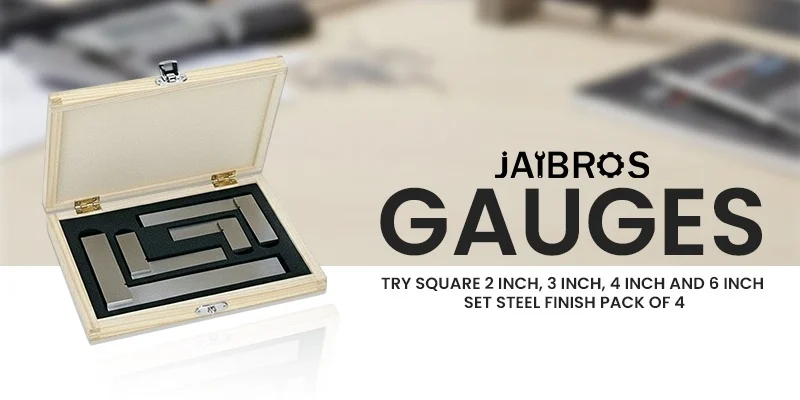
Try Square is an essential measuring tool for carpenters and machinists, helping check and mark perfect 90-degree angles for accurate, high-quality results.
What Is a Try Square and Why It Matters
A Try Square is a simple but very important measuring tool used to mark or check right angles. It usually has two parts — a long metal blade and a handle fixed at a perfect 90 degrees. When a worker places this tool against the edge of the work material, they can immediately confirm whether the angle or corner is completely straight or has an error.
This tool has been used for decades in the woodworking and metalworking industry. Even today, modern factories and high-tech CNC machining centers prefer using it during inspection because manual checking with this tool gives great accuracy.
How It Helps Carpenters and Metalworkers
A carpenter's try square is specially used in woodworking. While cutting wooden boards, drawers, doors, and furniture pieces, this tool helps carpenters make sure that joints are perfectly straight. When the angle is correct, the final product becomes strong, smooth, and long-lasting.
In metal workshops too, this tool plays a big role. During fabrication or machining, workers continuously check the edges of metal plates and blocks. With the help of a try square, a worker can detect a small mistake before welding, drilling, or fitting the metal part. This saves time, reduces wastage, and improves work quality.
Try Square Set and Why Professionals Prefer It
Many workshops buy a try square set instead of a single tool. This is because different jobs need different sizes. A small size is perfect for checking short edges and small blocks, while a bigger size is useful for long surfaces and industrial-scale projects.
A good set usually includes multiple sizes ranging from small handheld squares to large measuring ones. Buying a set also helps workers maintain uniform measurements across all projects. For professional workshops or CNC units, a set becomes a smart investment.
Accuracy and Material Quality
A high-quality try square is made of hardened stainless steel so that it does not bend or change shape even after long use. The handle is often made of metal, hardwood, or solid plastic. The blade has graduation markings so workers can measure lengths at the same time while checking angles.
Accuracy is the most important factor. When the 90-degree angle is not exact, the measurement results become wrong. A good measuring tool stays accurate even after heavy daily use.
Try Square Tool Price and What Affects It
The try square tool price depends on many factors:
-
Material used (steel or wooden handle)
-
Size of the blade
-
Brand and manufacturing quality
-
Whether it is a single tool or a complete set
Most workshops prefer buying branded high-accuracy measuring tools because they last longer and offer a better finish. For professional woodworkers and machinists, price becomes less important compared to the reliability of the tool.
Try Square in CNC Machining
Even though CNC machines work automatically, workers still check the part manually during setup and inspection. A measuring tool like a Try Square becomes very useful here. If the component is not fixed properly at the correct angle before machining, the entire process becomes wrong.
That is why this tool is commonly kept near CNC machines along with other measuring devices such as vernier calipers, angle gauges, and dial indicators. It helps ensure accuracy before pressing the start button on costly operations. A simple tool saves time and reduces the chance of damage.
How to Use It Properly
Using a try square is very easy:
-
Place the handle firmly against the edge of the material.
-
Hold the blade flat on the surface.
-
Observe the space between blade and surface.
-
If there is no gap, the angle is perfect.
-
If a gap appears anywhere, the corner needs correction or re-cutting.
Workers also use it as a marking tool by placing a pencil or scriber along the blade to draw a perfectly straight line.
Why Every Workshop Should Use One
A workshop that focuses on accuracy cannot ignore this tool. It helps workers:
-
Improve finishing quality
-
Reduce rework and wastage
-
Produce parts that fit correctly
-
Save time during inspection
-
Maintain standard measurements in all projects
Because of its low cost and high usefulness, this measuring tool is equally valuable for beginners as well as professionals.
Where to Buy a Reliable Try Square
There are many options in the market today, from small local brands to precision-grade industrial manufacturers. For workers who want tested and accurate measurement tools, online industrial stores like Jaibros provide trusted quality products. Users can easily compare options, read information, select the correct size, and buy tools from one place. It also becomes easier to find matching accessories for woodworking and CNC tool requirements.
Frequently Asked Questions (FAQs)
Q1. What is a Try Square used for?
It is used to check and mark perfect 90-degree angles on wood or metal.
Q2. Is a Try Square only for carpenters?
No, it is used in woodworking, metalworking, CNC machining, and fabrication.
Q3. Does a Try Square need calibration?
Good-quality metal ones rarely lose accuracy, but checking once in a while is recommended.
Q4. What size should I buy for general work?
A medium-size 6-inch or 8-inch tool is suitable for most workshop tasks.
Q5. Where can I buy a Try Square online?
You can buy it from trusted industrial tool websites like Jaibros for reliable quality.
Conclusion
In every workshop, accuracy decides performance and quality. A Try Square may look like a simple measuring device, but it protects the project from angle errors that can ruin the final results. It helps carpenters, metalworkers, CNC machinists, and DIY users produce professional-grade work with confidence. It is strong, long-lasting, affordable, and easy to use — which is why every workshop should keep this tool ready at the workbench.