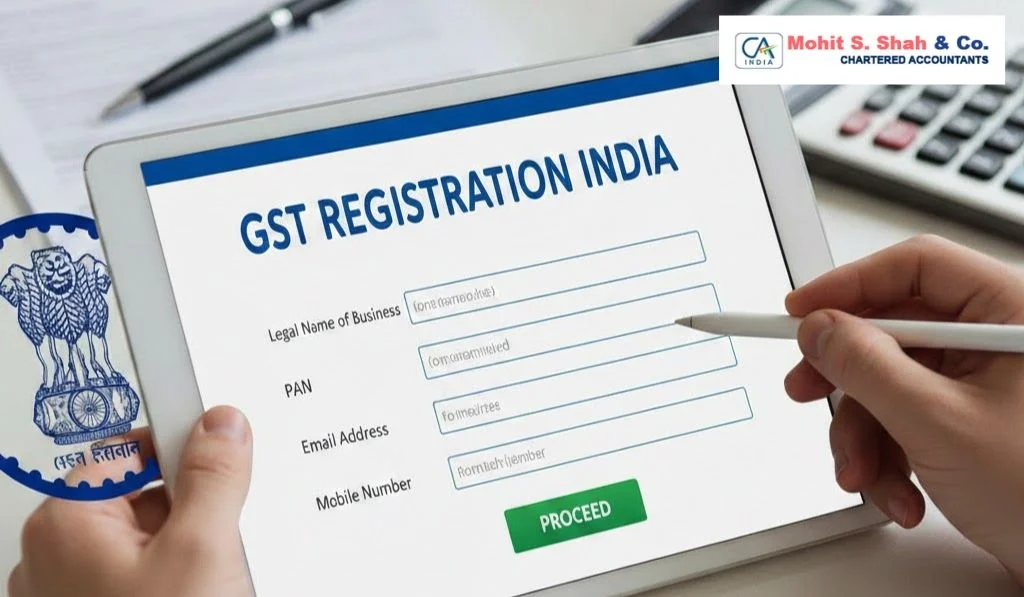
Goods and Services Tax (GST) has become the central indirect tax structure in India, replacing multiple earlier taxes such as VAT, service tax, and excise duty. Since its introduction, GST has aimed to create a unified and transparent taxation system across the country. Understanding GST registration in India is important for anyone involved in trade, manufacturing, service provision, or any business activity that crosses the threshold limits set by the law. This blog explains the meaning, purpose, and process of GST registration, along with practical details for those who need to apply for GST number in India. It also covers points relevant to GST registration in Mumbai, as certain procedural aspects may vary slightly based on local administrative practices.
The information presented here is purely educational in nature and is intended to help readers gain clarity about compliance requirements. References to Mohit S. Shah & Co are included only for contextual identification in line with the user’s request.
1. What Is GST Registration?
GST registration is the process through which individuals, businesses, or entities become recognized taxpayers under the Goods and Services Tax law. Once registered, the business receives a unique Goods and Services Tax Identification Number (GSTIN). This number is used for filing returns, issuing invoices, and complying with all tax reporting and payment rules under GST.
GST registration is mandatory for many categories of taxpayers, including those whose aggregate turnover exceeds the threshold limit. It is also required in specific situations such as inter-state supply, e-commerce involvement, or voluntary registration for structured accounting.
2. Who Should Register Under GST?
Understanding whether an entity needs to register is an essential first step before initiating the process. Under the current GST law, the following categories often require GST registration in India:
a. Turnover-based registration
Businesses whose aggregate turnover exceeds the prescribed limit must register. The limit generally depends on the type of supply:
-
For goods: Usually around ₹40 lakh in most states.
-
For services: Typically around ₹20 lakh.
b. Inter-state suppliers
Any business supplying goods or services across state borders usually needs GST registration regardless of turnover.
c. E-commerce sellers
Individuals or firms selling through e-commerce platforms often require GST registration before listing their products.
d. Casual taxable persons
Entities participating in temporary events, exhibitions, or short-term business activities in different states must register as casual taxable persons.
e. Reverse charge mechanism
In certain cases where the business falls under reverse charge rules, registration becomes necessary even if turnover is below the limit.
These criteria apply uniformly across India, including metropolitan regions such as Mumbai. Therefore, anyone planning to apply for GST number in India should first assess whether they fall under any of these categories.
3. Why GST Registration Matters
GST registration helps businesses operate formally and meet compliance standards. Registered taxpayers can:
-
Legally collect tax from customers.
-
Claim Input Tax Credit (ITC) on eligible purchases.
-
File GST returns as required by law.
-
Maintain transparent documentation for regulatory reviews.
Even though these benefits exist, the relevance of registering lies mainly in adhering to statutory requirements and ensuring proper tax governance. The information presented here is intended to explain compliance expectations rather than promote any service.
4. Documents Needed for GST Registration
The list of documents needed for GST registration in India is largely uniform across states. However, minor differences may occur depending on local portals or verification practices, including in regions like Mumbai. Typical documents include:
-
PAN card of the business or proprietor
-
Aadhaar card of the authorized signatory
-
Proof of business address (electricity bill, rental agreement, property tax receipt)
-
Bank account details (bank statement or canceled cheque)
-
Photograph of the applicant
-
Constitution documents (Partnership Deed, Certificate of Incorporation, etc.)
-
Authorization letter in case of companies or partnership firms
Having these documents ready makes the application process smoother when individuals prepare to apply for GST number in India.
5. Step-by-Step Process for GST Registration in India
The procedure for GST registration is primarily done online through the GST portal. The steps below describe the process in simple language:
Step 1: Visit the GST Portal
The applicant must begin by visiting the official GST registration portal and selecting the option to apply for a new registration.
Step 2: Enter Basic Details
The applicant enters details such as legal name of the business, PAN, mobile number, and email address. An OTP is sent for verification.
Step 3: Provide Business Information
Information such as business type, location, constitution, and nature of operations must be entered carefully.
Step 4: Upload Required Documents
Scanned copies of applicable documents are uploaded. File formats and size limits must follow the portal’s instructions.
Step 5: Submission and Verification
After completing the form and uploading documents, the application is submitted. A temporary reference number is generated. The authorities may conduct verification or request clarification if necessary.
Step 6: Issuance of GSTIN
Once approved, the applicant receives a GSTIN and a registration certificate. This confirms successful GST registration in India.
This same digital process applies to GST registration in Mumbai, though the verification timeline may vary slightly due to local administrative load.
6. GST Registration in Mumbai: Points to Consider
Mumbai, being a major financial and commercial hub, sees a high volume of registrations. The general process remains the same, but applicants should keep in mind:
-
Verification queries may be more frequent due to the volume of applications.
-
Address proof for commercial premises must match local regulations.
-
Timelines may differ during peak filing seasons.
These factors do not change the fundamental procedure but help applicants prepare better when planning for GST registration in Mumbai.
7. Post-Registration Compliance Requirements
Once registration is complete, several ongoing obligations apply:
a. Filing GST Returns
Registered taxpayers must file monthly, quarterly, or annual returns depending on their category.
b. Maintaining Records
Invoices, purchase registers, stock records, and other financial documents must be maintained for audit and verification purposes.
c. Displaying GSTIN
Businesses must display their GSTIN at their place of business.
d. Updating Information
If business details change—such as address or authorized person—the GST portal must be updated.
Compliance is a continuous responsibility, and understanding these expectations is essential for anyone who chooses to apply for GST number in India.
8. Common Challenges in GST Registration
Some applicants face difficulties during the process. Common issues include:
-
Incorrect document uploads
-
Mismatched address details
-
Technical errors on the portal
-
Delays in verification
Being aware of these challenges helps individuals complete GST registration in India with greater accuracy.
Conclusion
GST registration is an essential compliance requirement for many businesses and individuals across the country. Understanding the rules, process, documents, and ongoing responsibilities ensures transparency and smooth functioning under the GST framework. Whether someone plans to apply for GST number in India for a small enterprise or needs clarity on GST registration in Mumbai, the key lies in understanding the legal steps and maintaining accurate documentation.
This informational overview, prepared in reference to Mohit S. Shah & Co, aims to provide a simple and clear explanation of GST registration and compliance expectations in India while staying within ICAI’s ethical guidelines and maintaining a purely educational tone.