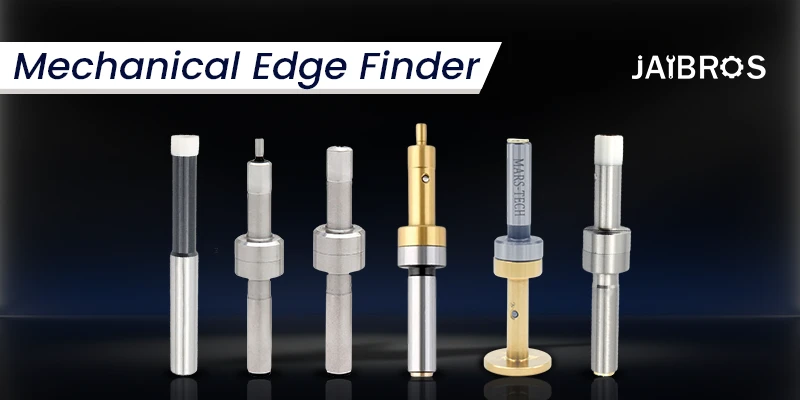
Explore the top applications of edge finder tools in manufacturing and learn how mechanical and electronic edge finders improve accuracy and efficiency.
Key Manufacturing Applications of Edge Finder Tools
Precision is the foundation of modern manufacturing. Whether producing a single prototype or running a high-volume CNC production line, accurate positioning of the workpiece is critical. One of the most reliable methods for achieving this precision is accurate edge location, which helps machinists establish correct reference points before machining begins.
An edge finder plays a key role in ensuring consistent accuracy, reduced setup time, and improved repeatability across a wide range of manufacturing operations.
Importance of Edge Location in Manufacturing
Before any cutting operation starts, machinists must define the origin or zero point of the workpiece. Incorrect referencing can lead to dimensional errors, wasted material, and costly rework. Edge detection tools provide a simple and effective way to locate workpiece boundaries with confidence.
In both traditional and CNC machining environments, accurate edge detection supports:
-
Faster machine setup
-
Improved dimensional control
-
Reduced scrap rates
-
Better tool life
Because of these advantages, edge detection has become a standard practice across manufacturing industries.
CNC Milling Operations
One of the most common applications of an edge finder (2) is in CNC milling. Milling operations require precise X, Y, and Z-axis referencing to ensure tool paths align with design specifications.
Using an edge finder tool, machinists can quickly locate the sides of a workpiece mounted on the machine table. This allows accurate zero setting without trial cuts, saving time and reducing errors. In CNC milling, this precision is especially important when producing complex geometries or working with tight tolerances.
Manual Milling and Conventional Machines
Edge location tools are not limited to CNC machines. Conventional milling machines also benefit greatly from accurate edge detection. In manual setups, machinists rely on visual and tactile feedback to determine reference points.
A mechanical edge finder is widely used in such applications due to its simplicity and reliability. It provides a clear visual indication when the tool reaches the edge of the workpiece, making it ideal for workshops that still operate manual machines alongside CNC equipment.
Precision Drilling and Hole Positioning
Accurate hole placement is essential in manufacturing assemblies where multiple components must align perfectly. Even minor positioning errors can cause misalignment during assembly or reduce part strength.
By using an edge finder to establish precise reference points, machinists can ensure that drilling operations start at the correct location. This improves consistency across batches and helps maintain quality standards in industries such as automotive and industrial equipment manufacturing.
Tool and Die Manufacturing
Tool and die manufacturing demands extremely high accuracy, as dies and molds directly affect the final product quality. Precise edge referencing is critical during machining and finishing stages.
In this application, an electronic edge finder is often preferred due to its higher sensitivity and faster detection. These tools reduce operator dependency and provide repeatable results, which is essential when producing high-value tooling components.
Prototype and Small-Batch Production
Prototyping and low-volume production runs require flexibility and quick setup changes. Advanced probing systems may not always be cost-effective or necessary for such jobs.
An edge finder offers a practical solution by enabling fast and accurate setup without complex programming. This makes it ideal for R&D departments, job shops, and manufacturers handling custom or short-run projects.
Surface Machining and Finishing Operations
In surface machining processes such as facing, slotting, and contouring, precise alignment ensures uniform material removal and better surface finish.
Edge detection tools help machinists align cutting paths accurately with the workpiece boundaries. This minimizes uneven cuts and improves overall part appearance, especially in visible or functional surfaces.
Aerospace and Automotive Manufacturing
Industries such as aerospace and automotive operate under strict quality and tolerance requirements. Even small deviations can lead to component failure or performance issues.
Using an edge finder during setup helps maintain dimensional accuracy across critical components. It supports compliance with industry standards while reducing the risk of costly rework or rejection.
Quality Control and Inspection Support
While edge detection tools are primarily used during setup, they also assist in inspection and verification processes. Machinists can recheck reference points to confirm alignment before and after machining
This added verification improves confidence in part quality and supports better documentation during audits and inspections.
Cost-Effective Alternative to Advanced Probing
Although touch probes and automated systems offer advanced capabilities, they may not be practical for all manufacturing environments due to cost or complexity.
A well-maintained edge finder provides an affordable and reliable alternative, especially for small and medium-sized workshops. It delivers excellent accuracy without the need for expensive upgrades or extensive training.
Conclusion:
Accurate edge detection remains a core requirement in manufacturing, regardless of machine type or production scale. From CNC milling and drilling to tool and die making, edge detection tools support precision, efficiency, and consistent quality. A properly used edge finder continues to be an essential solution for manufacturers seeking dependable results without unnecessary complexity.
About Jaibros:
Jaibros is a trusted name in CNC cutting and measuring solutions, offering high-quality tools designed for precision manufacturing. With a focus on durability, accuracy, and performance, Jaibros supports industries in achieving reliable and efficient machining outcomes.
FAQs
1. What is the main use of an edge finder tool in manufacturing?
It is used to accurately locate workpiece edges for correct machine setup and reference point establishment.
2. Where are mechanical edge detection tools commonly used?
They are commonly used in manual milling machines and conventional workshop environments.
3. Why are electronic edge detection tools preferred in precision industries?
They offer higher sensitivity, faster detection, and improved repeatability for high-accuracy applications.
4. Can edge detection tools be used for prototyping?
Yes, they are ideal for prototype and small-batch production due to quick setup and flexibility.
5. Are edge detection tools suitable for high-volume manufacturing?
Yes, they help reduce setup time and maintain consistent accuracy, supporting efficient high-volume production.