Global Carbon Capture and Storage Market Overview
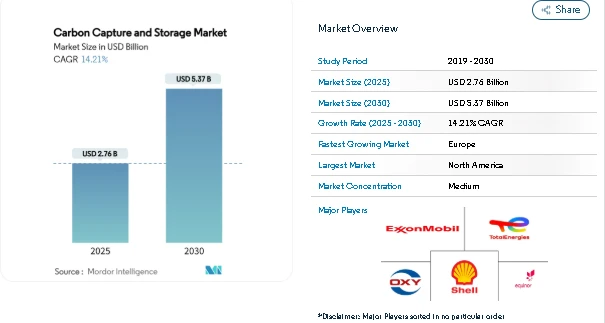
The carbon capture and storage market is growing as industries seek ways to cut emissions from sectors that cannot fully adopt renewable energy, such as cement, steel, chemicals, and oil and gas. According to Mordor Intelligence, the market is valued at USD 2.76 billion in 2025 and is projected to reach USD 5.37 billion by 2030, growing at a CAGR of 14.21%, supported by stricter emissions rules, carbon pricing, and government incentives.
Market Drivers & Insights of Carbon Capture and Storage Market
Rising Role of CCS in Hard-to-Abate Industries
One of the most important carbon capture and storage market trends is its increasing adoption in industries such as cement, iron and steel, and chemicals. These sectors generate emissions not only from fuel use but also from chemical reactions during production.
Expansion of Carbon Pricing and Compliance Mechanisms
Carbon pricing mechanisms, emissions trading systems, and border adjustment policies are influencing investment decisions across regions. Manufacturers supplying emissions-intensive products to regulated markets are under pressure to lower their carbon footprint.
Growth of CO₂ Utilization and Enhanced Oil Recovery
Enhanced oil recovery (EOR) continues to support early-stage CCS economics by creating revenue from captured carbon dioxide. Oil and gas companies are pairing industrial emitters with mature oil fields, helping offset high upfront costs.
Segmentation Analysis of Carbon Capture and Storage Market
-
By Technology
-
Pre-Combustion Capture
-
Post-Combustion Capture
-
Oxy-Fuel Combustion Capture
-
By End-User Industry
-
Oil and Gas
-
Coal and Biomass Power Plant
-
Iron and Steel
-
Cement
-
Chemical
-
By Geography
-
Asia-Pacific
-
North America
-
Europe
-
South America
-
Middle East and Africa
Key Players in the Carbon Capture and Storage Market
-
Occidental Petroleum Corporation
-
Exxon Mobil Corporation
-
Shell PLC
-
TotalEnergies
-
Equinor ASA
Conclusion
The carbon capture and storage market is positioned for steady growth through 2030 as industries face rising pressure to reduce emissions while maintaining production. Supportive policies, carbon pricing, and targeted incentives are improving project viability, especially in regions with established infrastructure. Although high capital costs and competition from renewables remain challenges, CCS continues to fill a critical gap for sectors with limited decarbonization options.