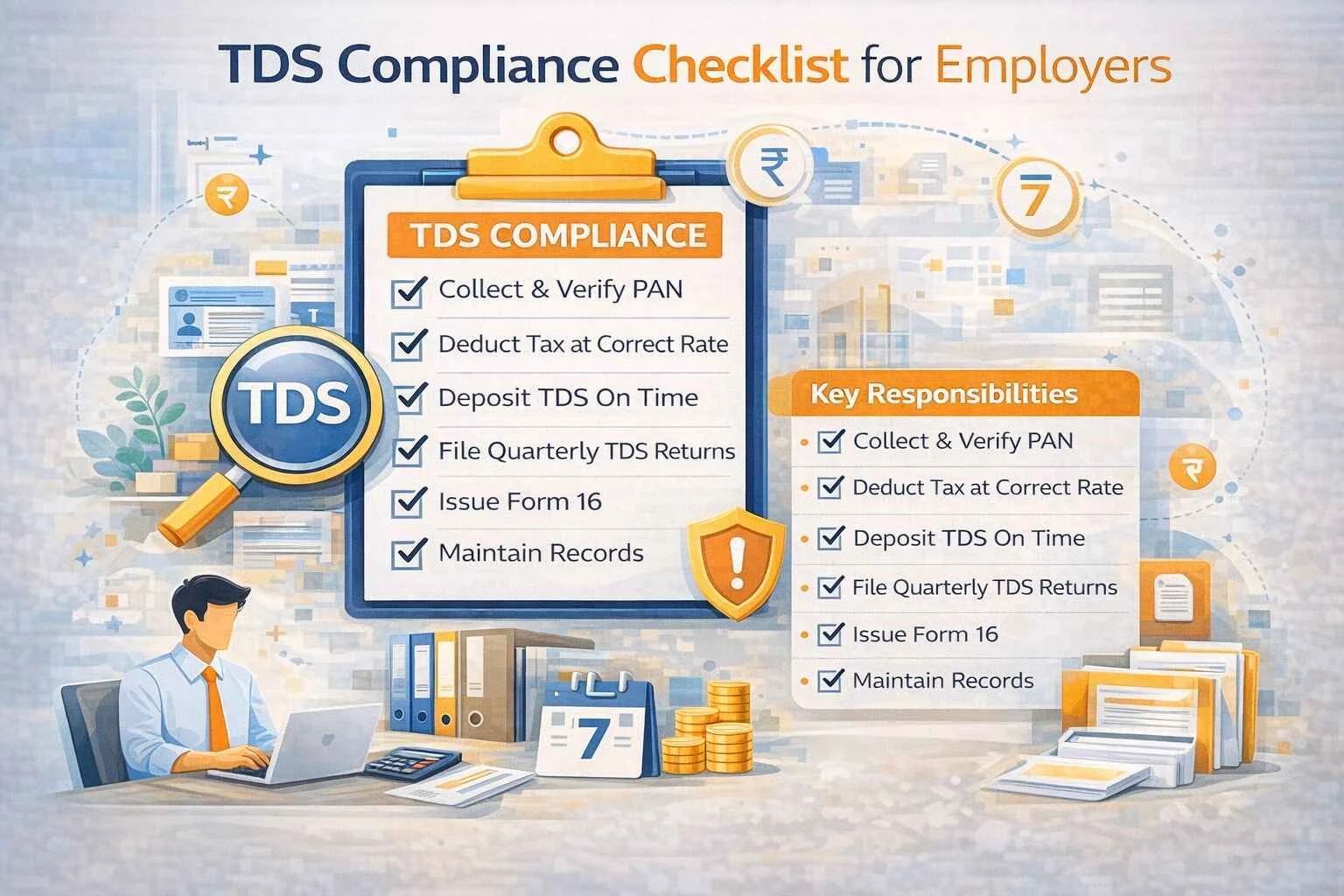
Tax Deducted at Source is one of those responsibilities employers cannot afford to treat casually. Once you deduct tax from an employee’s salary, you become a trustee of the government’s money. That changes the rules of the game. Delays, errors, or casual handling do not just attract penalties; they invite scrutiny. A clear TDS compliance checklist helps employers stay disciplined. More importantly, a well-followed TDS compliance checklist for employers ensures that monthly TDS compliance requirements in India are met without stress, confusion, or last-minute firefighting. Let’s break this down in a way that actually helps you run payroll and compliance properly.
Understanding why monthly TDS compliance matters for employers
Here’s the thing. Most employers think of TDS as an annual headache tied to Form 16 or tax returns. That assumption is wrong.TDS compliance is monthly at its core. Every month, employers deduct TDS on salaries, deposit it with the government, and maintain accurate records. Miss a step, and the consequences start piling up fast. Interest, late fees, notices, and unnecessary follow-ups with the tax department all stem from poor monthly discipline. A strong TDS compliance checklist is not about ticking boxes. It is about protecting your company from avoidable risks. A reliable TDS compliance checklist for employers ensures that monthly TDS compliance requirements in India are followed consistently, not occasionally.
Identifying employees liable for TDS deduction
Before you deduct even one rupee, you need clarity on who falls under TDS. This sounds obvious, but it is where many mistakes begin. Employers must estimate annual taxable income for each employee, considering salary structure, allowances, deductions, and exemptions. Employees below the taxable threshold may not require TDS, while others do. This step belongs at the top of every TDS compliance checklist. If employee categorization is wrong, everything else that follows collapses. A practical TDS compliance checklist for employers always starts with accurate employee income estimation as part of monthly TDS compliance requirements in India.
Collecting and validating employee declarations
Declarations are not paperwork formalities. They directly affect how much tax you deduct each month. Employees submit investment declarations, HRA details, and other deduction claims. Employers must validate these declarations instead of blindly accepting them. Over-reliance on declarations without verification creates compliance risk. Your TDS compliance checklist should clearly include declaration collection and validation timelines. For employers, this step is essential to align monthly TDS compliance requirements in India with actual tax liability.
Calculating monthly TDS correctly on salary
This is the core operational step. Monthly TDS calculation must reflect projected annual income, applicable tax slabs, cess, and surcharge where relevant. The challenge is consistency. Employers often adjust TDS only at year-end, leading to uneven deductions and employee dissatisfaction. A strong TDS compliance checklist promotes monthly accuracy rather than annual correction. A disciplined TDS compliance checklist for employers treats monthly TDS compliance requirements in India as ongoing calculations, not retrospective adjustments.
Deducting TDS at the correct time
Timing matters. TDS must be deducted at the time of salary payment, not when it is booked in accounts or approved internally. Delaying deduction, even if payment is delayed, can still trigger non-compliance if salary is credited. This nuance is frequently misunderstood. Your TDS compliance checklist should explicitly state deduction timing. Employers who follow a proper TDS compliance checklist for employers reduce the risk of interest under monthly TDS compliance requirements in India.
Depositing TDS within the prescribed due date
This is where most penalties originate.TDS deducted must be deposited with the government by the seventh day of the following month. For March deductions, the timeline is slightly extended. Missing this deadline attracts interest automatically discretion. No negotiation. Every TDS compliance checklist must prominently highlight deposit due dates. For employers, timely deposit is the backbone of monthly TDS compliance requirements in India.
Using the correct challan and payment codes
Even when employers deposit TDS on time, errors in challan selection create compliance gaps. Incorrect section codes, wrong assessment year, or mismatched TAN details can lead to uncredited payments. A detailed TDS compliance checklist includes challan verification before payment. This step is non-negotiable for any reliable TDS compliance checklist for employers handling monthly TDS compliance requirements in India.
Reconciling TDS payments with Form 26Q and 24Q data
Payment alone is not enough. What this really means is that deposited TDS must reflect accurately in quarterly returns later. Monthly reconciliation between payroll records and challan data prevents future mismatches. Employers who skip this step face correction filings and notices. A mature TDS compliance checklist integrates reconciliation as a monthly habit. This is how employers truly manage monthly TDS compliance requirements in India instead of reacting to errors later.
Maintaining employee-wise TDS records
Every deduction must be traceable employee-wise. This includes PAN, amount deducted, date of deduction, and challan linkage. Incomplete records are a silent risk. They surface painfully during audits or notices. A professional TDS compliance checklist for employers treats documentation as a living record, not a year-end scramble. This supports smooth adherence to monthly TDS compliance requirements in India.
Monitoring PAN validity and compliance
Invalid or missing PANs attract higher TDS rates. Employers must actively verify PAN details and ensure accuracy in records. Ignoring PAN validation leads to excess deduction, employee complaints, and correction filings. Your TDS compliance checklist should include periodic PAN verification. Employers who prioritize this step strengthen their TDS compliance checklist for employers and stay aligned with monthly TDS compliance requirements in India.
Handling new joiners and exits during the month
Employee movement complicates TDS. New joiners bring previous salary details, while exits require final settlement calculations. Failing to factor this correctly distorts annual tax computation. A thoughtful TDS compliance checklist includes onboarding and exit procedures. For employers, this clarity is essential to manage monthly TDS compliance requirements in India accurately.
Adjusting TDS for bonuses, incentives, and arrears
Variable pay disrupts static calculations. Bonuses and arrears can significantly change taxable income. Employers must recalculate projected tax when such payments arise. Ignoring this leads to short deduction and year-end pressure. A practical TDS compliance checklist for employers includes triggers for recalculation. This ensures monthly TDS compliance requirements in India remain realistic, not theoretical.
Tracking interest and late fee exposure proactively
Sometimes delays happen. What matters is awareness. Employers should calculate interest immediately if a delay occurs and deposit it without waiting for notices. A smart TDS compliance checklist treats interest tracking as part of compliance, not damage control. This mindset strengthens the overall TDS compliance checklist for employers following monthly TDS compliance requirements in India.
Preparing for quarterly return alignment every month
Quarterly returns are built on monthly data. If monthly records are clean, quarterly filings become routine instead of stressful. Employers who wait until quarter-end to review TDS data almost always face mismatches. A forward-looking TDS compliance checklist aligns monthly processes with quarterly outcomes. This is the hidden advantage of disciplined monthly TDS compliance requirements in India.
Ensuring coordination between HR, payroll, and finance teams
TDS compliance breaks down when departments work in silos.HR handles employee data, payroll calculates salaries, and finance deposits tax. Misalignment creates errors. A realistic TDS compliance checklist for employers clearly defines ownership at each step. This coordination is critical for smooth monthly TDS compliance requirements in India.
Reviewing compliance status before the month close
Here’s a habit that changes everything. Before closing payroll for the month, review TDS status and ask simple questions. Was TDS deducted correctly? Was it deposited on time? Are records complete? This review step is often missing from a basic TDS compliance checklist. Adding it elevates the checklist into a reliable TDS compliance checklist for employers managing monthly TDS compliance requirements in India.
Training payroll teams on TDS updates
Tax rules change. Slabs, surcharge thresholds, and compliance processes evolve. Employers must ensure payroll teams stay updated. Outdated knowledge leads to incorrect deductions. A proactive TDS compliance checklist includes periodic training. This keeps employers aligned with monthly TDS compliance requirements in India without relying on outdated assumptions.
Using professional support when internal capacity is limited
Not every employer has a full-fledged tax team. That is fine. What matters is recognizing limits. Engaging professionals for review or end-to-end handling can reduce risk significantly. A realistic TDS compliance checklist for employers acknowledges when expert support is needed to meet monthly TDS compliance requirements in India confidently.
Common mistakes employers make despite having a checklist
Many employers claim they follow a TDS compliance checklist, yet errors persist. The issue is not the checklist itself but how it is used. Checklists that sit in folders do nothing. Checklists that guide monthly action create compliance. A functional TDS compliance checklist for employers must be operational, reviewed monthly, and updated as rules change. That is how monthly TDS compliance requirements in India are actually met.
How a strong TDS compliance checklist protects your business
What this really means is peace of mind. A strong TDS compliance checklist reduces notices, avoids penalties, improves employee trust, and keeps your financial records clean. For employers, the value goes beyond compliance. It reflects governance discipline. A well-implemented TDS compliance checklist for employers transforms monthly TDS compliance requirements in India from a burden into a predictable routine.
Conclusion
TDS compliance is not about fear of penalties. It is about responsibility. When employers deduct tax from salaries, they step into a role that demands accuracy, discipline, and consistency. A clear TDS compliance checklist provides that structure. A thoughtful TDS compliance checklist for employers ensures that monthly TDS compliance requirements in India are handled calmly, month after month, without surprises. It replaces last-minute panic with steady control. It reduces dependency on corrections and explanations. It builds trust with employees and credibility with authorities. If you treat TDS as a monthly habit rather than an annual event, compliance stops feeling heavy. It becomes part of how your organization functions responsibly. And that is exactly what a good TDS compliance checklist is meant to achieve.