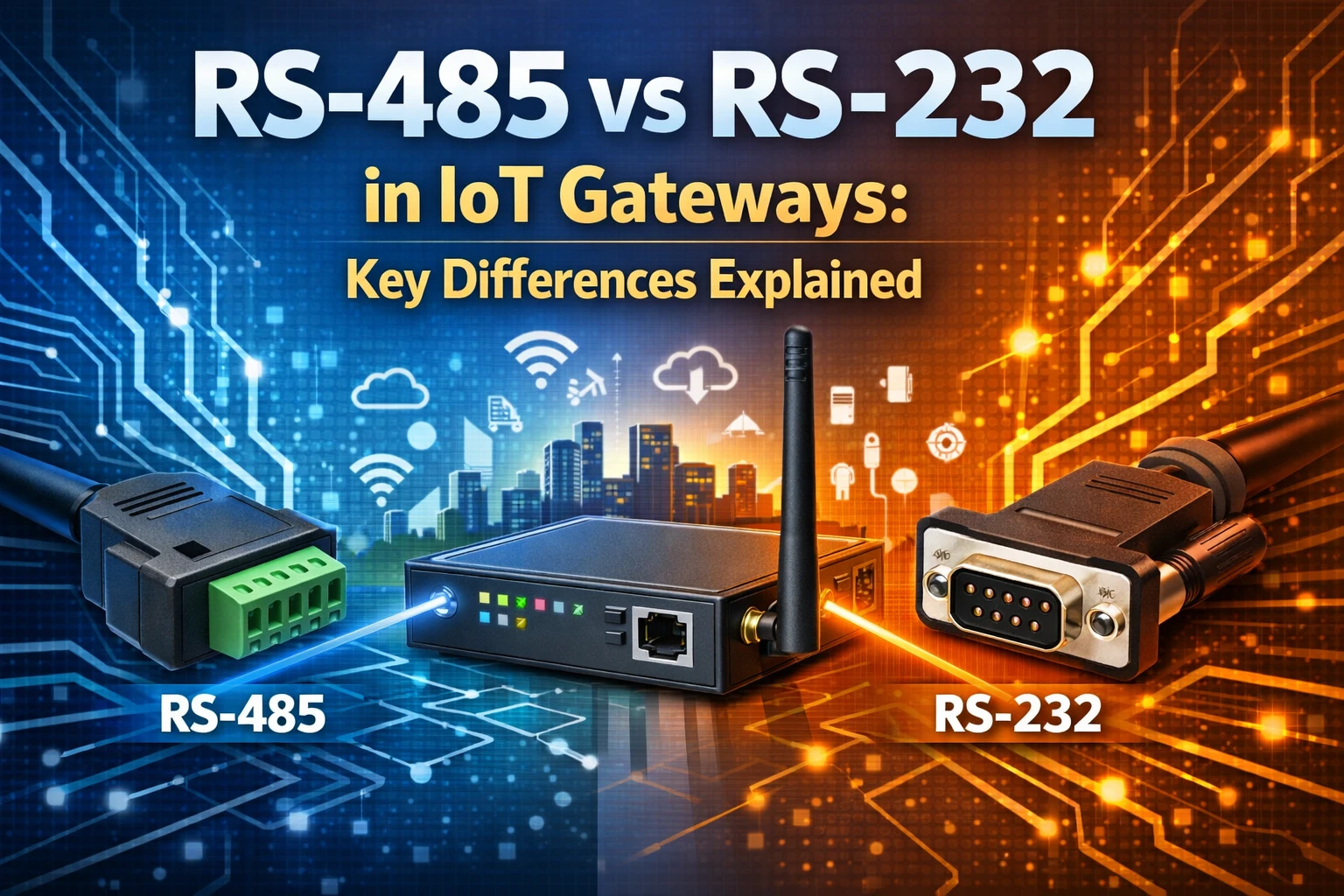
Serial communication remains a cornerstone of industrial connectivity. Despite modern networks like Ethernet and Wi-Fi, legacy serial standards still power many field devices. Engineers designing IoT systems must understand the strengths and limits of these interfaces. This article explains the technical differences between RS-485 and RS-232, especially in the context of RS-485 IoT Gateways. Along the way, we will explore facts, performance comparisons, and examples from real use cases.
Introduction to Serial Communication in IoT
The rise of connected industrial sensors, controllers, meters, and gateways means older hardware still needs reliable ways to transfer data. Many industrial devices use serial interfaces to communicate because they are:
-
Simple and reliable
-
Low cost
-
Compatible with long-established protocols such as Modbus
Two serial standards, RS-232 and RS-485, remain widely used. IoT gateways often act as bridges, converting serial data into modern network protocols for cloud storage, dashboards, and analytics. In this environment, choosing the correct serial interface influences system performance, scalability, and reliability.
What is RS-232?
RS-232 is a serial communication standard that emerged in the late 20th century. It defines the electrical levels, connector types, and signaling method for data exchange between a transmitter and a receiver. RS-232 was originally designed for short links between computers and peripherals such as modems or printers. The key attributes include:
-
Single-ended signaling where voltages are referenced to ground.
-
Uses negative and positive voltages to represent bits.
-
Typically implemented with DB9 or DB25 connectors.
-
Supports point-to-point communication between two devices only.
RS-232 remains useful for short serial links, configuration ports, and simple device communication due to its straightforward design.
What is RS-485?
RS-485 also defines a serial communication standard. It improves upon limitations of RS-232, especially in noise performance and network size. RS-485 works by using differential signaling across twisted pair cables. Differential signaling means receivers measure the voltage difference between two wires (A and B), not voltage relative to ground. This yields higher noise immunity and longer reach. Key characteristics include:
-
Differential signaling for better noise resistance.
-
Multipoint bus topology supporting many devices on one network.
-
Operation over long distances.
-
Possible half-duplex or full-duplex communication.
This combination makes RS-485 ideal for industrial systems where many devices connect to a central controller or gateway.
Main Technical Differences
Understanding how RS-232 and RS-485 differ helps engineers choose the right interface for their design.
1. Network Topology
-
RS-232 operates in a point-to-point mode. Only one transmitter and one receiver communicate.
-
RS-485 supports a multi-point bus where many devices share the same communication lines. A typical RS-485 bus can have up to 32 nodes without repeaters.
In an IoT gateway scenario, RS-485’s bus topology dramatically reduces wiring compared to many RS-232 links.
2. Electrical Signaling
-
RS-232 uses a voltage on one wire relative to ground to indicate bit values. This method lacks strong noise suppression.
-
RS-485 uses a differential signal, where the voltage difference between two wires conveys data. This method reduces susceptibility to interference from electrical noise.
In industrial environments with motors and heavy equipment, RS-485’s method yields more reliable communication.
3. Distance and Data Rate
| Feature | RS-232 | RS-485 |
| Max Distance | ~15 m | ~1200 m |
| Data Rate | Up to ~115.2 kbps | Up to ~10 Mbps (theoretical higher) |
| Typical Use | Short links | Long, bus networks |
RS-232 has a practical distance limit around 15 meters before signal degradation becomes problematic. RS-485 designs support distances of 1200 meters or more, depending on speed and cabling.
4. Noise Immunity
Electrical noise—from motors, power switching, or heavy machinery—can corrupt signals. RS-232’s single-ended signaling is more vulnerable to noise. RS-485’s differential method rejects common-mode noise better, making it suitable for industrial IoT environments.
5. Duplex Modes
-
RS-232 normally supports full-duplex communication, allowing simultaneous send and receive.
-
RS-485 usually uses half-duplex operation on two wires, where devices must take turns transmitting data. Full-duplex is possible with four wires.
For simple device configuration, full-duplex may be useful. For multi-device buses, half-duplex with proper arbitration works well.
6. Wiring Complexity
RS-232 wiring usually requires more conductors and often separate hardware control lines. RS-485 networks need twisted pair cables and sometimes termination resistors at the ends of bus segments. While RS-485 wiring is more complex, it supports scalable networks.
Why These Differences Matter for IoT Gateways
IoT gateways act as bridges between field sensors/actuators and modern networks. They collect data via serial ports and forward it using Ethernet, Wi-Fi, cellular, or other protocols. Choosing between RS-232 and RS-485 affects:
-
Scalability – How many devices you can connect.
-
Distance – How far field units can be located from the gateway.
-
Reliability – How well the signal survives industrial noise and harsh environments.
-
Cost – Cabling, hardware, and support infrastructure.
An RS-485 IoT Gateway often connects numerous devices across long distances. In a factory, a single gateway might link PLCs, sensors, and meters distributed over hundreds of meters. RS-485’s robust design supports such configurations without extensive converters or multiple gateways.
Example Use Cases
Understanding real examples helps ground technical differences.
1. Factory Automation
In a manufacturing plant, PLCs and sensors communicate over RS-485 to track production status. An RS-485 IoT Gateway reads sensor values, converts Modbus RTU frames to MQTT, and sends data to a dashboard for live analytics. Placing gateways near the control room limits wiring cost and simplifies maintenance.
RS-232 here would require many separate links and repeaters, increasing hardware and configuration effort.
2. Building Management Systems
Large buildings have HVAC sensors, energy meters, access control panels, and fire detectors at various floors. RS-485 connects these devices on a bus topology. An IoT gateway aggregates data and forwards it to a management server. RS-485’s reach means fewer wiring conduits and reduced installation time.
3. Device Configuration and Diagnostics
RS-232 still shines in device configuration and direct access tasks. Technicians connect laptops to equipment using RS-232 to set parameters or debug firmware. For these short, direct links, RS-232’s simplicity is useful.
Performance Metrics and Statistics
Some technical statistics help quantify differences:
-
RS-232 typical maximum distance < 15 m, whereas RS-485 supports up to ~1200 m.
-
RS-232 typical speeds max around 115.2 kbps, while RS-485 often runs at orders of magnitude higher data rates.
-
RS-485 can connect 32 devices on a single bus without repeaters.
These figures illustrate why RS-485 dominates industrial layering in IoT and automation applications.
Selecting the Right Interface
Choosing between RS-232 and RS-485 depends on application needs. Consider these factors:
-
Distance Requirements
-
If devices are within 10–15 meters, RS-232 may suffice.
-
For distances beyond tens of meters, RS-485 is more reliable.
-
-
Number of Devices
-
For point-to-point links, RS-232 works.
-
For bus networks with many nodes, RS-485 scales.
-
-
Environment
-
Low noise environments might handle RS-232.
-
High EMI conditions favor RS-485.
-
-
Data Throughput
-
Applications needing faster updates benefit from RS-485’s higher capacity.
-
-
Future Expansion
-
RS-485’s multipoint bus offers better long-term flexibility for growing networks.
-
These criteria help engineers match the interface to system constraints and project goals.
Summary of Key Points
Here is a quick recap of the primary contrasts:
-
Topology: RS-232 is point-to-point, RS-485 supports multi-point buses.
-
Signaling: RS-232 uses single-ended signals; RS-485 uses differential pairs.
-
Distance: RS-232 < 15 m, RS-485 up to 1200 m.
-
Noise Resistance: RS-485 offers higher immunity.
-
Device Count: RS-232 links only two devices; RS-485 supports many.
These differences influence hardware choices in IoT gateway design and field deployment.
Conclusion
RS-232 and RS-485 represent two pillars of serial communication. For simpler, short-range connections, RS-232 remains useful. For industrial IoT environments where devices are spread out, noisy conditions prevail, and scalability matters, RS-485 IoT Gateways offer clear benefits.
Making the right choice requires evaluating distance, device count, noise conditions, and future system growth. Engineers who consider these factors will design IoT connectivity solutions that perform reliably and scale with operational demands.