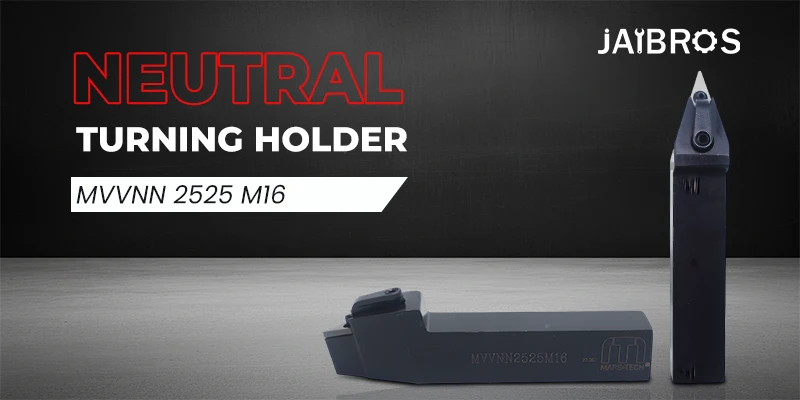
Learn how to choose the right VNMG tool holder for CNC machining. Understand holder angles, neutral designs, and insert compatibility for precision turning.
Selecting the Best VNMG Tool Holder for Accurate CNC Turning
Selecting the correct turning tool holder is critical for achieving precision, stability, and efficiency in CNC machining. Among the various insert-based solutions available, VNMG tool holders are widely used due to their strength, versatility, and compatibility with negative-rake inserts. However, choosing the right holder configuration requires understanding machining requirements, tool geometry, and application type.
Understanding VNMG Tool Holder Basics
VNMG inserts feature a 35-degree diamond shape and are designed for negative rake turning applications. These inserts are commonly used for roughing, semi-finishing, and finishing operations. To utilize them effectively, a properly designed holder is required to support cutting forces and maintain insert stability.
A vnmg tool holder is engineered to clamp the insert securely while positioning it at an optimal cutting orientation. Its design directly affects machining accuracy, surface finish, and overall tool life.
Importance of Machining Application
Before selecting a holder, it is important to define the machining application clearly. External turning, internal turning, profiling, and finishing all impose different demands on tooling.
For external turning, rigidity and vibration resistance are essential. Internal turning requires slim yet stable designs to handle tool overhang. Choosing the correct vnmg tool holder based on application ensures better cutting control and consistent results across different CNC operations.
Role of Tool Holder Angle
One of the most important selection criteria is the holder angle. The vnmg tool holder angle determines how the insert engages with the workpiece material and how cutting forces are distributed.
Correct angle selection helps:
-
Improve chip flow
-
Reduce cutting pressure
-
Enhance surface finish
-
Minimise tool wear
Incorrect angles can lead to chatter, poor finish, and premature insert failure, especially during heavy-duty turning.
Neutral Tool Holder Configuration
A vnmg neutral tool holder is designed without a positive or negative cutting bias, making it suitable for a wide range of machining setups. This design allows flexibility in tool orientation and supports consistent performance across different CNC machines.
The vnmg neutral tool holder angle balances cutting forces evenly, which is particularly useful for operations involving interrupted cuts or variable material hardness. Neutral holders are often preferred in production environments where versatility and repeatability are required.
Insert Compatibility and Clamping System
Insert compatibility plays a vital role in tool performance. A high-quality vnmg insert holder ensures precise insert seating, which directly impacts cutting accuracy and surface finish.
Key factors to evaluate include:
-
Insert size compatibility
-
Clamping mechanism strength
-
Ease of insert indexing
-
Resistance to insert movement under load
Secure clamping reduces vibration and helps maintain dimensional accuracy throughout long machining cycles.
Machine Capability and Rigidity
CNC machine rigidity and spindle power should always be considered when choosing tooling. Machines with higher horsepower can handle aggressive cutting parameters, while lighter machines require more conservative setups.
Matching the holder design with machine capability allows the vnmg tool holder to perform efficiently without overloading the spindle or compromising tool life.
Material Type and Cutting Conditions
Different materials generate different cutting forces and heat levels. VNMG holders are commonly used for machining carbon steel, alloy steel, cast iron, and stainless steel.
For harder materials, selecting a rigid holder design and appropriate insert grade becomes even more important. Proper pairing ensures stable machining and reduces the risk of insert breakage.
Benefits of Choosing the Right Holder
When selected correctly, a vnmg tool holder offers several advantages:
-
Longer insert life due to even load distribution
-
Improved surface finish
-
Reduced vibration and chatter
-
Consistent performance in CNC automation
These benefits contribute to lower tooling costs and higher production efficiency.
Common Mistakes to Avoid
Many machining issues arise from incorrect tool holder selection. Common mistakes include:
-
Ignoring holder angle requirements
-
Using incompatible inserts
-
Selecting holders without considering machine rigidity
-
Overlooking application-specific needs
Avoiding these errors ensures reliable turning performance and extends tool life.
Conclusion
Selecting the right VNMG holder is an important step toward achieving stable, accurate, and efficient CNC turning operations. By understanding factors such as machining application, holder angle, insert compatibility, and machine capability, machinists can significantly improve cutting performance and tool life. Paying attention to these details helps reduce vibration, maintain surface quality, and ensure consistent results across different materials and cutting conditions.
A well-matched vnmg tool holder supports smoother machining, better insert utilisation, and reliable productivity in CNC environments. When selected correctly, it becomes a long-term asset that enhances precision, minimises downtime, and improves overall machining efficiency.
FAQs
1. What is a VNMG tool holder used for?
It is used to hold VNMG inserts for external and internal CNC turning applications, providing stability and precision.
2. Why is tool holder angle important?
The angle affects cutting forces, chip flow, and surface finish, directly influencing machining performance.
3. What is a neutral tool holder?
A neutral holder allows flexible tool orientation and balanced cutting forces without directional bias.
4. Can VNMG holders be used for internal turning?
Yes, specially designed holders are suitable for boring and internal turning operations.
5. How do I choose the right VNMG holder for my machine?
Consider application type, holder angle, insert compatibility, machine rigidity, and material being machined.