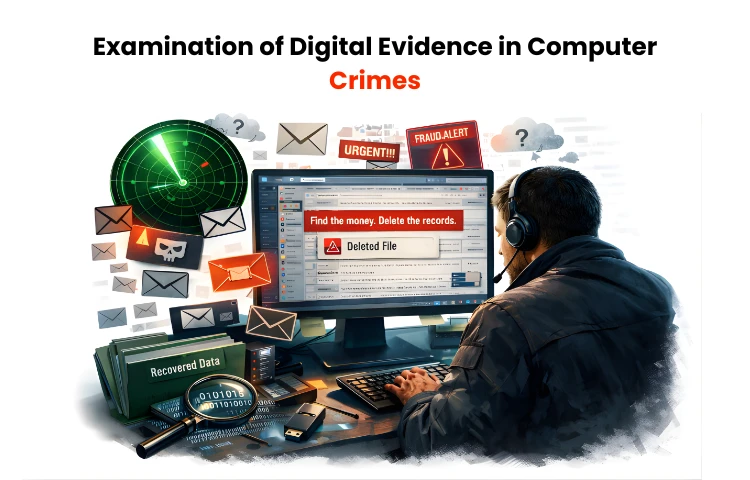
An investigator opens a seized computer in a fraud case. Inside are thousands of emails, deleted attachments, hidden links, and suspicious domains. Somewhere in that digital ocean is the message that proves intent.
But time is short. Pressure is high. One mistake can weaken the case.
If the examination of digital evidence in computer crimes feels confusing, this guide will walk you through it step by step in clear, practical language.
Digital crime rarely leaves fingerprints on glass. It leaves fingerprints in inboxes.
Why Examination of Digital Evidence in Computer Crimes Is So Challenging
The examination of digital evidence in computer crimes is difficult because criminals hide inside normal communication channels. They use emails, attachments, spoofed headers, and cloud accounts to blend in.
Imagine a squadron leader staring at a radar filled with hundreds of signals. Only one signal represents the real threat. Choosing wrong means mission failure.
Investigators face the same reality. Thousands of emails. Only a few matter.
When deleted files, encrypted attachments, or corrupted archives are added, the job becomes more complex. Evidence may exist, but it is buried. This is the reason we will be discussing a powerful email forensics tool MailXaminer.
Digital Evidence Analysis in Cybercrime Investigations: Where Manual Review Fails
Many teams begin with manual review. They open email files one by one. They search for simple keywords. They scroll for hours.
That approach worked when cases were small. It does not work today.
Digital evidence collection in cybercrime investigations now involves massive volumes of communication data. Manual methods create serious risks:
• Important evidence gets missed
• Metadata changes accidentally
• Deleted emails remain hidden
• Chain of custody becomes questionable
Think of it like searching a warehouse without shelves or labels. You may eventually find what you need, but the process is slow and unreliable.
In courts, evidence must remain intact. If digital data appears altered, its credibility can collapse. That is why preservation and structure matter from the very beginning.
Step 1: Preserve Digital Evidence Like a Crime Scene
Before analysing anything, evidence must be preserved.
Digital evidence is like a crime scene. If someone walks through it carelessly, footprints mix, and contamination begins.
Every email contains metadata. Metadata is like the shipping label on a package. It shows when the email was sent, who handled it, and the path it travelled.
Professional forensic methods use hashing techniques such as MD5. Think of hashing as a digital seal of trust. If the file changes even slightly, the seal breaks.
Without that seal, defence attorneys can question authenticity.
Preservation is not optional. It is foundational.
Step 2: Make a Digital Evidence Analysis in Cybercrime Investigations Structured
Once preserved, analysis must be strategic.
Investigators need to:
• Search by sender, domain, or IP address
• Examine suspicious URLs safely
• Identify patterns in communication
• Review attachments without risk
• Build timelines of activity
Imagine being a mission commander analysing a battlefield map. You do not blindly scan the entire territory. You zoom into critical coordinates.
Structured digital evidence analysis works the same way. Advanced search, pattern matching, and filtering enable investigators to narrow thousands of messages to a focused set of relevant evidence.
This reduces time and increases accuracy.
The Hidden Risk of Deleted and Corrupted Emails
Criminals often delete emails or intentionally damage files to hide evidence.
To a regular user, a corrupted email archive looks useless. To a forensic investigator, it may contain the strongest proof in the case.
Deleted messages can still leave traces. Suspicious attachments may contain hidden code. Header information can reveal the real sender behind a spoofed email.
When handled properly, even damaged data can become courtroom-ready evidence.
A Smarter Approach to the Examination of Digital Evidence in Computer Crimes
Modern investigations require tools built specifically for email forensics.
Instead of manually reviewing files, structured forensic software can process data from dozens of email platforms, examine hundreds of file types, and analyse communication patterns visually.
Investigators can:
• Recover deleted emails
• Trace malicious IP addresses
• Perform link analysis between individuals
• Create detailed timelines of events
• Maintain documented chain of custody
Professional Tools are designed to function like a digital crime lab for email investigations. It allows investigators to organise cases, preserve the integrity of evidence, analyse communication networks, and prepare structured exports suitable for legal proceedings.
Rather than using a magnifying glass, investigators operate with mission-grade clarity.
Common Mistake 1: Opening Evidence in Standard Email Clients
Regular email applications may automatically modify metadata. Even small changes can impact admissibility in court.
Common Mistake 2: Relying Only on Basic Keyword Searches
Criminal communication often avoids obvious words. Pattern-based analysis and relationship mapping are far more effective.
Investigator Checkpoint
Are you manually reviewing emails one by one?
Or are you conducting structured digital evidence analysis built for legal standards?
The difference affects speed, accuracy, and courtroom confidence.
Final Brief
Email remains one of the most critical sources of evidence in corporate espionage, phishing, internal policy violations, and serious criminal investigations.
The examination of digital evidence in computer crimes demands preservation, clarity, and intelligent analysis.
When investigators move from manual searching to structured forensic workflows, they shift from reactive guessing to controlled investigation.
In high-stakes cases, control is everything.