Hospitality PMS Market Outlook
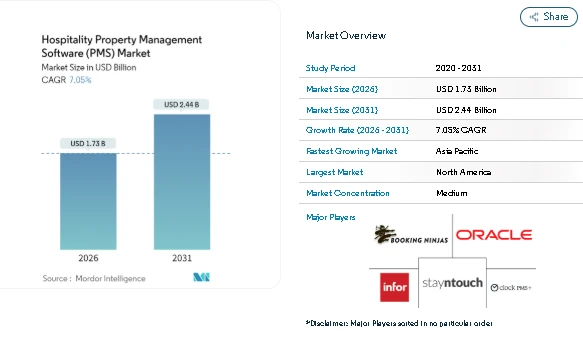
The Hospitality PMS Market is experiencing steady growth as properties of all sizes increasingly adopt property management software (PMS) to streamline operations, optimize revenue, and enhance guest experiences. In 2026, the market size is projected to reach USD 1.73 billion, growing from USD 1.62 billion in 2025. Forecasts indicate the market will reach USD 2.44 billion by 2031, reflecting a healthy CAGR over the period. This growth is supported by the ongoing replacement of legacy systems, accelerated adoption of cloud-based PMS platforms, and the integration of AI-driven revenue management tools.
Key Trends in the Hospitality PMS Market
Shift to Cloud-Based PMS Solutions
Cloud deployments now dominate the market, allowing hotels to eliminate expensive on-premise hardware and simplify software updates. Cloud PMS platforms offer real-time analytics, multitenant architectures, and centralized disaster recovery, which support better operational oversight across multiple properties.
AI-Driven Revenue Management
AI-powered revenue-management tools are increasingly embedded within PMS platforms. These modules help hotels optimize room rates, forecast demand, and suggest upselling opportunities. By automating repetitive forecasting tasks, AI enables staff to focus on enhancing guest experiences, while improving overall revenue per available room.
Integration-Friendly, API-First Architectures
Modern PMS platforms emphasize open APIs, allowing properties to integrate best-of-breed modules, including energy management, spa scheduling, and loyalty programs. This flexibility enables operators to tailor their software stack to their specific business needs while fostering a growing ecosystem of third-party solutions.
Challenges with Legacy Systems and OTA Fees
Despite growth, the market faces friction from properties running outdated booking engines or proprietary POS systems. Integration with these legacy systems can be costly and time-consuming. In addition, escalating commission fees from online travel agencies (OTAs) add complexity to revenue management, influencing PMS configuration and pricing strategies.
Market Segmentation in the Hospitality PMS Industry
By Deployment
-
Cloud
-
On-Premise
By Property Size
-
Small and Medium Enterprises (SMEs)
-
Large Enterprises
By Property Type
-
Hotels and Resorts
-
Motels and Lodges
-
Homestay Accommodations
-
Serviced Apartments
-
Other Property Types
By Ownership Model
-
Independent Properties
-
Chain-Affiliated Properties
By Functionality Module
-
Front Desk and Operations
-
Booking and Reservations
-
Revenue Management
-
Channel Management
-
Housekeeping
-
Other Modules
By Geography
-
North America
-
Europe
-
Asia-Pacific
-
Middle East and Africa
Key Players in the Hospitality PMS Market
-
Oracle Corporation
-
Booking Ninjas
-
Clock Software Ltd.
-
Infor Equity Holdings LLC
-
Stayntouch, Inc.
Conclusion
The Hospitality PMS Market is on a growth trajectory as cloud adoption, AI-driven revenue tools, and API-based architectures redefine property management capabilities. Looking ahead, the Hospitality PMS Market Forecast suggests robust expansion across all regions, with North America and Asia-Pacific leading adoption.
As more properties embrace modern PMS platforms, the market will witness broader digitization, increased operational efficiency, and enhanced guest experiences, solidifying the Hospitality PMS Market Share and reinforcing its position as a critical component of the global hospitality ecosystem. The combination of scalable cloud platforms, AI-assisted tools, and flexible deployment options ensures that the Hospitality PMS Market Growth will remain strong through 2031, creating opportunities for new entrants and established players alike.