Green Ammonia Market Overview
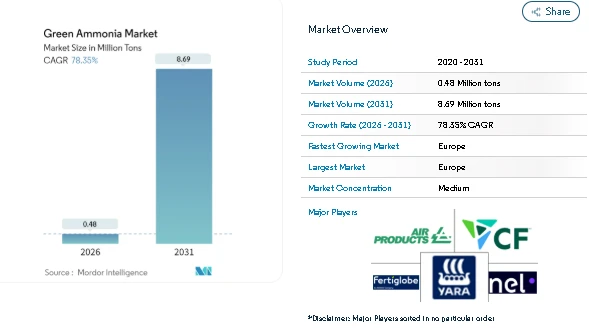
The Green Ammonia Market is experiencing rapid growth, driven by the increasing need for carbon-free energy solutions, sustainable fertilizers, and maritime fuel alternatives. The market is projected to grow from a size of 0.48 million tons in 2026 to 8.69 million tons by 2031, reflecting a CAGR of 78.35% over the forecast period. Several factors are contributing to this growth, including supportive policies in Europe, Japan, and India, declining renewable electricity costs, and the dual-use nature of green ammonia as both a fertilizer and a carbon-free fuel.
Key Trends in the Green Ammonia Market
Fertilizer Demand Driving Market Expansion
Agriculture remains the largest application segment of the green ammonia market. Developing nations are prioritizing domestic production to reduce reliance on imported fertilizers and enhance food security. Countries in Africa and South Asia are initiating renewable-to-ammonia projects to stabilize fertilizer supply chains and reduce import dependency.
Maritime Decarbonization Encouraging Adoption
The shipping sector is adopting green ammonia as part of efforts to reduce emissions in line with the International Maritime Organization’s targets. Several shipping companies have placed orders for ammonia-ready vessels, and co-firing mandates in power plants are creating additional fuel demand.
Hydrogen Carrier Applications
Green ammonia is gaining traction as a hydrogen carrier due to its storage and transport advantages. Countries like Germany, Japan, and South Korea are leveraging ammonia to meet hydrogen demand efficiently. New cracking technologies can recover almost all hydrogen with minimal energy penalties, allowing ammonia to serve as a bridge between renewable-rich regions and industrial consumption centers.
Policy and Sustainability Initiatives
Increasing adoption of climate-aligned sourcing policies by food processors and governments is also driving demand. Premium incentives for fertilizers with low lifecycle emissions encourage long-term supply agreements, which reduce financial risks and support investment. Sustainability requirements in Europe and North America are further integrating green ammonia into conventional supply chains, enhancing revenue visibility for producers.
Challenges: High Capital Requirements and Safety Concerns
The main hurdles include the high upfront costs of electrolyzers and retrofitting Haber-Bosch plants, which can represent a significant portion of project expenditure. Additionally, ammonia’s toxicity and corrosive nature present challenges for maritime bunkering and transport. r-term market growth.
Green Ammonia Market Segmentation
By Application:
-
Agriculture
-
Marine Fuel
-
Power Generation
-
Hydrogen Carrier
-
Other Applications (Industrial Feedstock, Steel Decarbonization)
By Geography:
-
Asia-Pacific
-
China
-
Japan
-
India
-
South Korea
-
ASEAN Countries
-
Rest of Asia-Pacific
-
North America
-
United States
-
Canada
-
Mexico
-
Europe
-
Germany
-
United Kingdom
-
France
-
Italy
-
Spain
-
Russia
-
NORDIC Countries
-
Rest of Europe
-
South America
-
Brazil
-
Argentina
-
Rest of South America
-
Middle East and Africa
-
Saudi Arabia
-
South Africa
-
Rest of Middle East and Africa
Key Players in the Green Ammonia Market
-
Air Products and Chemicals Inc. – Focuses on large-scale electrolysis and ammonia projects.
-
CF Industries Holdings Inc. – Expanding domestic and export-oriented green ammonia capacity.
-
Fertiglobe – Integrates renewable energy with ammonia production for efficiency.
-
Nel – Provides electrolyzer solutions for clean hydrogen generation.
-
Yara – Repurposes existing distribution channels to support green ammonia adoption.
Conclusion
The Green Ammonia Market is set for strong growth, driven by agriculture, maritime fuel, power generation, and hydrogen transport. Supportive policies, lower renewable energy costs, and technological improvements in electrolysis and ammonia synthesis are boosting adoption. The Green Ammonia Turbine Market is emerging as a key area for clean power, with market size, share, and trends closely watched by stakeholders. As projects and supply chains mature, the market offers long-term opportunities across the Green Ammonia Turbine Industry and ammonia value chain, supporting both energy and environmental goals.