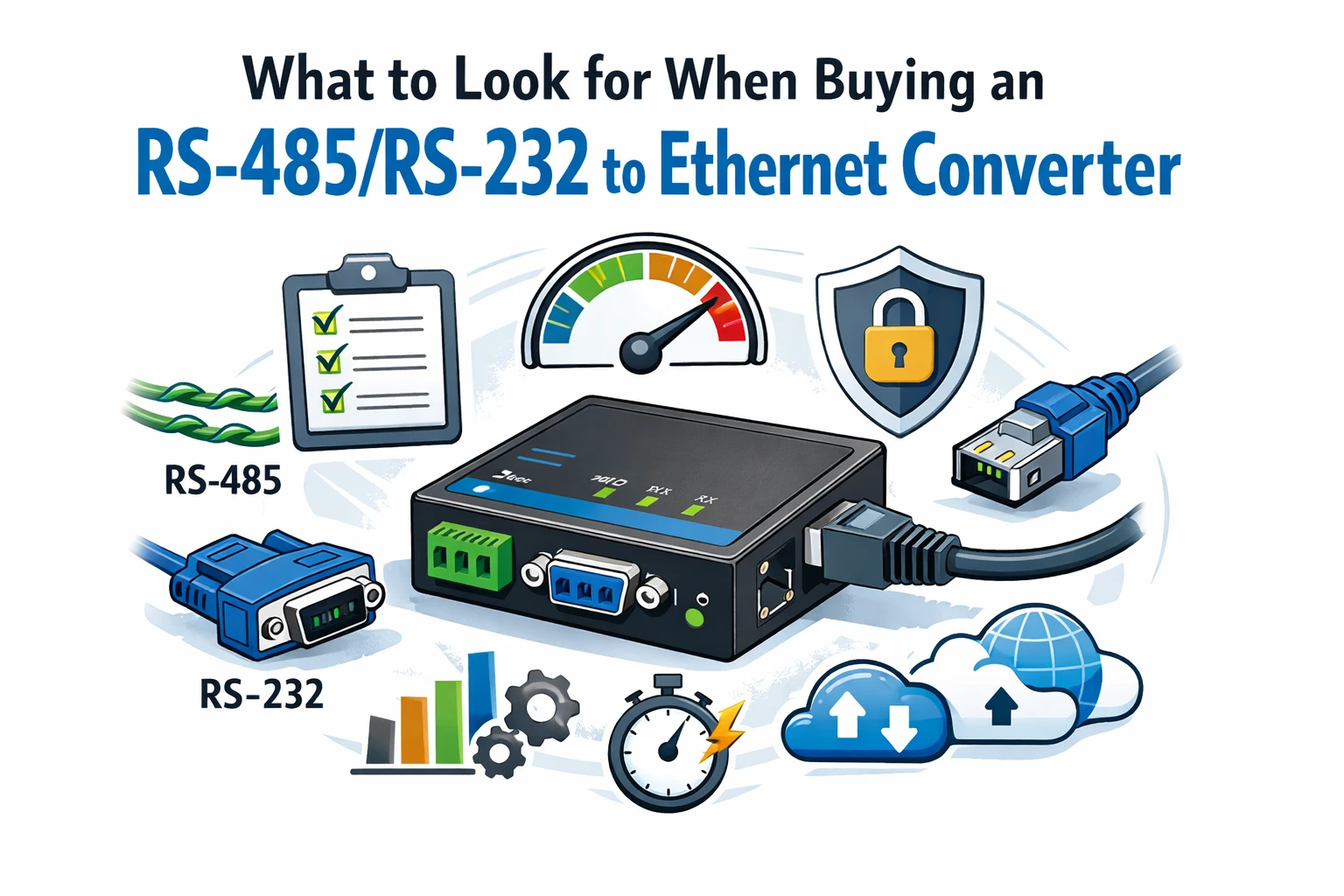
In industrial automation, building management, and IoT systems, many devices still communicate using serial protocols like RS-485 and RS-232. But as networks evolve toward Ethernet and IP-based communication, you often need a bridge — a serial-to-Ethernet converter — to connect these legacy devices to modern networks. Choosing the right converter is crucial for performance, reliability, and long-term scalability.
In this guide, we’ll walk through exactly what to look for when buying an RS-485/RS-232 to Ethernet converter, so you can make an informed purchase and avoid common pitfalls.
1. Know Your Serial Protocols: RS-485 vs RS-232
Before evaluating converters, understand the differences between the serial interfaces they support:
-
RS-232 – Common on older PCs and instruments, supports point-to-point communication with short cable lengths and single devices.
-
RS-485 – Supports multipoint connections (multiple devices on one bus), longer cable distances, and differential signaling that’s more noise-resistant.
What to check:
✔ Whether the converter supports both RS-485 and RS-232, or just one.
✔ If RS-485 is half-duplex or full-duplex (affects performance and wiring).
If your system uses both serial standards, a hybrid converter that supports both can simplify deployment.
2. Ethernet Connectivity & Network Compatibility
Since the whole purpose of a converter is network integration, how it connects and behaves on the network matters.
Ethernet Features to Consider
-
10/100 Mbps or Gigabit Ethernet – Gigabit can future-proof installations but is not required for low-data serial traffic.
-
PoE Support (Power over Ethernet) – Allows powering the converter through Ethernet cable, reducing cabling complexity.
-
Managed vs Unmanaged Network Support
-
Managed devices allow better control, VLAN tagging, and advanced network integration.
-
Unmanaged devices are simpler and cheaper but less flexible.
-
When buying, check if the converter supports the network standards you plan to use (e.g., DHCP, static IP, SNMP).
3. Protocol & Data Conversion Capabilities
Not all converters just “pass bits” from serial to Ethernet. Some add intelligent features, such as:
Protocol Support
-
Modbus TCP/RTU Gateway – Ideal when connecting Modbus devices on RS-485 to Ethernet-based Modbus TCP networks.
-
TCP/UDP Transparent Mode – Passes data directly without changing the protocol.
-
Web/Serial Configuration Tools – Simplify setup and firmware updates.
Evaluate whether your system needs simple tunneling or protocol translation.
4. Performance Factors
Performance may not be critical for low-rate sensors, but industrial systems often require:
✔ Low Latency – Especially where timing matters (e.g., process control).
✔ Throughput – Ensure the converter can handle the data rate of your devices.
✔ Buffer Size – Larger buffers help with network jitter and bursty traffic.
Manufacturers may list maximum throughput, but it’s also valuable to check real-world performance via reviews or datasheets.
5. Power & Installation Considerations
You’ll want to think about how and where the converter will be powered:
Power Options
-
DC Power Input – Common in industrial settings (e.g., 9–36 V DC).
-
PoE – Simplifies installations where ethernet is accessible but power isn’t.
-
Redundant Power Inputs – Boosts reliability.
Additionally:
✔ DIN-rail mounting is often preferred in control panels.
✔ Compact form factor may be useful in constrained spaces.
6. Environmental & Durability Specs
Industrial converters may be installed in harsh environments — dusty floors, hot control cabinets, or outdoor enclosures.
Check:
-
Operating Temperature Range – Wide ranges (e.g., -40 °C to +75 °C) are better for outdoor or industrial use.
-
Housing Protection Rating – Like IP30, IP40, or better for protection against dust and moisture.
-
Vibration & Shock Resistance – Important in heavy machinery environments.
If your installation is in non-controlled environments, industrial-rated devices are worth the investment.
7. Security Features
Networking legacy serial devices exposes them to new risks. Security becomes essential when converters are on corporate or production networks.
Security capabilities to look for:
-
Authentication & Password Protection
-
TLS/SSL for encrypted communication
-
Firewall rules / Access lists
-
Secure web interfaces
Even simple features like disable unused services can significantly improve security.
8. Manageability & Diagnostics
Troubleshooting serial-to-Ethernet connections can be tricky. Useful features include:
✔ Web admin interface – Easy access for setup and status checks.
✔ LED indicators – Show link/activity on serial and Ethernet ports.
✔ Event logs – Helpful for diagnosing failures.
✔ SNMP support – Useful in larger networks.
Being able to remotely monitor and manage converters saves time and reduces downtime.
9. Warranty, Support & Firmware Updates
Reliable support can make or break a deployment:
-
Manufacturer Warranty – Look for at least 1-2 years.
-
Technical Support Availability – Regional support locations matter.
-
Firmware Updates – Ensure the vendor regularly updates firmware for security and features.
Products from reputable vendors with active support communities reduce risk.
10. Price vs Value
Finally, consider cost — but don’t choose the cheapest option blindly.
Balance features vs price:
-
Basic converters are fine for simple point-to-point links.
-
More advanced models with protocol gateways, security, PoE, and industrial ratings cost more but offer better reliability and scalability.
Always check total cost of ownership, not just upfront price.
Conclusion
Buying an RS-485/RS-232 to Ethernet converter isn’t just about finding a box with the right ports — it’s about matching capabilities, performance, and reliability to your system’s needs. Focus on:
-
Serial support (RS-485/RS-232)
-
Ethernet & network features
-
Protocol handling
-
Performance requirements
-
Power and installation options
-
Environmental ruggedness
-
Security and manageability
-
Warranty and support
With the right converter, you’ll seamlessly bridge legacy equipment into modern Ethernet and IoT systems — boosting connectivity, flexibility, and future-proofing your infrastructure.