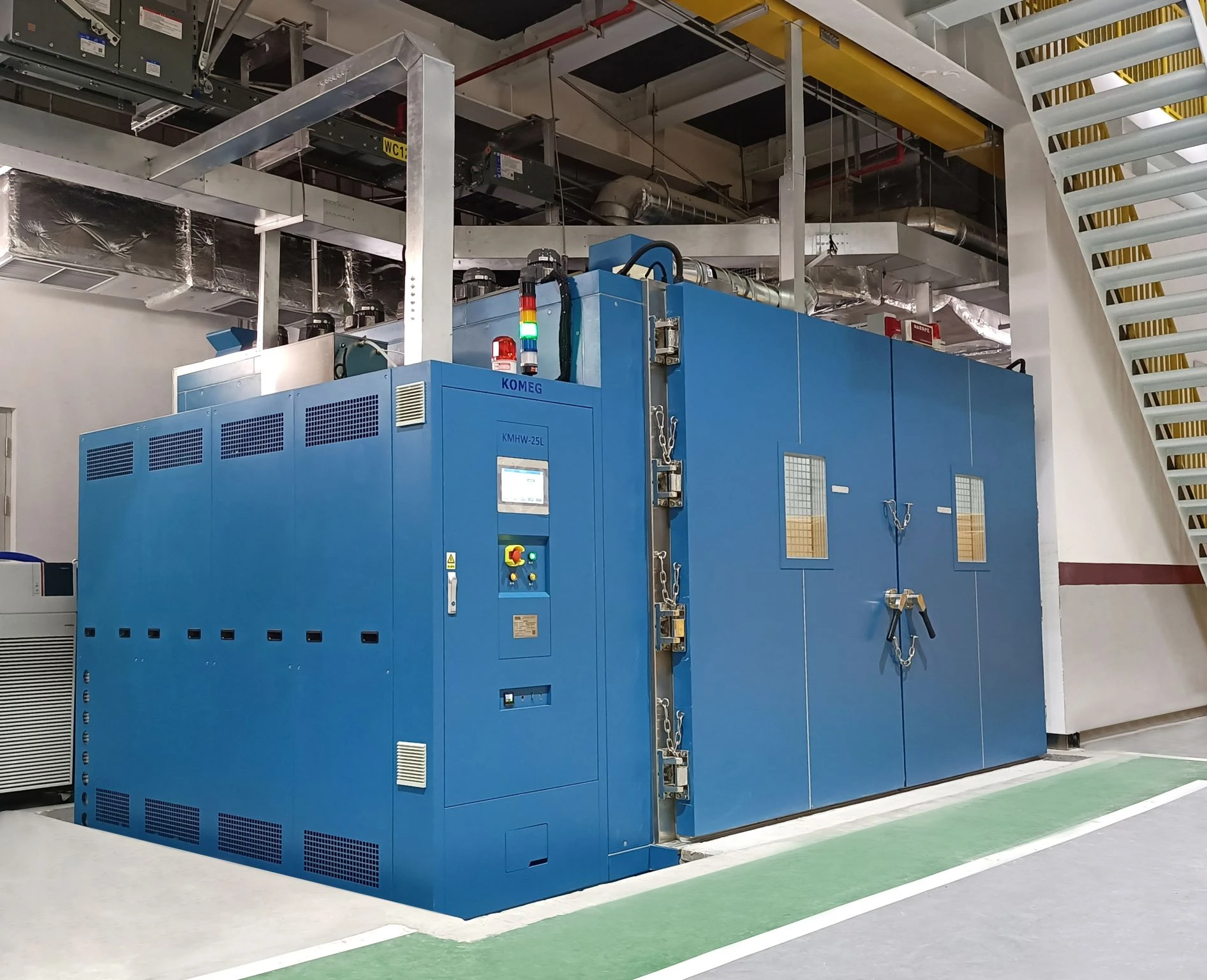
Walk-in environmental chambers are enclosed, walkable test systems designed to simulate extreme or controlled environmental conditions—such as temperature, humidity, dryness, dust, and altitude—for large, bulky, or irregularly shaped products. Their core value lies in verifying product durability, supporting quality control, and facilitating R&D across diverse industries.
These chambers find wide application in defense, aerospace, automotive components, electronic and electrical parts, plastics, telecommunications, food, metalworking, and pharmaceuticals. Key test scenarios include temperature-humidity cycling, battery reliability testing, dust/sand resistance, explosion-proof validation, altitude simulation, complex salt spray tests, and rapid temperature change experiments.
There are three primary types of walk-in environmental chambers, each tailored to specific testing needs:
Walk-In Humidity Chamber: Specializes in precise humidity control to test products’ moisture resistance. It features automatic humidity regulation, user-friendly operation, a sensitive humidification system, uniform humidity distribution, and built-in lighting for sample observation. Constructed with corrosion-resistant SUS#304 stainless steel and fireproof glass wool insulation, it is available in various sizes and customizable.
Walk-In Stability Chamber: Focuses on heat and cold resistance tests for large components, semi-finished products, or high-volume samples. It offers expandable internal volume, easy assembly/disassembly, a sturdy waterproof structure, low wind speed with high uniformity, explosion-proof lighting, and comprehensive safety protections (e.g., fault display, power cutoff, and troubleshooting guidance).
Walk-In Climate Chamber: Replicates artificial environmental conditions to accelerate exposure effects or simulate real-world scenarios. It serves multiple roles, including standalone environmental testing, sample preparation for further physical/chemical analysis, and providing controlled environments for specialized tests.
Pricing of walk-in environmental chambers is influenced by several factors: equipment power (a key determinant), brand, functional configurations, and external factors like market demand, climate conditions, and government regulations. Most manufacturers, such as KOMEG, offer factory-direct pricing and customization options to meet specific client requirements.

Walk-In Environmental Chambers: A Comprehensive Guide