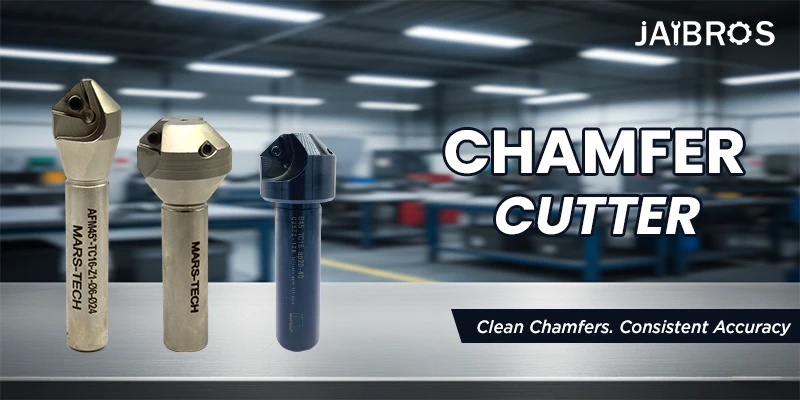
Discover the key differences between chamfer tools and deburring tools in CNC machining, including uses, benefits, and edge finishing applications.
Using a Chamfer Tool or Deburring Tool for CNC Edge Preparation
In CNC machining and precision manufacturing, edge finishing plays a critical role in product quality, safety, and performance. Machined components often leave sharp edges, burrs, or rough surfaces that can affect assembly, usability, and even tool life. To solve these issues, manufacturers commonly rely on chamfering and deburring processes. Although these methods may seem similar, they serve different purposes and require different tools.
Understanding the difference between a Chamfer Tool and a deburring tool helps machinists choose the right solution for specific applications, improve machining efficiency, and maintain consistent part quality. This guide breaks down their functions, advantages, and ideal use cases in CNC work.
What is Edge Finishing in CNC Machining?
Edge finishing refers to post-machining operations used to refine edges created during milling, drilling, or turning. Raw machine edges often contain burrs, micro-cracks, or sharp corners that can cause functional and safety issues.
Proper edge finishing helps to:
-
Improve part safety and handling
-
Ensure smooth assembly
-
Enhance dimensional accuracy
-
Increase product durability
-
Achieve professional surface quality
Chamfering and deburring are two of the most widely used edge-finishing techniques in CNC manufacturing.
Understanding Chamfering
Chamfering is a machining process that creates a defined angled surface on the edge of a part. This angle is straight and measurable, making chamfering ideal for precision-based applications.
A Chamfer Tool is designed to produce clean, uniform bevels that enhance both aesthetics and functionality. Chamfers are commonly added to external edges, internal holes, and mating surfaces to support better alignment and stress distribution.
Common applications of chamfering include:
-
Preparing edges for assembly
-
Creating lead-ins for fasteners
-
Reducing edge chipping
-
Meeting engineering drawing specifications
Angle selection depends on the application. For example, a 30-degree chamfer tool is often used for general edge preparation, while a 15-degree chamfer tool is preferred for light edge breaking in high-precision components.
Understanding Deburring
Deburring focuses on removing unwanted burrs rather than creating a defined edge geometry. Burrs are small, raised pieces of material formed during cutting or drilling operations. If left untreated, they can interfere with assembly, damage mating parts, or pose safety hazards.
Deburring tools are designed to:
-
Remove loose material from edges
-
Smooth sharp corners
-
Improve surface finish
-
Prevent component damage
Unlike chamfering, deburring does not aim for a specific angle or measurable edge. It is more about cleanup and refinement than precision shaping.
Key Differences Between Chamfering and Deburring
1. Purpose and Precision
The biggest difference lies in intent. Chamfering is a controlled, dimension-specific operation, while deburring is a corrective finishing step.
A Chamfer Tool produces a consistent, angled edge that is often specified in technical drawings. Deburring tools simply remove burrs without changing edge geometry significantly.
2. Edge Geometry
Chamfering creates a visible, straight bevel that improves fitment and load distribution. Deburring results in a softened edge with no defined angle.
For components requiring accurate lead-ins or alignment features, chamfering is the preferred method.
3. CNC Integration
Chamfering is commonly programmed directly into CNC operations, allowing edge finishing to be completed in the same machining cycle. Deburring is often performed as a secondary process, sometimes manually or using specialised automated tools.
A back chamfer tool allows internal or reverse-edge chamfering without flipping the workpiece, which is especially useful in complex CNC setups.
4. Application Flexibility
Deburring tools are versatile and suitable for various materials and shapes, especially where burr formation is inconsistent. Chamfering tools are selected based on specific angles, dimensions, and part requirements.
In vertical machining centers, a back tool for VMC improves productivity by enabling rear-edge finishing in a single setup.
5. Impact on Part Functionality
Chamfered edges improve assembly efficiency, reduce stress concentration, and enhance component lifespan. Deburred edges primarily improve safety and surface cleanliness.
A Tool is ideal when the edge itself plays a functional role, while deburring tools are best for general cleanup.
When to Use a Chamfering Solution
Chamfering is the right choice when:
-
Engineering drawings specify an edge angle
-
Parts require precise assembly guidance
-
Stress reduction is critical
-
Aesthetic finish matters
-
CNC automation is preferred
Using the correct chamfer angle ensures optimal results without unnecessary material removal.
When Deburring Is the Better Option
-
Deburring is suitable when:
-
Burrs vary in size and location
-
Edge geometry is not critical
-
Manual finishing is acceptable
-
Cost-effective cleanup is needed
Deburring tools are often used after drilling, milling, or tapping operations where burrs form unpredictably.
Choosing the Right Tool for CNC Operations
Selecting between chamfering and deburring depends on:
-
Part design requirements
-
Tolerance levels
-
Production volume
-
Machine capability
-
Material type
A Tool is preferred in high-precision CNC environments where consistency and repeatability are essential.
Productivity and Quality Considerations
Integrating chamfering into CNC programs reduces manual labour and inspection errors. Automated chamfering improves cycle efficiency and ensures uniform quality across large production batches.
Deburring, while necessary, may add extra steps to the workflow if not optimized properly.
Conclusion
Both chamfering and deburring play important roles in CNC edge finishing, but they serve distinct purposes. Chamfering delivers precise, functional edges that enhance assembly, safety, and durability, while deburring focuses on removing unwanted material for cleaner surfaces. Choosing the right approach improves machining efficiency and final product quality. The Chamfer Tool stands out as a critical solution for manufacturers seeking controlled, repeatable, and high-quality edge finishing.
About Jaibros:
Jaibros is a reliable manufacturer and supplier of premium CNC cutting tools, offering high-performance solutions designed for precision machining. With a strong focus on quality, innovation, and durability, Jaibros tools help industries achieve consistent results and long-term productivity.
FAQs
1. What is the main difference between chamfering and deburring?
Chamfering creates a defined angled edge, while deburring removes unwanted burrs without forming a specific geometry.
2. Is chamfering always required in CNC machining?
No, chamfering is used when precision, assembly support, or safety requirements demand controlled edge geometry.
3. Can chamfering be automated in CNC machines?
Yes, chamfering can be programmed directly into CNC operations for consistent and repeatable results.
4. Are deburring tools suitable for high-volume production?
They can be, but automated chamfering is often more efficient for large-scale CNC manufacturing.
5. How do chamfer angles affect performance?
Smaller angles are used for light edge breaking, while larger angles improve lead-in, assembly ease, and stress distribution.