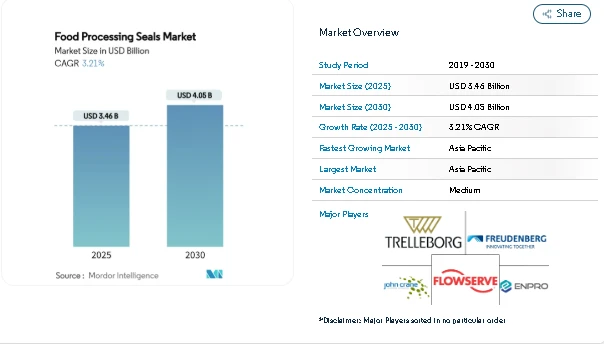
Food Processing Seals Market Overview
The Food Processing Seals Market is experiencing steady growth, driven by the increasing demand for hygiene, safety, and efficiency in food production processes. The market size is projected to reach USD 4.05 billion by 2030, up from USD 3.46 billion in 2025, reflecting a moderate growth trajectory during the forecast period.
Seals play a vital role in food processing, packaging, and cleaning systems, ensuring hygiene and reducing downtime. The Food Processing Seals Market Growth is driven by material performance, regulatory standards, and demand across sectors like meat, plant-based proteins, and beverages.
Market Drivers & Insights in the Food Processing Seals Market
Rising Demand for Shelf-Stable and Ready-to-Eat Foods
Urban lifestyles and smaller households are increasing the demand for convenience foods. High-temperature and high-pressure processing for shelf-stable meals require premium elastomer and PTFE seals that maintain stability and hygiene.
Stricter Regulatory Compliance
Global food-contact regulations, including FDA and European EC mandates, are pushing suppliers to provide certified materials with detailed documentation. Vendors with accredited labs and proven compliance gain a competitive edge.
Adoption of Automation and Smart Manufacturing
Industry 4.0 investments are driving continuous-run plants and predictive maintenance. Seals with precise compression, wear resistance, and digital monitoring capabilities are becoming increasingly important.
Shift Toward Plant-Based Protein Processing
Processing plant-based proteins involves harsh pH and abrasive conditions, creating demand for advanced EPDM and HNBR seals. Color-coded and metal-detectable seals are also gaining adoption to prevent cross-contamination.
Market Breakdown of Food Processing Seals
By Material Type:
-
Elastomers (EPDM, HNBR)
-
Polytetrafluoroethylene (PTFE)
-
Polyurethane (TPU)
-
Other materials (metal-detectable or X-ray-visible compounds)
By Seal Type:
-
O-rings
-
Gaskets
-
Lip seals
-
Mechanical seals
-
Diaphragms
-
Shaft/rotary seals
-
Hygienic clamp seals and tri-clamp gaskets
By Application:
-
Processing equipment (heat exchangers, extruders, homogenizers)
-
Packaging equipment
-
Cleaning systems (CIP/SIP)
-
Refrigeration and freezing equipment
By End-User:
-
Bakery and confectionery
-
Dairy products
-
Meat, poultry, and seafood
-
Beverages
-
Other industries (ready meals, fruits and vegetables, snacks)
By Geography:
-
Asia-Pacific (China, India, Japan, ASEAN countries)
-
North America (United States, Canada, Mexico)
-
Europe (Germany, France, UK, Italy, Spain, Russia, Nordic countries)
-
South America (Brazil, Argentina)
-
Middle East & Africa (Saudi Arabia, South Africa)
Leading Companies in the Food Processing Seals Market
-
Freudenberg
-
Trelleborg AB
-
Flowserve Corporation
-
Enpro Inc.
-
John Crane
Conclusion
The Food Processing Seals Market is expected to grow steadily through 2030, driven by regulatory compliance, automation, and changing end-user needs. Advances in elastomers, PTFE, and polyurethane, along with digital monitoring and hygienic design, are enabling more durable and efficient sealing solutions.
Growth is strongest in Asia-Pacific due to rising middle-class demand and investments in modern facilities. North America focuses on smart seals and equipment retrofits, while Europe