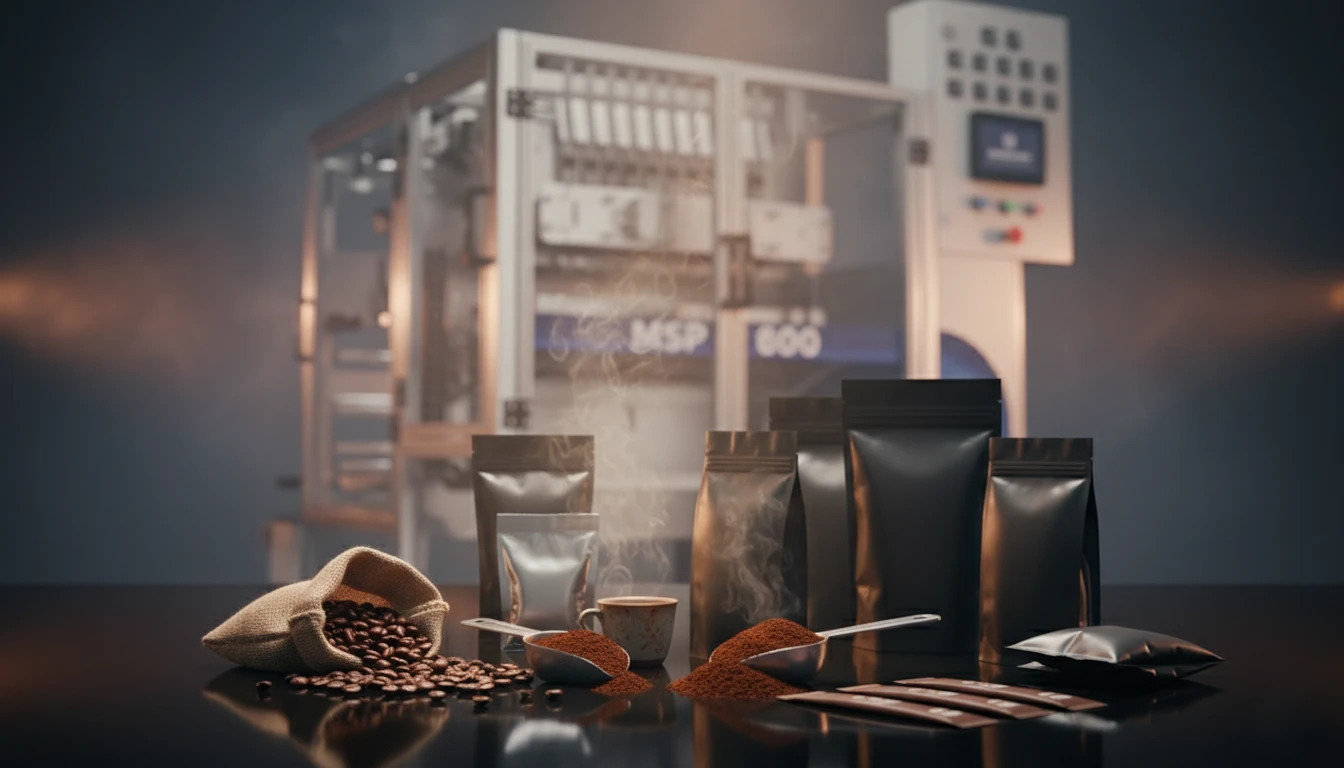
Imagine tearing open five bags from the same roast and being met with the exact same aroma each time, warm, familiar, and unmistakably right. The grind looks the same, the scoop weighs the same, and the brew tastes exactly how you remember it. That kind of repeatability does not happen by luck. It happens because a coffee packaging machine quietly manages every detail, from the moment beans drop into the hopper to the instant the bag is sealed shut.
These machines bring order to a process where even small variations can change the cup. Whole beans for home grinders, medium grinds for drip brewers, or fine espresso powder for single serve sticks are all handled with the same steady control. Weight, fill level, seal strength, and aroma stay in sync, batch after batch.
For small roasters filling limited runs for neighborhood cafés or large facilities sending out thousands of bags to retail shelves, consistency is what keeps people coming back. Accurate weighing, controlled dosing, reliable sealing, and gas flushing work together to remove the guesswork that comes with manual packing or aging equipment. The result is a uniform package that protects the roast profile you worked so hard to get right and delivers the same cup customers expect every single time.
Coffee packaging machines turn every roast into the same perfect cup, pack after pack.
Why Is Consistency the Foundation of Repeat Coffee Sales?
Consistency is the foundation of repeat coffee sales because customers buy the same brand expecting the same taste, strength, and experience every time, and even small differences in pack weight, grind size, or seal quality can break that trust. When one bag brews weak because it’s short on grounds or another tastes stale because air slipped past a weak seal, people switch brands fast. In a market where shoppers compare side by side, uniform packs mean the roast you cupped last week tastes exactly the same in their kitchen this week. Machines deliver this by measuring every gram, sealing every pouch with the same pressure, and flushing gas to the same level, removing human error that varies from operator to operator or shift to shift. For small roasters who rely on word-of-mouth or large brands who supply stores nationwide, consistent packs reduce returns, lower waste from rejects, and let the flavor you created shine through reliably, turning one-time buyers into loyal drinkers who reach for your label again and again.
How Do Precise Fillers Keep Weight Uniform Across Packs?
Precise fillers keep weight uniform by measuring coffee with tools that adjust in real time:
- Load-Cell Weigh Scales Under Hoppers — Check actual weight during every fill and send instant feedback to the auger or piston so each bag or stick contains the exact grams listed on the label, no more, no less.
- Servo-Controlled Auger Speed — Turn the screw at exact RPM to release grounds or beans steadily, preventing light packs that brew weak or heavy ones that waste product during long production runs.
- Multi-Head Combination Weighers — Use several small weighers working together to hit target weight faster and more accurately, especially useful for high-volume ground coffee lines.
- Volumetric Cups with Calibration — Drop fixed volumes of whole beans gently, adjusted for roast density so every pack stays consistent even when bean size varies slightly.
- No-Fill Skip Detection — Sensors see if product arrived and skip dosing on empty cycles, avoiding half-filled bags that reach customers and hurt brand reputation.
- Real-Time Adjustment Loops — Automatically correct for humidity or temperature changes that affect powder flow, keeping espresso grounds or flavored blends uniform shift after shift.
How Do Seal Controls Prevent Air Leaks in Every Pouch?
Seal controls prevent air leaks by making every closure strong and repeatable:
- Servo Jaw Pressure System — Applies the same force across the seal area on every bag or stick, creating uniform bonds that resist pressure during transport without weak spots.
- Digital Temperature Regulation — Holds heat steady for the exact dwell time needed by film type, avoiding cold seals that leak or hot ones that burn delicate roast oils.
- Ultrasonic Vibration Welding — Bonds film with high-frequency waves instead of heat, ideal for heat-sensitive flavored grounds or single-serve sticks that need clean seals.
- Double-Seal Backup Pass — Runs jaws twice on premium bean bags, adding extra protection against micro-leaks that let oxygen in over weeks on shelves.
- Seal Width and Strength Sensors — Measure every closure in real time and reject any below spec, ensuring only airtight packs move forward in production.
- Cool-Down Air Jets After Seal — Blow cool air on jaws instantly to prevent heat transfer to grounds near the seal that could alter flavor in the pack.
How Does Gas Flushing Create the Same Low-Oxygen Environment?
Gas flushing creates the same low-oxygen environment by replacing air inside each pouch with nitrogen or a custom mix:
- Inline Nitrogen Injection Nozzles — Flood the pouch just before sealing with 99.9 % pure nitrogen, pushing oxygen levels below 1 % for uniform protection across every pack.
- Precise Gas Volume Control — Servo valves deliver the exact amount needed for bag size and roast type, avoiding under-flush that leaves stale air pockets or over-flush that wastes gas.
- Oxygen Analyzer Verification — Samples sealed packs inline and rejects any above target level, guaranteeing consistent low-oxygen atmosphere in bean or ground coffee.
- Valve-Compatible Flush for Beans — Works alongside degassing valves so CO₂ escapes safely later while oxygen stays out from the start.
- Flush Timing Synchronization — Injects gas at the perfect moment in the cycle so every pouch gets the same treatment, even at high speeds.
- Recipe-Linked Gas Settings — Store different flush volumes for light roasts vs dark, ensuring each blend gets the ideal protection for flavor stability.
Consistency in coffee packaging is what turns a good roast into a great brand.
How Do Inline Quality Checks Catch Variations Early?
An automatic packaging machine uses inline quality checks to catch variations early so only perfect packs leave the line. Vision cameras photograph every seal at high speed, spotting gaps, wrinkles, or weak bonds before they reach boxing, while oxygen sensors sample gas levels inside finished pouches to confirm nitrogen flush worked correctly. Weight scales under conveyors verify each bag or stick matches the target down to the gram, rejecting outliers instantly without stopping flow. Metal detectors scan for foreign objects before sealing, and fill-level photo eyes ensure no empty or half-filled packs slip through. All these checks feed data back to the PLC, which adjusts auger speed, jaw pressure, or gas flow on the fly if trends appear. For small roasters running single-origin beans or large plants filling flavored grounds, these systems remove human judgment from quality control, delivering the same reliable pack every time and protecting the reputation built into the roast.
How Do Quick Changeovers Support Multiple Coffee Types?
Quick changeovers support multiple coffee types by letting you switch roasts fast:
- Tool-Less Forming Collar Release — Swap tube size in under five minutes when moving from whole bean bags to fine ground sticks, keeping downtime low.
- Recipe Memory with One-Touch Recall — Store settings for light roast, dark roast, decaf, or flavored blends, load instantly so production resumes quickly.
- Modular Filler Heads — Detach auger for grounds and attach piston for liquid coffee concentrates in minutes for product variety.
- Film Splice on the Fly — Join new rolls without stopping, seamless transition between matte bags for premium beans and glossy for flavored sticks.
- Hopper Quick Drain — Empty remnants fast between regular and decaf runs to avoid flavor carryover in next batch.
- Jaw Face Quick-Change Plates — Swap seal patterns for flat sticks or gusset bags when switching single-serve to bulk formats.
How Do Film Choices Affect Long-Term Consistency?
Film choices affect long-term consistency by controlling how well flavor stays protected:
- High-Barrier Laminates with EVOH — Block oxygen and light so delicate floral notes in light roasts remain stable for months on shelf.
- Metallized Films for Dark Roasts — Shield oily beans from UV damage that turns bold flavors flat over time.
- Moisture-Resistant Inner Layers — Prevent humidity from reaching grounds, avoiding clumps in espresso or drip blends during storage.
- Anti-Static Coatings — Reduce dust cling on film, cleaner fills for fine powders and stronger seals on stick packs.
- Recyclable Barrier Options — Maintain protection while meeting sustainability rules, consistent freshness with eco-friendly materials.
- Matte or Gloss Finishes — Allow clear branding without affecting barrier strength, uniform appearance across every pack.
How Do Sensors and Feedback Loops Keep Quality Steady?
Sensors and feedback loops keep quality steady by watching every pack and correcting issues instantly. Load cells under the fill tube weigh each bag or stick as it forms and adjust auger speed or piston stroke the next cycle if weight drifts even slightly. Vision cameras scan print registration so logos and dates line up perfectly across thousands of packs, rejecting misaligned ones before they reach boxing. Oxygen analyzers sample gas levels inside sealed pouches and fine-tune flush volume if oxygen creeps above target. Seal inspection cameras photograph every closure at high speed, measuring width and strength to catch weak spots early. Temperature probes on jaws ensure heat stays exact for film type, alerting if drift starts. All data feeds back to the PLC, which tweaks parameters automatically so the next pack corrects the last. For roasters running light single-origin beans or dark espresso blends, this closed-loop control removes variation, delivering the same weight, seal, and protected flavor in every pack that leaves the line.
How Does Easy Cleaning Support Flavor Purity?
Easy cleaning supports flavor purity by preventing carryover between roasts:
- Tool-Free Hopper Removal — Detach in seconds to rinse between hazelnut and plain coffee runs, no residue left behind.
- Open-Frame Stainless Design — Reach every surface quickly for wipe-down after flavored grounds or sticky syrup sticks.
- Quick-Detach Auger or Piston — Swap fillers fast when moving from powder to liquid coffee concentrate, keeping lines pure.
- Sloped Internal Paths — Let water and dust drain away easily after cleaning, no trapped particles in espresso grind lines.
- CIP Spray Ports Option — Automated rinse for hard-to-reach areas in high-volume flavored stick production.
- UV Film Treatment Inline — Sterilizes material before fill, extra layer against contamination in decaf or organic runs.
How Does Scalability Match Future Growth?
Scalability matches future growth by letting the machine expand as your coffee business grows:
- Add-On Lanes for Higher Output — Start single-lane for small batches and add lanes later when stick pack or ground coffee sales increase.
- Speed Upgrade Modules — Boost from 80 to 150 bags/min with motor or jaw upgrades as retail demand rises.
- Filler Expansion Ports — Add nitrogen flush or valve applicators when moving to premium whole-bean lines.
- Frame Strength for Heavy Loads — Built to handle larger bags or higher throughput without new purchase as volumes grow.
- Software Updates for New Features — Add recipe memory or data tracking remotely as product range expands.
- Conveyor Extensions — Lengthen infeed or outfeed easily when integrating more roasters or cartoning.
Consistency is what turns a great roast into a great brand.
Comparison Table of Coffee Packaging Machines
Here’s a comparison of four real Unified Flex coffee packaging machines focused on consistency:
| Feature | VFFS Vertobagger Hornet | VFFS Vertobagger Hornet XL | VFFS Vertobagger Falcon | VFFS Vertobagger 2.0 |
| Max Bags Per Minute | 80 continuous with weigh feedback for grounds, steady uniform output | 50 continuous with wide film for bulk beans, reliable portion control | 100 continuous for flavored roasts, fast consistent dosing | 150 continuous high-speed for premium blends, maximum repeatability |
| Maximum Bag Width | 13" suits standard ground or bean bags, everyday uniform sizing | 18" ideal for family bulk or valve packs, generous capacity | 13" optimized for retail coffee pouches, balanced speed | 13" engineered for exact dosing in high-barrier films at top rates |
| Maximum Bag Length | 20" accommodates tall stand-up or flat packs, extended uniform reach | 30" handles oversized roast or catering bags, extra room | 20" fits most retail formats efficiently every cycle | 15" designed for fast, identical sealing on premium pouches |
| Dosing Accuracy | ±0.5 g with servo auger for fine grounds, consistent every fill | ±1 g with volumetric for whole beans, reliable weight control | ±0.3 g with multi-head for flavored mixes, precise repeatability | ±0.2 g with servo combo for single-origin, ultimate uniformity |
| Seal Consistency | Servo heat jaws + sensor check for airtight grounds, no variation | Servo + ultrasonic option for cool bean seals, stable protection | Pneumatic jaws + vision verify for flavored packs, uniform strength | 6-servo motion + band sealer for perfect valve or plain seals |
| Best Consistency Application | Medium roasts needing reliable weight and aroma lock | Large bean or bulk grounds requiring stable shelf performance | High-volume flavored or decaf with exact dose every pack | Ultra-fast premium roasts preserving delicate notes identically |
FAQs About Coffee Packaging Machines
How do machines keep weight consistent?
Weigh cells and servo fillers adjust dosing instantly for exact grams in every pack.
Can they handle beans and grounds the same?
Yes, quick auger or volumetric swaps maintain uniform fills across roast types.
Do valves affect consistency?
Valves apply precisely inline, keeping seal strength and gas release identical.
How fast can they pack while staying uniform?
From 50 bags/min on XL to 150/min on Vertobagger 2.0 with full checks.
Why is seal uniformity important?
Even seals block oxygen completely, preserving the same fresh flavor pack after pack.
All in All
Coffee packaging machines are the reliable force that shapes consistency across every pack, turning your roasted beans, ground blends, or single-serve sticks into uniform portions where weight, seal strength, aroma protection, and appearance stay exactly the same from the first bag to the thousandth. With servo dosing that hits the exact gram every time, weigh feedback that corrects variations instantly, ultrasonic or heat seals that close airtight without fail, and sensors that watch every step, they remove the ups and downs that come from manual work or old equipment. Small roasters get factory-level uniformity for their limited releases, large plants maintain it across multiple lines and shifts, and every size in between enjoys quick changeovers, easy cleaning, and scalable output that grows with demand. Add nitrogen flush for months of stable taste, precise valve placement for degassing, or recipe memory for dozens of blends, and these machines become the quiet reason customers trust your coffee to taste the same great way every morning. Choose the features that match your roast style and volume, and let consistency become the strength that keeps your coffee on repeat order lists, cup after perfect cup.
Read More Article At Globbook!