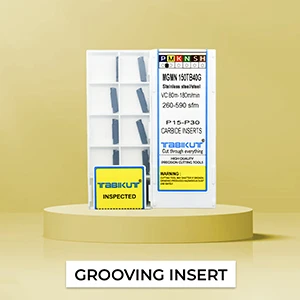
Discover the best grooving insert materials for high-performance machining, including grooving insert type, face grooving inserts, 1 mm grooving insert, and cnc grooving insert options.
How to Select the Best Grooving Insert Material for Industrial Use
High-performance machining demands precision, durability, and consistent tool life. In groove cutting operations, material selection plays a critical role because the cutting edge works in a confined area with high heat concentration. Choosing the right grooving insert material improves surface finish, reduces downtime, and increases overall productivity. Understanding different material options helps manufacturers achieve better results in demanding CNC environments.
Why Insert Material Matters in Grooving Operations
Grooving is more challenging than standard turning because chip evacuation is restricted and cutting pressure is concentrated on a narrow edge. A high-quality grooving insert must resist thermal shock, abrasion, and mechanical stress. If the material is not suitable for the workpiece, problems such as chipping, excessive wear, and vibration may occur.
Material selection directly affects machining speed, tool life, and consistency. Therefore, manufacturers must evaluate performance characteristics before making a purchase decision.
Carbide: The Most Widely Used Material
Carbide is the industry standard for most machining applications. It provides an ideal balance of hardness and toughness, making it suitable for steel, stainless steel, and cast iron. A carbide-based grooving insert performs well in both roughing and finishing operations.
Carbide inserts are durable, cost-effective, and capable of handling moderate to high cutting speeds. For general-purpose machining, carbide remains the first choice.
Coated Carbide for Enhanced Performance
Coated carbide inserts offer improved wear resistance and thermal stability. Advanced coatings reduce friction and allow higher cutting speeds without premature wear. In high-speed machining environments, a coated grooving insert delivers longer service life and improved chip control.
These inserts are especially useful in dry machining or when cutting tough materials that generate excessive heat.
Cermet Inserts for Superior Surface Finish
Cermet inserts combine ceramic hardness with metallic toughness. They are mainly used for finishing operations where smooth surface quality is required. Although not as tough as carbide, cermet provides stable cutting performance and reduces built-up edge formation.
For precision components where appearance and dimensional accuracy matter, cermet is a strong option.
Ceramic and CBN for Extreme Applications
Ceramic inserts are ideal for machining hardened steels and cast iron at very high speeds. They maintain hardness even at elevated temperatures but require stable machine conditions to avoid chipping.
Cubic Boron Nitride, commonly known as CBN, is one of the hardest materials available. It is suitable for machining hardened materials above 45 HRC. Though expensive, CBN ensures exceptional wear resistance and precision in high-value manufacturing.
Understanding Different Grooving Insert Type Options
Selecting the right grooving insert type is equally important as choosing the material. External inserts are used for machining grooves on shafts, while internal inserts are designed for cutting inside bores.
For front-side machining, face grooving inserts are commonly used to create grooves on component faces such as flanges and housings. When narrow and precise grooves are required, a 1 mm grooving insert is ideal for tight-tolerance applications.
In automated production environments, a CNC grooving insert ensures consistent positioning, accurate repeatability, and stable performance at high speeds.
Comparing Insert Materials for Performance
Each insert material offers unique benefits. Carbide provides versatility and affordability. Coated carbide increases wear resistance and durability. Cermet improves finishing quality. Ceramic handles extreme heat conditions. CBN delivers unmatched hardness for hardened materials.
The best material depends on workpiece hardness, cutting parameters, and production volume. Evaluating these factors ensures optimal machining efficiency.
Common Mistakes When Selecting Insert Materials
Many manufacturers focus only on price rather than performance. Using a cheaper insert in demanding operations can increase downtime and replacement frequency. Ignoring workpiece hardness and machine stability also leads to premature failure.
Selecting the correct material based on application requirements ensures long-term cost savings and productivity improvement.
Future Trends in Insert Materials
With advancements in coating technology and material science, inserts are becoming more durable and efficient. Nano-coatings, improved chip breakers, and hybrid materials are enhancing performance in modern CNC systems.
As manufacturing evolves, selecting the right insert material will continue to be a key factor in achieving competitive productivity levels.
FAQs
1. What is the best material for a grooving insert?
Carbide and coated carbide are the most commonly used materials due to their durability and cost-effectiveness.
2. When should face grooving inserts be used?
They are ideal for machining grooves on the front surface of components like flanges and hydraulic parts.
3. Is a 1 mm grooving insert suitable for heavy-duty machining?
No, it is mainly used for narrow and precision grooves in light to medium applications.
4. What makes a CNC grooving insert different?
It is optimized for CNC machines, offering better repeatability and consistent performance.
5. How do I choose the correct grooving insert type?
Consider groove width, workpiece material, cutting speed, and machine stability before making a decision.
Conclusion
Selecting the right insert material is essential for achieving high-performance machining results. From carbide to advanced CBN grades, each material serves a specific purpose. A well-chosen grooving insert enhances productivity, ensures surface quality, and reduces operational costs. Careful evaluation of machining requirements helps manufacturers make informed and profitable tooling decisions.
About Jaibros
Jaibros is a trusted supplier of premium CNC cutting tools and industrial solutions. Known for quality, precision, and reliability, Jaibros provides advanced tooling products designed to meet modern manufacturing needs and deliver consistent performance across industries.