
Introduction to the Industrial Lubricants Market
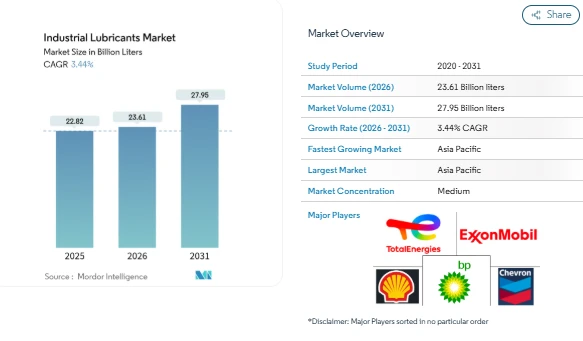
The global Industrial Lubricants Market is steadily growing, with the market size expected to expand from 23.61 billion liters in 2026 to reach 27.95 billion liters by 2031. This growth reflects increasing demand across heavy industries, power generation, and emerging smart manufacturing setups. Industrial lubricants are critical in reducing friction, wear, and energy loss in machinery while also offering heat transfer, corrosion protection, and sealing functions. The industrial sector increasingly relies on these fluids to improve equipment uptime, ensure energy efficiency, and meet environmental compliance requirements.
Emerging Trends in the Industrial Lubricants Market
Rising Demand from Wind and Renewable Energy
One of the most noticeable Industrial Lubricants Market Trends is the surge in specialized oils for wind-turbine gearboxes. Offshore and onshore wind farms require synthetic oils with anti-wear and corrosion inhibitors, water-separation properties, and consistent viscosity across wide temperature ranges.
Industry 4.0 and Automation Driving Lubrication Intensity
The adoption of smart manufacturing and automation increases the need for precision lubricants. Equipment operating at high speeds and temperatures requires fluids with narrow viscosity tolerances that do not interfere with sensor systems. Automated lubrication systems can now dispense fluids based on real-time data from temperature and vibration sensors, optimizing consumption and boosting operational uptime.
Shift Toward Synthetic and Semi-Synthetic Oils
Labor shortages and extended maintenance cycles are encouraging industries to adopt long-drain oils that last several thousand operating hours, compared with traditional mineral oils. Synthetic and semi-synthetic formulations provide enhanced oxidation resistance, suppress sludge formation, and maintain stability under extreme temperatures. Semi-synthetic oils balance performance and cost, making them suitable for cement, textile, and other price-sensitive operations.
Industrial Lubricants Market Segmentation
By Product Type
-
Engine Oil
-
Hydraulic and Transmission Fluid
-
Metalworking Fluid
-
General Industrial Oil
-
Gear Oil
-
Grease
-
Process Oil
-
Others
By End-User Industry
-
Power Generation
-
Heavy Equipment
-
Food and Beverage Processing
-
Metallurgy and Metalworking
-
Chemical and Process Industries
-
Other Industries (Pulp and Paper, Marine, etc.)
By Geography
Asia-Pacific
-
China
-
India
-
Japan
-
South Korea
-
Indonesia
-
Thailand
-
Vietnam
-
Malaysia
-
Rest of Asia-Pacific
North America
-
United States
-
Canada
-
Mexico
Europe
-
Germany
-
United Kingdom
-
France
-
Italy
-
Spain
-
Russia
-
Rest of Europe
South America
-
Brazil
-
Argentina
-
Colombia
-
Rest of South America
Middle-East and Africa
-
Saudi Arabia
-
United Arab Emirates
-
South Africa
-
Egypt
-
Rest of Middle-East and Africa
Key Players in the Industrial Lubricants Market
-
Shell plc
-
Exxon Mobil Corporation
-
BP p.l.c. (Castrol)
-
Chevron Corporation
-
TotalEnergies SE
Conclusion
The Industrial Lubricants Market continues to grow steadily, driven by expanding industrial operations, renewable energy deployment, and increased automation across manufacturing sectors. Key trends such as the shift toward synthetic and semi-synthetic oils, stricter environmental regulations, and automation-driven lubrication demand are shaping market dynamics.
The market’s segmentation across product types, end-user industries, and geographies provides multiple avenues for expansion, making the Industrial Lubricants Market Forecast optimistic for suppliers and end users alike. Continued attention to performance, regulatory compliance, and operational efficiency will remain central to achieving growth in this critical industrial sector.



