Overview of the Bahrain Construction Market
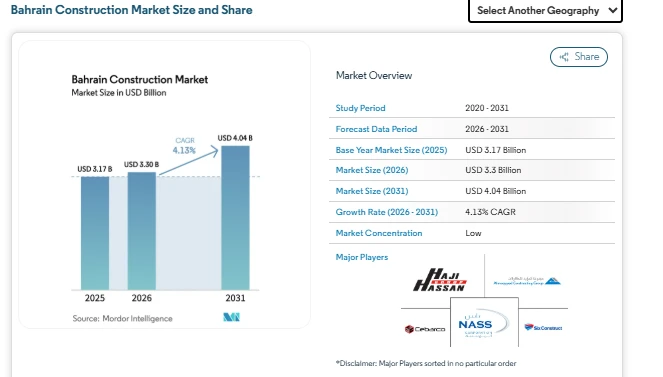
The Bahrain construction market size is estimated at USD 3.3 billion in 2026, rising from USD 3.17 billion in 2025. The market is projected to reach USD 4.04 billion by 2031, growing at a CAGR of 4.13% during the forecast period from 2026 to 2031.
This industry expansion is closely linked with national development plans under Vision 2030. Public-private partnerships, transport infrastructure projects, and residential development initiatives help to maintain a stable pipeline of construction activity. Major programs such as metro development, refinery upgrades, and housing schemes are creating opportunities across multiple segments of the market.
Bahrain Construction Market Growth Drivers
Infrastructure Investment Driving the Market
Infrastructure development remains one of the strongest drivers of the Bahrain construction market growth. The government has outlined a large infrastructure pipeline designed to strengthen transportation networks, utilities, and logistics connectivity across the country. Major transport initiatives, including metro development and causeway expansion projects, are helping to modernize urban mobility. These projects are expected to create new demand for engineering services, construction materials, and specialized contractors within the industry. Local contractors often focus on civil works and urban development projects, while international firms participate in complex engineering projects such as transport systems, energy infrastructure, and large-scale industrial construction
Housing Development Supporting the Industry
Housing demand continues to influence the Bahrain construction market share, particularly under government programs aimed at expanding residential availability. Plans to increase housing supply respond to population growth and the need to reduce waiting lists for subsidized homes. Mixed-income residential communities and transit-oriented developments are also being introduced near transport corridors. These projects improve land utilization and create balanced urban development. Private developers are increasingly participating in housing programs through partnership structures, further strengthening market growth. Foreign ownership rules that allow broader property access have also expanded the potential buyer base. This policy has helped support long-term residential demand within the industry.
Green Building Requirements in the Bahrain Construction Industry
Sustainability requirements are becoming an important part of the Bahrain construction market trends. Government guidelines now encourage green building standards for public developments, pushing developers and contractors to incorporate energy-efficient designs. Features such as solar power integration, water conservation systems, and sustainable materials are being introduced in several projects. Developers also see long-term operational savings and higher property value from environmentally responsible construction. These changes are gradually creating a dedicated sustainability segment within the market, attracting consultants and suppliers specializing in green building design.
Challenges Impacting Bahrain Construction Market
Despite steady development, the market also faces operational challenges. Fluctuations in the prices of key materials such as steel and cement can influence project budgets and contractor margins. Additionally, the availability of skilled labor remains a concern. Workforce localization policies limit foreign labor participation, creating a need for stronger domestic training programs. Contractors are responding by improving construction planning, adopting digital tools, and exploring modular building techniques to reduce labor intensity.
Check out more details and stay updated with the latest industry trends, including the Japanese version for localized insights: https://www.mordorintelligence.com/ja/industry-reports/construction-sector-in-bahrain-industry?utm_source=globbok
Bahrain Construction Market Segmentation
By Sector
-
Residential construction
-
Commercial construction
-
Infrastructure projects
By Construction Type
-
New construction projects
-
Renovation and refurbishment projects
By Construction Method
-
Conventional on-site construction
-
Prefabricated or modular construction
By Investment Source
-
Public sector investment
-
Private sector investment
By Geography
-
Manama
-
Muharraq
-
Rest of Bahrain
Key Players in the Bahrain Construction Market
-
Nass Corporation
-
Haji Hassan Group
-
Almoayyed Contracting Group
-
Cebarco Bahrain
-
Six Construct
Conclusion
The Bahrain construction market forecast indicates stable expansion supported by infrastructure programs, residential demand, and policy initiatives encouraging investment. Vision-based development strategies and public-private partnerships will continue to guide project activity across the kingdom. Infrastructure investment remains a central driver of market growth, particularly in transportation, logistics, and energy sectors. At the same time, housing development programs are helping diversify project activity and strengthen the residential segment of the industry. Partnerships between local and international companies are common, particularly for infrastructure and large urban developments
Sustainability guidelines and modern construction practices are also shaping the future market trends. Green building standards, modular construction methods, and digital planning tools are gradually becoming part of project execution. Overall, steady project pipelines, regulatory support, and rising private participation position the Bahrain construction market growth for consistent development during the forecast period. As infrastructure expansion continues and urban development progresses, the industry is expected to maintain balanced growth across residential, commercial, and infrastructure segments