Asia-Pacific MICE tourism Market Outlook
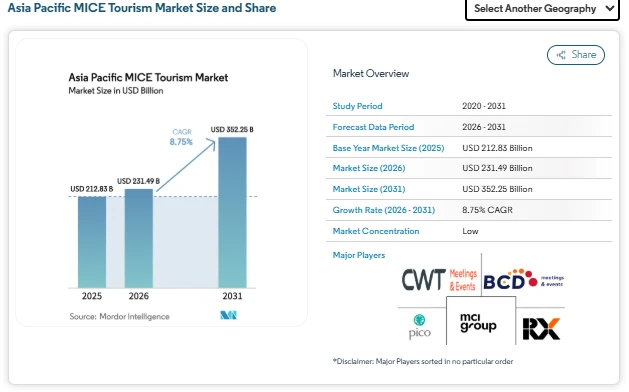
The Asia-Pacific MICE tourism Market size is expected to grow from USD 212.83 billion in 2025 to USD 231.49 billion in 2026, and it is projected to reach USD 352.25 billion by 2031, registering a CAGR of 8.75% during the forecast period. The steady recovery of corporate travel, increasing demand for cross-border meetings, and the return of international exhibitions are supporting this market growth.
The Asia-Pacific MICE tourism industry covers meetings, incentives, conventions, and exhibitions across a diverse group of economies. Countries such as China, India, Japan, Singapore, and Australia have strengthened their event infrastructure and tourism policies to support large-scale conferences and corporate gatherings. These initiatives are helping the market maintain strong momentum in event hosting and international participation.
Growth Driver in the Asia-Pacific MICE tourism Market
Corporate Travel Spending Supporting Market Growth
Corporate travel recovery remains a major factor influencing the Asia-Pacific MICE tourism Market growth. Businesses across sectors such as technology, finance, healthcare, and manufacturing are increasing spending on conferences, training programs, and business networking events. As companies expand their operations across Asia-Pacific countries, regional meetings are becoming essential for collaboration and knowledge sharing. Many companies are also locking in multi-year event schedules. This trend provides greater stability for event organizers, hotels, and venues. Corporate incentive programs, including employee recognition trips and sales conferences, are also contributing to the growth of the MICE tourism market in the region.
Hybrid Events Strengthening the Industry
Hybrid events have become a key trend shaping the Asia-Pacific MICE tourism industry. Event organizers are integrating virtual participation tools to allow remote attendees to join conferences, seminars, and exhibitions. This approach helps expand audience reach while maintaining physical networking opportunities. Technology solutions such as live streaming platforms, attendee engagement tools, and multilingual translation systems are making hybrid events more practical. These digital features also allow organizers to track audience participation and improve event planning for future editions.
Venue Expansion Across Major Cities
The expansion of convention and exhibition infrastructure is another important trend in the Asia-Pacific MICE tourism Market size outlook. Major cities across the region are investing in large-scale venues to attract global conferences and trade fairs. New convention centers, hotel meeting spaces, and exhibition halls are increasing the region’s capacity to host international events. These developments are helping cities compete for large conferences and industry exhibitions. Improved transportation networks and airline connectivity are also supporting cross-border event participation.
Sustainability Goals Influencing Event Planning
Sustainability considerations are increasingly influencing the Asia-Pacific MICE tourism Market share. Companies and event planners are selecting venues that meet environmental standards and energy efficiency requirements. Hotels and convention centers are adopting green certifications and sustainable event management practices to align with corporate sustainability targets. This shift is encouraging venues to reduce waste, improve energy usage, and support environmentally responsible event operations. As sustainability expectations increase, venues with strong environmental credentials are becoming more attractive for global conferences.
Asia-Pacific MICE tourism Market Segmentation
By Event Type
-
Meetings
-
Incentives
-
Conventions
-
Exhibitions
-
Hybrid Events
By Industry Vertical
-
IT and Telecom
-
Healthcare and Life Sciences
-
BFSI
-
Manufacturing
-
Energy and Utilities
-
Others
By Venue Type
-
Convention and Exhibition Centers
-
Hotels and Resorts
-
Corporate Campuses and Offices
-
Cruise and Alternative Venues
By Service Type
-
Planning and Execution
-
Accommodation
-
Transportation
-
Entertainment and Ancillary Services
By Organization Size
-
Large Enterprises
-
Small and Medium Enterprises
By Country
-
India
-
China
-
Japan
-
Australia
-
South Korea
-
Southeast Asia including Singapore, Malaysia, Thailand, Indonesia, Vietnam, and the Philippines
-
Rest of Asia-Pacific
Key Players in the Asia-Pacific MICE tourism Market
-
CWT Meetings & Events
-
BCD Meetings & Events
-
MCI Group
-
Reed Exhibitions Asia (RX)
-
Pico Far East Holdings
Conclusion
The Asia-Pacific MICE tourism Market growth is entering a period of steady expansion supported by rising corporate travel, stronger regional connectivity, and increasing demand for international conferences and exhibitions. Companies are recognizing the value of in-person engagement for networking, collaboration, and business development, which continues to support event demand across the region. Hybrid event models are also becoming a permanent part of the industry landscape. By combining physical participation with digital access, organizers can expand audience reach and improve event flexibility. This approach allows businesses to maintain engagement even when travel constraints arise.
Infrastructure investments across Asia-Pacific cities are strengthening the market outlook as well. Convention centers, hotels, and transport networks are improving their capacity to host international events, which supports the region’s position as a major destination for conferences and exhibitions. Overall, the Asia-Pacific MICE tourism Market forecast indicates sustained demand for meetings, incentives, conventions, and exhibitions across a wide range of industries. As companies continue to expand their regional operations and prioritize business engagement, the Asia-Pacific MICE tourism industry is expected to maintain steady development throughout the forecast period.