Corporate espionage investigations usually begin when a company realizes that confidential information has quietly reached a competitor. Product designs, research data, or financial plans suddenly appear outside the organization. Investigators then face a difficult question: how did the information leave the company?
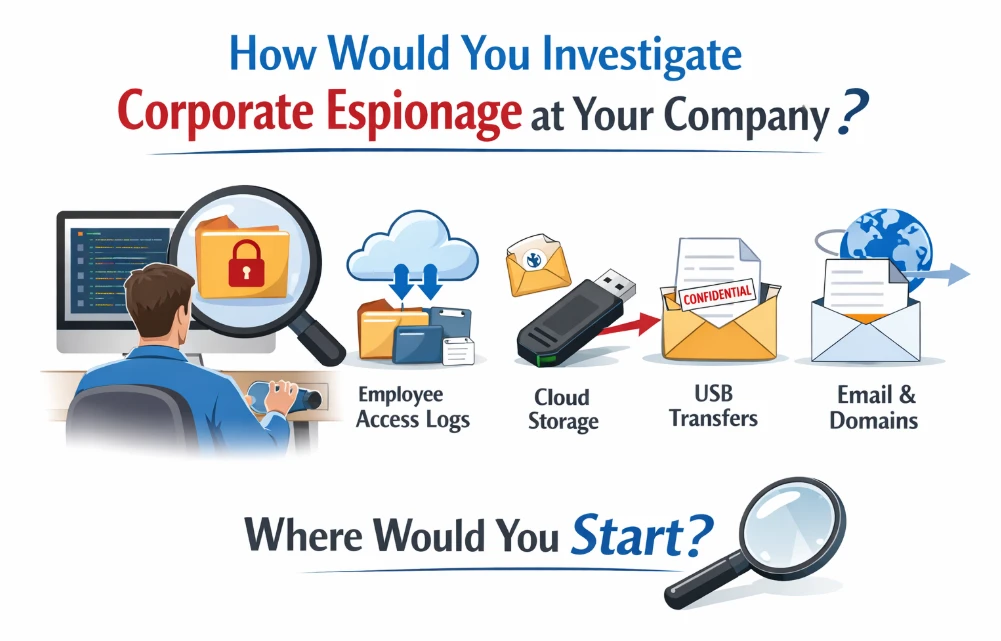
Sensitive business data can move through many channels such as cloud storage, messaging platforms, portable devices, and email systems. To uncover the truth, investigators must analyze digital evidence carefully and reconstruct the path the information followed.
This article explains how corporate espionage investigations work and how investigators identify the digital trail behind insider data leaks.
What Is Corporate Espionage
Corporate espionage, also known as industrial espionage, is the act of stealing confidential business information for competitive advantage. This information may include trade secrets, intellectual property, pricing strategies, customer lists, or product designs.
Organizations spend years developing valuable intellectual assets. When these assets are stolen, the consequences can be severe. Companies may lose market advantage, suffer financial losses, and face damage to their reputation.
Corporate espionage can occur through external cyberattacks or insider involvement. In many cases, the insider threat becomes the key focus because employees already have access to sensitive information.
How Corporate Espionage Typically Happens
Corporate espionage rarely happens through a single action. Instead, it usually involves a series of small activities that gradually move sensitive information outside the organization.
Some common methods include:
-
Uploading confidential files to personal cloud storage
-
Sharing screenshots or documents through messaging platforms
-
Copying files to external storage devices
-
Sending sensitive information through email communication
Each of these actions may appear harmless individually. However, when investigators connect them together, they often reveal a pattern of information leakage.
The Digital Investigation Process
When an organization suspects espionage, investigators follow a structured digital forensic process to identify the source of the leak.
Identifying Individuals with Access
The first step is identifying employees or departments that had access to the compromised information. These individuals are often referred to as custodians in forensic investigations.
For example, if confidential engineering designs were leaked, investigators will focus on employees within the research and development team.
Collecting Digital Evidence
After identifying relevant individuals, investigators collect digital evidence from multiple sources such as:
-
corporate email systems
-
cloud storage accounts
-
employee computers and devices
-
collaboration platforms
This data must be preserved carefully to maintain the integrity of the investigation.
Analyzing Communication Patterns
Once the evidence is collected, investigators begin analyzing communication activity. The goal is to determine how the confidential information moved from inside the company to an external party.
During this stage, investigators often discover unusual communication patterns, such as frequent contact with unfamiliar domains or sudden transfers of large attachments.
Why Email Evidence Often Reveals the Truth
Although corporate espionage can involve multiple channels, email frequently becomes the most valuable evidence source during investigations.
Email systems maintain detailed records of communication. These records include information about the sender, recipient, time of transmission, and the servers through which the message traveled.
This technical information, known as email metadata, allows investigators to reconstruct communication timelines even if messages are deleted or modified.
Emails also contain attachments that may include confidential reports, internal presentations, or product documentation. By analyzing these attachments and communication patterns, investigators can identify when sensitive data left the organization. To analyze this people use email analysis tools like MailXaminer
Visualizing Hidden Communication Networks
One challenge investigators face is analyzing thousands or even millions of email messages.
Reading each message individually would take months. Instead, investigators use techniques that visualize communication relationships between individuals and external domains.
This approach, commonly known as link analysis, maps how different people communicate with each other. When visualized as a network, unusual connections become easier to identify.
For example, if an employee frequently exchanges emails with an unknown external domain shortly before confidential information appears outside the company, investigators immediately recognize the pattern.
Specialized email investigation platforms help investigators generate these communication maps and examine the number of messages exchanged between parties.
Detecting Attempts to Hide Evidence
Individuals involved in corporate espionage sometimes attempt to hide their actions by altering digital records.
Investigators examine technical details within email metadata to detect such manipulation. Metadata fields contain information about when a message was created, modified, and transmitted.
If the timestamps show inconsistencies, investigators may conclude that the email record was altered after its original creation.
Detecting these inconsistencies helps investigators maintain reliable digital evidence during the investigation.
Searching Large Email Datasets Efficiently
Corporate espionage investigations often involve analyzing extremely large volumes of email data.
To locate relevant evidence quickly, investigators rely on advanced search techniques. These techniques allow them to find specific keywords, document references, or communication patterns within massive datasets.
Examples include searching for variations of sensitive terms, locating words that appear near each other within messages, or identifying structured patterns such as account numbers.
These methods help investigators reduce millions of messages to a smaller group of highly relevant communications.
Protecting Digital Evidence for Legal Proceedings
Forensic investigations must ensure that digital evidence remains unchanged throughout the investigation process.
Investigators use cryptographic verification methods to confirm that files have not been altered after collection. These digital fingerprints provide assurance that the evidence remains identical to the original data.
Maintaining this integrity is essential when investigation findings may later be presented in legal or regulatory proceedings.
Conclusion
Corporate espionage investigations require a comprehensive digital forensic approach because sensitive information can move through multiple communication channels. Investigators must analyze data sources such as cloud platforms, employee devices, collaboration tools, and email systems.
Among these sources, email often provides the clearest communication trail. By analyzing email metadata, attachments, and communication networks, investigators can identify how confidential information left the organization.
Modern email investigation platforms help investigators analyze large datasets, visualize hidden communication patterns, and uncover critical evidence faster during corporate espionage investigations.