Introduction
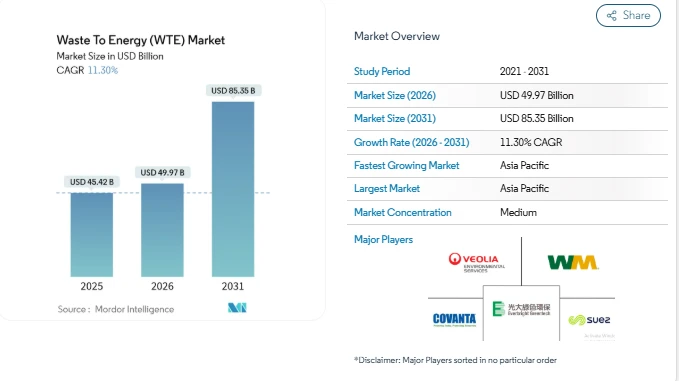
The global Waste To Energy (WTE) Market is witnessing steady growth, with market size expected to increase from USD 45.42 billion in 2025 to USD 49.97 billion in 2026. The market is projected to reach USD 85.35 billion by 2031, growing at a CAGR of 11.3% over the forecast period. Additionally, utilities and independent power producers are increasingly exploring long-term off-take agreements for biofuels, which mitigate merchant-price risks and strengthen the overall Waste To Energy (WTE) Market Forecast.
The Waste To Energy (WTE) industry is gaining attention as cities and industrial hubs face growing pressure to manage waste efficiently while generating renewable energy. Increasing mandates for municipal solid waste diversion, coupled with technology upgrades and circular-economy strategies, are reshaping the way energy is extracted from waste streams across the globe.
Market Drivers & Insights in the Waste To Energy (WTE) Market
Public-Private Partnership Expansion in China
Provincial authorities in China’s Greater Bay Area have earmarked CNY 45 billion to create 120,000 tonnes per day of new WTE capacity, backed by 25-year revenue guarantees. This model reduces debt-service risk for private investors and is being extended to the Yangtze River Delta and Chengdu-Chongqing Economic Circle. Bottom-ash recycling and higher-calorific feedstock have improved net energy generation per tonne, encouraging further investment.
European Green Taxonomy Incentives
The EU Green Taxonomy has enabled high-efficiency retrofits of legacy incinerators as sustainable investments. This has unlocked EUR 2.8 billion in green-bond proceeds, allowing plants to upgrade flue-gas cleaning and heat-recovery systems. For example, MVV Energie financed a condensing economizer that now supplies district heat to thousands of households, increasing plant efficiency and expanding revenue streams in the Waste To Energy (WTE) Market Trends.
India’s Landfill Diversion Policies
India’s 2024 amendment to the Solid Waste Management Rules prohibits unsegregated waste landfilling in cities above 100,000 population. This has led to the commissioning of biomethanation plants in Tier-2 cities, supplying compressed natural gas for municipal bus fleets and reducing diesel consumption significantly. Such initiatives are boosting the Waste To Energy (WTE) Market Growth in emerging economies.
Segmentation Overview
By Technology
-
Physical
-
Refuse-Derived Fuel
-
Mechanical Biological Treatment
-
Thermal
-
Incineration / Combustion
-
Gasification
-
Pyrolysis
-
Plasma-Arc
-
Biological
-
Anaerobic Digestion
-
Fermentation
By Waste Type
-
Municipal Solid Waste
-
Industrial Waste
-
Agricultural and Agro-industrial Residues
-
Sewage Sludge
-
Others
-
Commercial Waste
-
Construction Waste
-
Hazardous Waste
By Energy Output
-
Electricity
-
Heat
-
Combined Heat and Power (CHP)
-
Transportation Fuels
-
Bio-SNG
-
Bio-LNG
-
Ethanol
By End-user
-
Utilities and Independent Power Producers (IPPs)
-
Industrial Captive Plants
-
District Heating Operators
-
Transport Fuel Distributors
By Geography
-
North America
-
United States
-
Canada
-
Mexico
-
Europe
-
United Kingdom
-
Germany
-
France
-
Spain
-
Nordic Countries
-
Russia
-
Rest of Europe
-
Asia-Pacific
-
China
-
India
-
Japan
-
South Korea
-
ASEAN Countries
-
Rest of Asia-Pacific
-
South America
-
Brazil
-
Argentina
-
Colombia
-
Rest of South America
-
Middle East and Africa
-
United Arab Emirates
-
Saudi Arabia
-
South Africa
-
Egypt
-
Rest of Middle East and Africa
Leading Companies in the Waste To Energy (WTE) Market
-
Veolia Environnement SA – Combines collection and thermal treatment, focusing on efficient feedstock management.
-
Waste Management Inc. – Operates integrated WTE facilities across North America.
-
Suez SA – Offers end-to-end waste management and energy recovery services.
-
Covanta Holding Corp. – Expands into plasma-based slag solutions for metal recovery.
-
China Everbright Environment Group – Implements digital carbon-tracking and blockchain for enhanced revenue.
Conclusion
The Waste To Energy (WTE) Market is set for robust growth through 2031, driven by regulatory mandates, carbon-credit incentives, and increasing adoption of modern thermal and biological technologies. Asia-Pacific leads the market with aggressive capacity expansion in China and India, while Europe leverages retrofit incentives to upgrade existing facilities.
The market outlook indicates that WTE will play an essential role in global waste management strategies, helping reduce landfill dependency while providing reliable renewable energy, making it a crucial component of the Waste To Energy (WTE) Market Forecast and future energy mix.