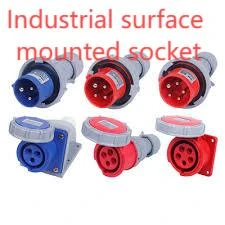
Choosing the right power outlet for production environments calls for close attention to durability and standards, and an Industrial surface mounted socket should meet not only electrical load requirements but also exposure and access needs when specified. In many facilities a poorly chosen Industrial surface mounted socket becomes a single point of failure — this guide explains how to pick, install, and maintain surface-mounted outlets so they keep operations running smoothly.
Assessing the Use Case and Environment
Start by documenting exactly how the outlet will be used: fixed machinery, portable tools, temporary test rigs, or outdoor equipment. Note environmental stresses such as continuous vibration, high humidity, chemical exposure, washdown procedures, and UV exposure. These conditions determine the demanded ingress protection (IP) and impact protection (IK) ratings. Also capture electrical parameters — voltage, phase, current, duty cycle, and whether isolation or lockable connections are necessary for safety or process control.
Mechanical Construction and Protection Ratings
Enclosure choice affects lifetime. Options include die-cast aluminum with corrosion-resistant coatings, 304/316 stainless steel for aggressive or sanitary environments, and glass-filled polyester for cost-effective corrosion resistance. Confirm IP rating (for example, IP66/IP67) for washdown and spray exposure, and IK rating for impact resistance where forklifts or carts may strike the unit. Pay attention to cover design: hinged lids with positive latches reduce foreign object ingress, while captive screws or tamper-resistant hardware improve security.
Mounting, Wiring, and Strain Relief Best Practices
Proper physical mounting reduces mechanical and electrical failures. Mount on a flat, rigid surface with vibration isolation when motors or compressors are nearby. Use correct gland sizes and cable clamps so conductors are strain-relieved and the enclosure seal is not compromised. Terminate conductors with the specified torque values and use anti-oxidation paste for aluminum conductors where applicable. Provide service loops for movable equipment and ensure cable routing avoids pinch points or heat sources.
Fly-Dragon Electrical Co., Ltd. Product Compatibility and Accessory Selection
Work with reputable suppliers to confirm plug-and-socket compatibility and to obtain certified drawings and accessory options. Consider integrated surge protective devices, circuit breakers, and fused isolators when specifying units for critical machinery. Accessories such as dust caps, locking collars, and color-coded covers improve serviceability and reduce cross-connection risk. A supplier with strong documentation and local support simplifies commissioning and long-term service.
Testing, Maintenance, and Lifecycle Management
Introduce a maintenance schedule tailored to duty and environment: monthly visual inspections, annual torque checks and insulation resistance testing, and thermal scans during commissioning and peak loads. Replace compressed gaskets and aging silicone seals proactively. Track failure modes in a logbook to identify systemic issues (loose terminals, ingress after impact, or UV-induced cracking). When calculating total cost of ownership, include expected downtime costs — a premium, properly specified surface-mounted unit often yields lower lifecycle cost.
Installation Checklist and Safety Considerations
Before ordering, confirm: mechanical enclosure material, IP/IK ratings, electrical ratings (voltage, current, phases), plug compatibility, gland sizes, locking/lockout capability, and any required certifications for hazardous areas. During installation, enforce lockout/tagout procedures, confirm earth continuity, and label circuits clearly. For food, pharmaceutical, or corrosive environments, select finishes and fasteners compatible with sanitizing agents and ensure traceability of materials for audits.
Conclusion and Further Resources
Selecting the correct surface-mounted outlet blends electrical specification with mechanical resilience and practical serviceability. Thoughtful choices at design and procurement stages prevent repetitive failures and save operational cost.