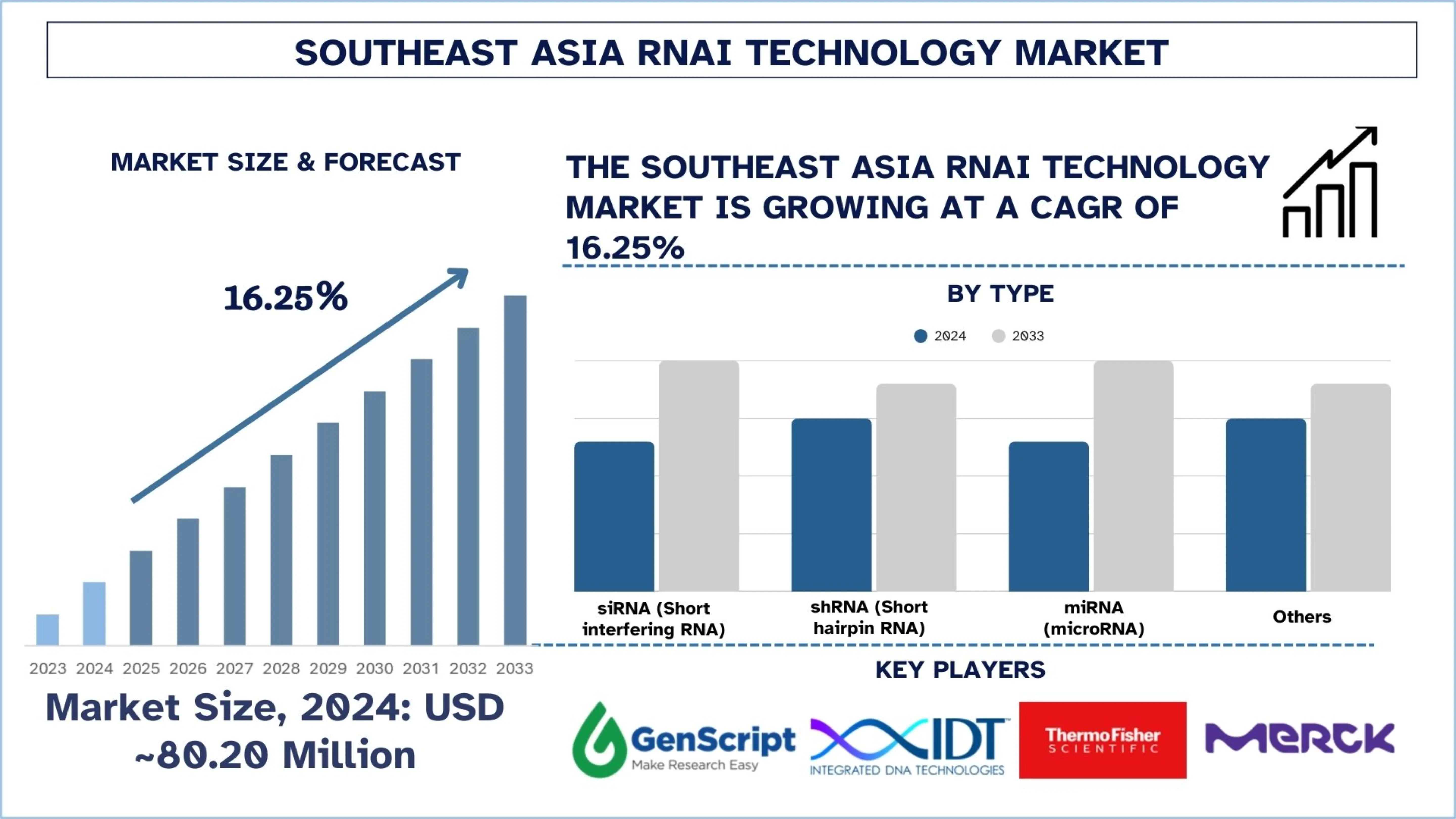
According to a new report by UnivDatos, the Southeast Asia RNAi Technology market is expected to reach USD Million in 2033 by growing at a CAGR of 16.25% during the forecast period (2025- 2033F). The market expansion is fueled by the increased investment in life sciences R&D, expanding genomics and precision medicine programs, and rising demand for efficient target validation tools. RNAi is being adopted in research and discovery processes due to government subsidies, academic-industrial partnerships, the need to shorten drug development cycles, and coherent research and development. Also, advances in RNA delivery technologies and increased validation in gene-silencing therapeutics are driving long-term commercial interest in the field. For example, on December 1, 2025, Precision Health Research, Singapore (PRECISE) announced a landmark partnership with companies Alnylam, Bayer, Boehringer Ingelheim, and Novo Nordisk, under Phase II of Singapore’s National Precision Medicine (NPM) programme. This pioneering initiative marks Singapore as the first country in Asia to establish a pre-competitive collaboration with leading pharmaceutical companies, contributing to a vibrant precision health ecosystem and reaffirming Singapore as a leading hub for precision medicine innovation in Asia.
Driver: Rising Life Sciences R&D Investment
The rising investment in life sciences research in Southeast Asia is a fundamental stimulus for the adoption of RNAi technology. Governments, academic institutions, and even private players are investing more funds in genomics, molecular biology, and advanced therapeutic research. The increased funding can facilitate broader applicability of RNAi in functional genomics and drug discovery at the earliest stages, when specific gene silencing is essential. The research grants and innovation programs are also enhancing the lab infrastructure and technical capabilities because of improved access to such programs. With the increasing intensity of R&D, RNAi is emerging as a commodity in the growing biomedical research environment in the region.
For example, on April 23, 2025, GenScript Biotech Corporation, a global leader in biotechnology research services, and NSG Bio, Singapore's premier biotech incubator, announced a strategic partnership designed to accelerate innovation and growth within the biotechnology sector. Through this partnership, GenScript will provide exclusive preferential rates along with technical guidance from experienced scientists across its extensive range of biotechnology services and products to NSG Bio residents.
Access sample report (including graphs, charts, and figures): https://univdatos.com/reports/southeast-asia-rnai-technology-market?popup=report-enquiry
Segments that transform the industry
· Based on the end-user, the market is segmented into pharmaceutical & biotechnology companies, academic & research institutes, contract development & manufacturing organizations (CDMOs), and others. Among these, the pharmaceutical & biotechnology companies segment held the dominant share of the Southeast Asia RNAi Technology market in 2024. The pharmaceutical and biotechnology companies contribute to market growth by increasing investment in R&D, diversifying their pipelines, and outsourcing RNAi-based discovery efforts. These companies in Southeast Asia are increasingly using RNAi to de-risk drug targets before clinical investment, thereby enhancing development efficiency. Their inclination toward scalable, validated RNAi systems enhances long-term commercial adoption across the value chain. For example, on April 23, 2025, GenScript Biotech Corporation, a global leader in biotechnology research services, and NSG Bio, Singapore's premier biotech incubator, announced a strategic partnership designed to accelerate innovation and growth within the biotechnology sector. Through this partnership, GenScript will provide exclusive preferential rates along with technical guidance from experienced scientists across its extensive range of biotechnology services and products to NSG Bio residents.
Region that transforms the industry
· Vietnam is expected to grow at a significant CAGR during the forecast period (2025-2033). This is propelled by booming pharmaceutical production, increased investment in life sciences, and biotech policy reforms. The growing demand for RNAi tools in functional genomics and drug discovery is driven by increased collaboration among universities, hospitals, and private research institutions. The rise in international partnerships and technology transfer, and government incentives for high-tech and biopharma R&D, drives the growth of the Vietnam Market.