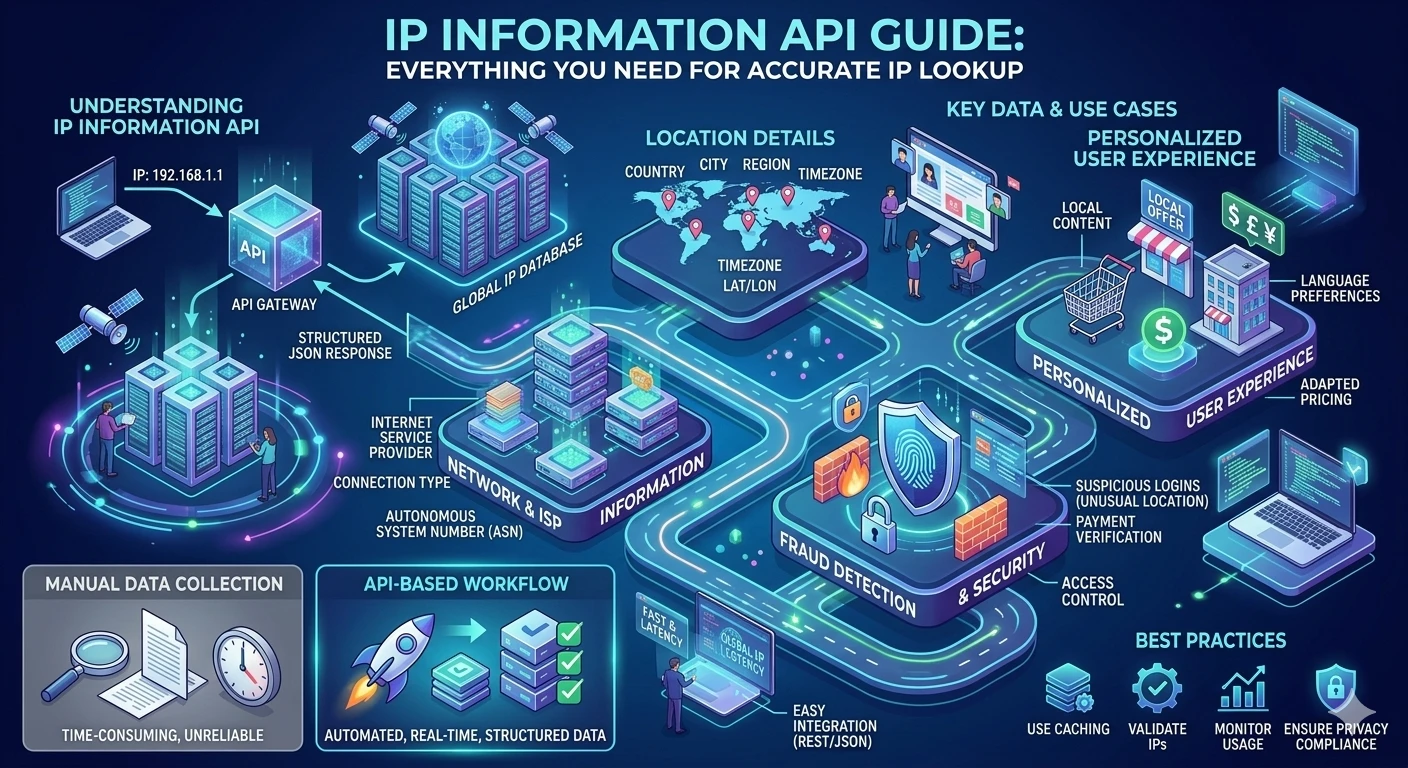
Understanding where your users come from can transform how you build applications, improve security, and personalize experiences. An ip information API makes this possible by providing detailed data about any IP address in a structured and automated way. Instead of guessing user locations or relying on incomplete data, businesses and developers can access reliable insights instantly.
This guide will help you understand how IP information APIs work, why they matter, and how you can use them effectively for better results.
What Is an IP Information API
An IP information API is a tool that allows you to retrieve data related to an IP address through a simple request. Instead of manually analyzing network data, the API delivers structured information that can be used in applications, analytics tools, or security systems.
The data typically includes location details, network provider information, and other useful attributes that help identify where and how a user is connecting from.
This automation saves time and ensures consistency, especially when dealing with large volumes of traffic.
Why IP Data Matters for Businesses and Developers
IP data plays a key role in modern digital systems. Whether you are running a website, managing an app, or analyzing traffic, knowing user location and behavior provides valuable insights.
Here are some important reasons why IP data is essential:
- It helps personalize user experiences based on location
- It improves security by detecting suspicious activity
- It supports targeted marketing campaigns
- It enhances analytics and reporting accuracy
With the right data, businesses can make smarter decisions and create more relevant interactions for users.
How an IP Information API Works
The process behind an IP information API is simple and efficient. It follows a request and response model that delivers results within seconds.
First, a request is sent to the API with an IP address. The API then processes this request by checking its database and mapping the IP to relevant information. Finally, it returns structured data in formats like JSON, which can be easily used in applications.
This entire process happens almost instantly, making it ideal for real time use cases.
Key Data You Can Retrieve
An IP information API provides a wide range of useful data points. These details can vary depending on the provider, but generally include:
- Country, region, and city
- Latitude and longitude
- Internet service provider
- Time zone
- Connection type
This information allows developers and marketers to understand users better and adapt their strategies accordingly.
Practical Use Cases
IP information APIs are widely used across different industries. Their flexibility makes them valuable for both technical and non technical users.
1. Personalizing User Experience
Websites and applications can display content based on user location. For example, showing region specific offers or language preferences improves engagement.
2. Fraud Detection and Security
By analyzing IP data, systems can detect unusual behavior such as login attempts from unexpected locations. This helps prevent fraud and unauthorized access.
3. Marketing and Analytics
Marketers can use location data to understand audience distribution and optimize campaigns for better results.
4. Content Localization
Businesses can deliver content tailored to specific regions, increasing relevance and user satisfaction.
Benefits of Using an API Instead of Manual Methods
Manual data collection is slow and often unreliable. APIs provide a faster and more accurate alternative.
Some major benefits include:
- Automation reduces manual effort
- Real time data improves decision making
- Structured output simplifies integration
- Scalability supports growing applications
These advantages make APIs an essential part of modern development and marketing workflows.
Choosing the Right IP Information API
Not all APIs offer the same level of performance or accuracy. Choosing the right one is important for long term success.
Here are some factors to consider:
Data Accuracy
The API should provide reliable and frequently updated data. Inaccurate information can lead to poor decisions.
Speed and Performance
Fast response times are crucial, especially for applications that rely on real time data.
Global Coverage
A good API should cover a wide range of locations to support international users.
Ease of Integration
Clear documentation and simple endpoints make integration easier and faster.
Pricing Flexibility
Choose a solution that matches your budget and usage requirements.
Common Challenges and How to Handle Them
While IP information APIs are powerful, there are a few challenges to keep in mind.
Data Limitations
IP based location is not always 100 percent precise. It provides an approximate location rather than an exact address.
Privacy Concerns
Handling user data responsibly is essential. Make sure your application follows data protection guidelines.
Rate Limits
Some APIs restrict the number of requests. Planning your usage can help avoid disruptions.
By understanding these challenges, you can use the API more effectively and avoid common issues.
Best Practices for Using IP Information APIs
To get the most value from your API, follow these best practices:
- Use caching to reduce repeated requests
- Focus on relevant data instead of collecting everything
- Combine IP data with other analytics tools
- Monitor performance and adjust usage as needed
These practices help improve efficiency and ensure better results.
Future of IP Lookup Technology
IP lookup technology continues to evolve with advancements in data processing and artificial intelligence. Future developments are likely to include:
- More accurate location detection
- Better integration with security systems
- Enhanced real time analytics
- Improved scalability for large applications
As digital systems grow more complex, IP data will play an even bigger role in shaping user experiences and business strategies.
An IP information API is a powerful tool that simplifies how businesses and developers access and use location data. From improving user experience to enhancing security and analytics, its applications are wide ranging and highly impactful.
By choosing the right API and following best practices, you can build smarter systems that rely on accurate and real time data. Whether you are working on a small project or a large scale application, integrating IP data can significantly improve your results.
When combined with a reliable ip address lookup, this approach becomes even more effective for understanding users and making informed decisions.
FAQs
1. What is an IP information API used for
It is used to retrieve data about an IP address, including location, network details, and other useful information for applications and analytics.
2. Is IP location data always accurate
IP based location provides an approximate location. While it is generally reliable, it may not always pinpoint the exact address.
3. Can beginners use an IP information API
Yes, most APIs are designed to be user friendly and come with documentation, making them accessible even for beginners.
Recommended Resources:-
Numverify vs Twilio vs Vonage: Phone Verification for Your Enterprise
How to expose APIs to LLMs without breaking security