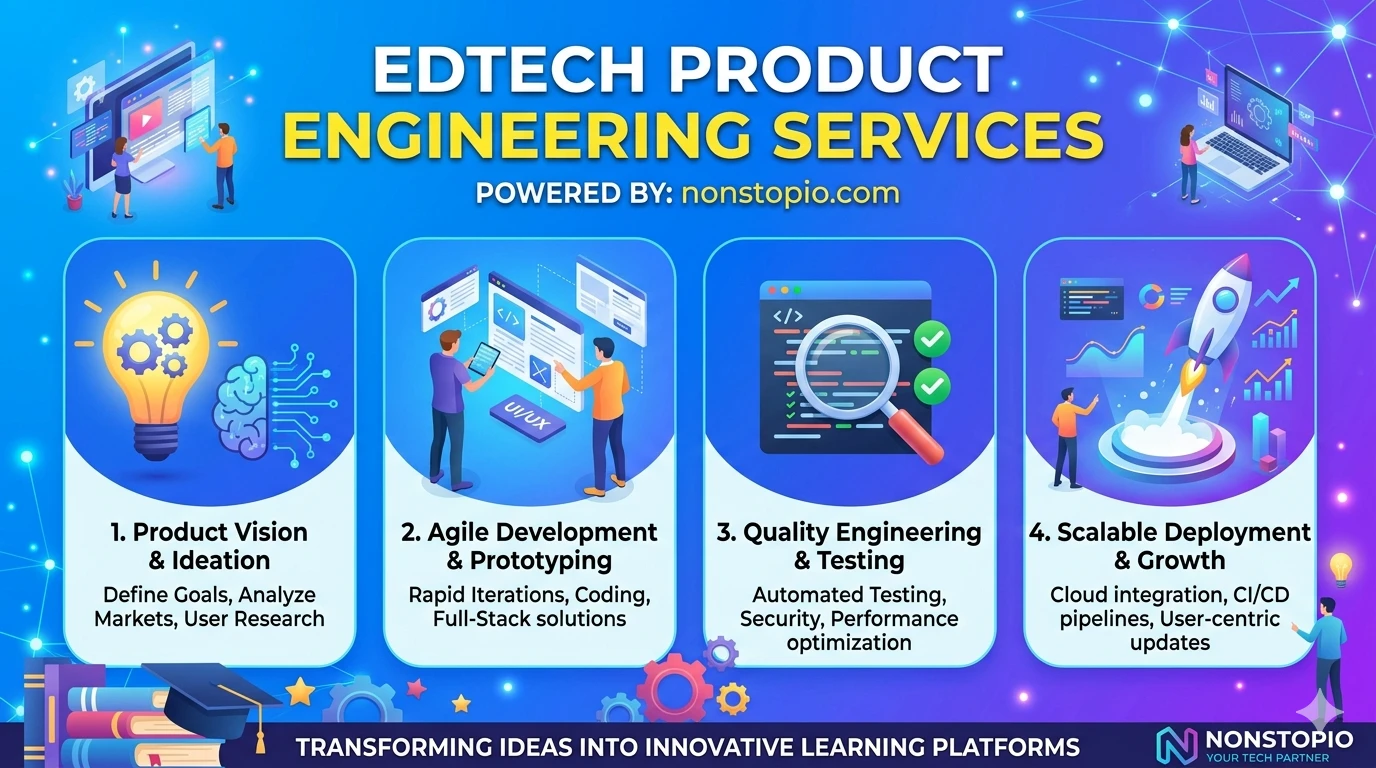
Education technology has rapidly evolved from simple digital classrooms to sophisticated platforms that personalize learning, track outcomes, and deliver immersive experiences across devices. Universities, corporate training providers, and digital education startups now rely on scalable platforms to deliver knowledge, assess skills, and measure real learning outcomes.
However, building a modern learning platform is not just about hosting course content. Successful platforms must combine engagement, data-driven insights, and scalable infrastructure.
This is where EdTech product engineering services play a crucial role. By combining learning science, modern software architecture, and advanced analytics, organizations can create platforms that improve engagement, completion rates, and measurable learning outcomes.
The Growing Demand for Modern EdTech Platforms
Digital learning has become a core component of education systems worldwide. Institutions and organizations increasingly require platforms that support:
• remote and hybrid learning environments
• personalized learning pathways
• collaborative knowledge sharing
• performance measurement and analytics
Yet many traditional learning platforms struggle to keep up with these demands. Static course delivery systems often fail to engage learners or provide meaningful insights into progress and outcomes.
Modern EdTech product engineering services help organizations build platforms designed for real learning environments rather than simple content distribution.
Engagement Through Gamified Learning Experiences
One of the biggest challenges in digital education is maintaining learner engagement. Without the structure of physical classrooms, many learners lose motivation before completing programs.
Gamification has proven to be one of the most effective methods for improving engagement.
EdTech platforms often integrate features such as:
• badges and reward systems
• leaderboards and competitive challenges
• progress tracking and milestone achievements
These gamified learning experiences help transform training and education into interactive journeys rather than passive learning sessions.
Organizations using gamification frequently see higher participation rates and improved learning retention.
AI-Powered Personalization for Better Learning Outcomes
Not all learners absorb information the same way. Some require additional practice, while others progress faster through material.
Modern learning platforms increasingly incorporate AI and machine learning to create personalized learning paths.
Through advanced EdTech product engineering services, platforms can support:
• adaptive assessments that adjust difficulty levels
• personalized course recommendations
• predictive learning pathways based on learner behavior
• automated evaluation and feedback systems
AI-driven personalization allows learning platforms to respond dynamically to individual learner needs, improving both engagement and completion rates.
Building Scalable Platforms for Diverse Learning Environments
Educational organizations often serve learners across multiple regions, devices, and connectivity environments.
To support this diversity, modern EdTech platforms must be designed with scalability and flexibility in mind.
Key capabilities often include:
Remote and Offline Learning
Learners may access courses from mobile devices, remote locations, or low-connectivity environments. Platforms must support offline access and seamless synchronization.
Rich Multimedia Learning Content
Modern platforms include interactive media such as videos, audio lessons, simulations, and assessments to create immersive learning experiences.
Multilingual and Accessible Design
Global learning platforms must support multiple languages and accessibility standards such as WCAG to ensure inclusive learning environments.
Through scalable architecture and cloud infrastructure, EdTech systems can support thousands of concurrent learners without performance issues.
Learning Analytics That Turn Data Into Insights
A key advantage of digital learning platforms is the ability to measure learning outcomes in real time.
Advanced analytics tools allow organizations to track:
• learner engagement and activity patterns
• course completion rates
• skill acquisition across cohorts
• training effectiveness and ROI
These insights help educators and learning leaders refine course content, optimize training programs, and improve learner success rates.
With data-driven insights, organizations can move beyond simple course delivery and focus on measurable learning impact.
Knowledge-Sharing Communities and Collaborative Learning
Learning does not happen in isolation. Many modern EdTech platforms incorporate social learning environments that allow users to collaborate and exchange knowledge.
Interactive features may include:
• discussion forums and learning communities
• peer feedback and ratings
• collaborative problem-solving activities
These environments encourage continuous learning and strengthen learner engagement through community participation.
AI-Powered Learning Assistants and Chatbots
AI-driven chatbots are becoming an essential component of modern EdTech platforms.
Using technologies such as retrieval-augmented generation, AI assistants can help learners quickly access relevant knowledge and support resources.
These chatbots can:
• answer learner questions instantly
• recommend learning materials
• guide learners through training modules
By automating learner support, platforms can provide continuous assistance while reducing instructor workload.
Assessment, Certification, and Credentialing
For many organizations, learning platforms must also validate and certify skills.
Modern EdTech platforms include integrated assessment and certification systems that allow learners to demonstrate competency.
These systems support:
• skill-based assessments
• certification workflows
• digital credentials and badges
By connecting learning activities to real performance outcomes, organizations can measure the effectiveness of training programs.
EdTech Platforms for Multiple Learning Environments
Different education sectors have unique requirements.
Through EdTech product engineering services, organizations can build platforms tailored to specific use cases.
Common applications include:
Higher Education Platforms
Universities and colleges rely on scalable learning management systems that support thousands of students and integrate with academic systems.
Corporate Learning and Development
Enterprises require training platforms that improve employee skills, track performance, and deliver measurable ROI.
Professional Certification Platforms
Certification providers need secure platforms for exam delivery, credential management, and skill validation.
Vocational and Skill Development Programs
Vocational training programs rely on digital platforms that combine practical learning modules with performance tracking.
Why Platform Architecture Matters in EdTech
Building a successful learning platform requires more than strong instructional content.
Modern EdTech platforms must be designed with robust architecture that supports growth and innovation.
Production-ready learning systems typically include:
• cloud-native infrastructure for scalability
• microservices architecture for modular development
• API-first integrations with third-party systems
• secure data management and compliance frameworks
These architectural principles ensure platforms can evolve with changing educational needs and technological advancements.
The Future of EdTech Product Engineering
Education technology continues to evolve as organizations adopt AI, analytics, and immersive digital experiences.
Future learning platforms will increasingly focus on personalized learning journeys, collaborative communities, and data-driven performance insights.
Organizations investing in EdTech product engineering services today are building the foundation for scalable, engaging, and measurable learning ecosystems.
By combining engagement-focused design, AI-driven personalization, and scalable architecture, modern EdTech platforms are transforming how knowledge is delivered and experienced.