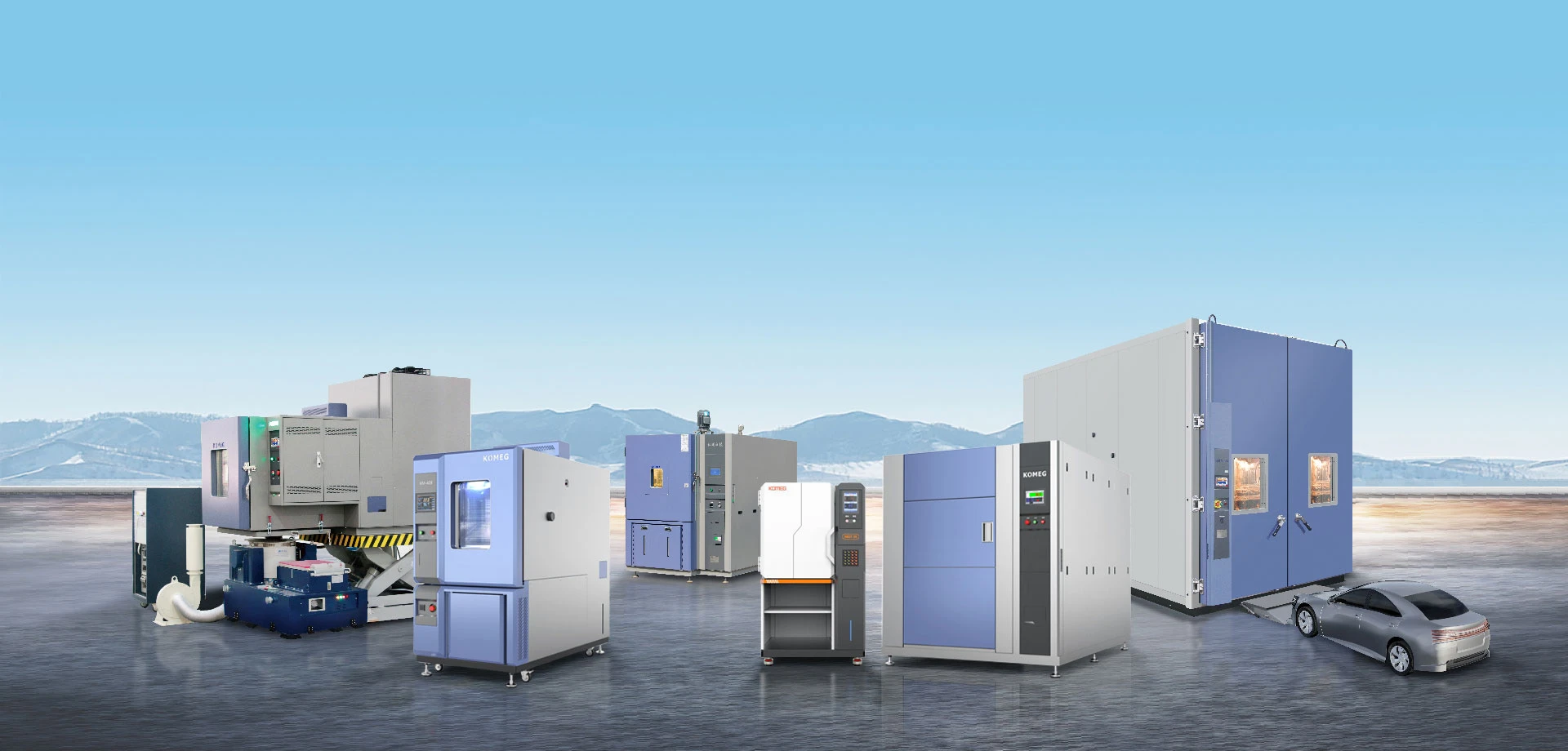
An environmental test chamber is a specialized testing device designed to simulate and precisely control environmental conditions such as temperature, humidity, and air pressure. Its core working principle relies on the collaborative operation of four key systems: refrigeration, heating, humidification/dehumidification, and intelligent control. It highly reproduces various natural environmental stresses that products may encounter in actual applications within a sealed chamber, providing a standardized test environment for product reliability testing and quality inspection.
Core Control Logic: Intelligent Closed-Loop Precision Control
An environmental test chamber is essentially a high-precision intelligent closed-loop control system that follows a complete closed-loop logic of "Setting - Sensing - Comparison - Execution - Stabilization" to achieve deviation-free control of environmental parameters:
- Instruction Setting: Operators set target test parameters, including temperature, humidity, and air pressure in advance through the equipment controller (equivalent to the "brain" of the system), defining the test standards.
- Real-Time Sensing: High-precision sensors such as platinum resistance thermometers and humidity-sensitive capacitors (equivalent to the "senses" of the system) are installed inside the chamber, continuously collecting real-time data on internal temperature, humidity, and air pressure, and feeding the data back to the controller immediately.
- Precise Calculation: The controller compares the measured data with the set parameters quickly after receiving it, and accurately calculates the required regulating power through a professional PID (Proportional-Integral-Derivative) control algorithm to avoid parameter fluctuations and deviations.
- Execution & Regulation: The controller issues instructions to drive actuating components, including heaters, refrigeration units, and humidification/dehumidification modules (equivalent to the "hands and feet" of the system), completing operations such as heating, cooling, humidification, and dehumidification.
- Stable Maintenance: Relying on the uninterrupted "Monitoring-Comparison-Execution" cycle, coupled with a high-density and high-efficiency insulation layer of the chamber to isolate external temperature interference, the internal environment of the chamber is stably maintained at the set state to ensure test accuracy.
Working Principles of Core Environmental Simulation Systems
1. Temperature Control System
Temperature regulation is realized through the two-way cooperation of the heating and refrigeration systems, equipped with a built-in circulation fan to achieve uniform temperature distribution inside the chamber without local temperature differences. It mainly consists of three links: heating, conventional refrigeration, and cryogenic refrigeration.
1.1 Heating Process
After a heating command is issued, the controller activates the nickel-chromium alloy finned electric heating tube. Air flows through the heating element and heats up rapidly, then is forced into the working chamber by the fan to form a full-domain thermal cycle. The heating power is steplessly adjusted through a solid-state relay (SSR), enabling extremely high temperature control accuracy with a steady-state deviation stably controlled at ±0.1℃.
1.2 Conventional Refrigeration Process
It adopts the industrial-standard vapor-compression refrigeration cycle, which shares the same principle as a household refrigerator: The compressor compresses low-temperature and low-pressure gaseous refrigerant into high-temperature and high-pressure gas; the gas dissipates heat to the outside through the condenser and condenses into medium-temperature and high-pressure liquid; the liquid passes through a throttling device such as an electronic expansion valve, where its pressure drops sharply and turns into low-temperature and low-pressure liquid refrigerant; the low-temperature refrigerant absorbs heat from the air inside the chamber in the evaporator and evaporates into gas, cooling the air. The cooled air is then sent into the working chamber by the fan for circulating refrigeration.
1.3 Cryogenic Refrigeration (-40℃ and Below)
The efficiency of a conventional single-stage refrigeration system drops sharply at low temperatures below -40℃, so a cascade refrigeration system is adopted. It consists of two compressors (high-temperature stage and low-temperature stage) forming a dual-cycle system, coupled through an evaporative condenser. It can stably achieve an ultra-low temperature environment of -70℃ to -80℃, meeting the requirements of extreme low-temperature tests.
2. Humidity Control System
Humidity regulation is realized through two-way operations of humidification and dehumidification, with no water droplets or impurities throughout the process to ensure a pure test environment.
2.1 Humidification Process
Steam humidification is the mainstream technology adopted. A heating tube is installed in the stainless steel shallow tank at the bottom of the equipment, which heats deionized water to a slight boil to produce pure steam. The circulation fan evenly brings the steam into the working chamber, featuring fast humidification speed, high sensitivity, and no condensed water dripping during the whole process to avoid damage to test samples.
2.2 Dehumidification Process
Mechanical refrigeration dehumidification is mainly used. The controller lowers the temperature of the evaporator to below the dew point temperature of the air. When moist air flows through the low-temperature evaporator, water vapor condenses into water droplets upon contact, which are discharged out of the chamber through a special pipeline, thus reducing the internal humidity. This method delivers stable dehumidification effect and strong controllability.
Specialized Principles of Special-Type Environmental Test Chambers
Based on the basic temperature and humidity regulation principles, a variety of specialized environmental test chambers have been derived for different industry testing needs, with distinct core functions and working principles:
- Thermal Shock Test Chamber: Abandoning the slow temperature change mode, it achieves rapid switching between high and low temperature extreme environments within 15 seconds. It is divided into two-zone basket type (samples move quickly between high and low temperature zones with the basket) and three-zone static type (samples stay still, and high-speed air dampers switch high and low temperature airflows). It is mainly used to detect structural failures, material cracking, and seal damage of semiconductors, PCBs, and automotive parts caused by thermal expansion and contraction.
- Rapid Temperature Change Test Chamber: Its core advantage is an ultra-fast heating and cooling rate, which can reach 5℃/min, 15℃/min, or even higher. Equipped with high-power heating and refrigeration components, it realizes rapid temperature tracking and is mostly used for product environmental stress screening to quickly expose early potential defects.
- Temperature-Humidity-Vibration Combined Test Chamber: Integrates a vibration table on the basis of temperature and humidity test chambers, simultaneously simulating the combined effects of three environmental stresses: temperature, humidity, and vibration. It restores the complex working conditions of products during transportation and operation, suitable for the strict testing of aerospace and high-end automotive parts.
- Salt Spray Corrosion Test Chamber: Atomizes salt solution through a special spray system to create a high-concentration salt spray and humid environment inside the chamber. It is specially used to evaluate the corrosion resistance of materials and coatings, such as testing the corrosion resistance of metals, coatings, and electroplated parts, and is widely used in corrosion testing of automotive and marine parts.
Industry Benchmark: KOMEG Environmental Test Equipment
Guangdong Komeg Environmental Instrument Industry Co., Ltd. (KOMEG) is a senior benchmark enterprise in the field of environmental test equipment. Founded in 1990, it has more than 30 years of R&D and production accumulation. With mature technology and a complete product line, it has become a core global supplier of reliability test equipment.
Core Product Line
KOMEG's product line fully covers various environmental simulation testing needs. Its main products include: temperature (humidity) cycle test chambers, thermal shock test chambers (two-slot/three-slot type), rapid thermal cycle test chambers, ESS environmental stress screening test chambers, various climate aging test chambers (xenon lamp aging, UV aging, ozone aging, etc.), altitude temperature environmental test chambers, large-scale walk-in environmental test laboratories, special thermal shock chambers for batteries, salt spray corrosion test chambers, etc., which can meet customized testing needs of different industries.
Application Scope & Industrial Strength
The equipment is widely used in many industries such as metals, plastics, rubber, cables and wires, automotive parts, aerospace, electronic appliances, and new energy batteries, providing key data support for product R&D and quality control. At present, KOMEG's business covers more than 70 countries and regions around the world, and has provided professional reliability testing equipment and technical support for more than 2,600 enterprises, enjoying an outstanding industry reputation and technical strength.

Working Principles and Technical Details of Environmental Test Chambers