
Introduction to the Air Compressor Market
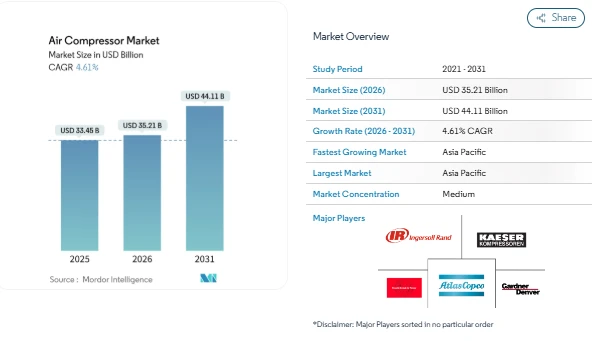
The global Air Compressor Market is projected to reach USD 35.21 billion in 2026 and is expected to grow steadily to USD 44.11 billion by 2031, reflecting a CAGR of 4.61% over the forecast period. This growth is driven by increasing demand for oil-free compressors in purity-sensitive industries, surging investments in LNG and hydrogen infrastructure, and the re-shoring of manufacturing activities across North America and Europe. High-capacity compressors above 500 kW are seeing rising adoption due to mega-projects in energy and industrial sectors.
The Air Compressor Market Size reflects both traditional manufacturing applications and emerging industries such as healthcare, semiconductor, and renewable energy. Technology adoption, energy-efficiency regulations, and the integration of AI-enabled predictive maintenance are influencing market dynamics. Companies are now focusing on service contracts and software solutions to capture additional value, alongside supplying advanced hardware.
Emerging Trends in the Air Compressor Market
-
Electrification and Oil-Free Demand
-
Tightening ISO 8573-1 air purity standards in pharmaceuticals, food, and semiconductors are accelerating the adoption of oil-free compressors.
-
Battery-electric and hydrogen vehicle lines require Class Zero air, boosting oil-free system penetration above the overall market CAGR.
-
OEMs are combining oil-free compressors with energy-management software, creating long-term service engagement opportunities.
-
LNG and Hydrogen Infrastructure Investment
-
Global hydrogen electrolyzer projects and LNG export terminals are driving demand for large centrifugal compressors.
-
Specialized high-pressure hydrogen compressors create profitable niches despite longer project timelines.
-
Re-Shoring of Manufacturing
-
North America and Europe are witnessing expansions in semiconductor fabs, battery plants, and pharmaceutical sites, leading to stationary, high-efficiency compressor installations.
-
Predictive maintenance packages and multi-megawatt compressor stations are becoming standard in these re-shored plants.
Segment Analysis in the Air Compressor Market
-
By Operating Principle: Positive Displacement, Dynamic
-
By Technology: Oil-Free, Oil-Flooded
-
By Portability: Stationary, Portable
-
By Cooling Method: Air-Cooled, Water-Cooled
-
By Power Rating: 101-300 KW, Above 500 KW, Others
-
By End-User Industry: Manufacturing, Oil and Gas, Power Generation, Healthcare, Others
Leading Companies in the Air Compressor Market
-
Atlas Copco Group – Extensive service network and digital analytics integration.
-
Ingersoll Rand Inc. – Strong presence in stationary and portable compressors globally.
-
Hitachi Global Air Power (Sullair) – Focused on industrial and energy applications.
-
Gardner Denver Industries – Specializes in oil-free and centrifugal compressors.
-
Kaeser Kompressoren SE – Leveraging domestic hydrogen demand and cost-efficient solutions.
Conclusion
The Air Compressor Market Forecast points to steady growth between 2026 and 2031, with demand driven by industrial expansions, renewable energy projects, and stricter air purity and energy-efficiency regulations. Both oil-free and high-capacity units are expected to see increased adoption across healthcare, LNG, hydrogen, and manufacturing sectors.
The overall outlook for the Air Compressor Market is positive, reflecting a balance of traditional industrial demand and emerging energy and healthcare applications. Businesses adopting modern compressor solutions, energy efficiency, and regional-specific strategies are poised to lead the


