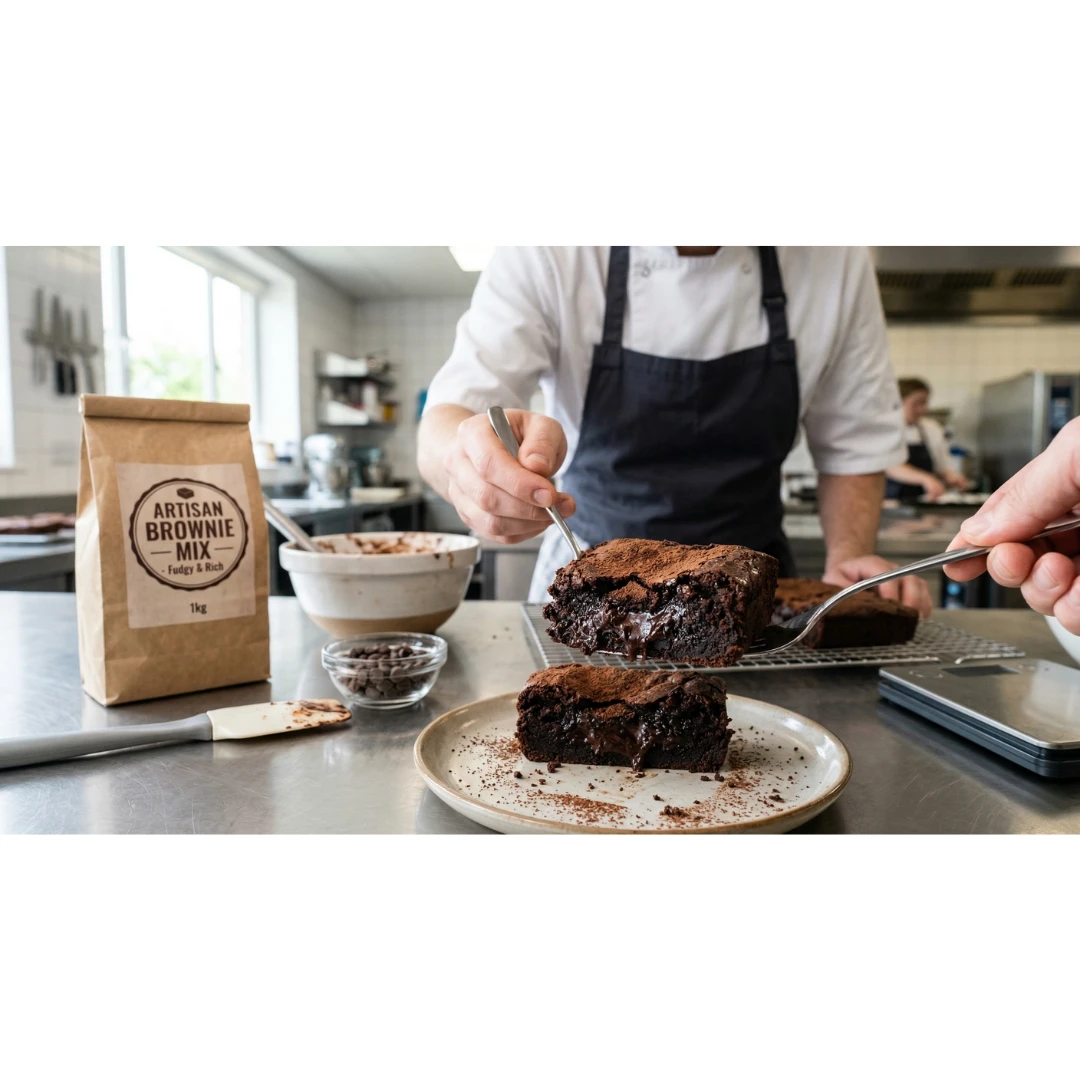
Consistency is non-negotiable in commercial baking. When a dessert menu promises fudgy brownies, every batch that leaves the production line must match that standard. Achieving this level of uniformity can be difficult when working with scratch formulas, especially across multiple shifts or production sites.
Pre-formulated mixes have become a practical solution for bakeries and food service operations that need reliable texture, reduced labor time, and repeatable results.
This blog explains how these mixes are engineered to deliver the soft, fudgy texture that professional bakers aim for, and why they can be a strategic addition to commercial workflows.
What Makes Brownies Soft and Fudgy
Texture in brownies comes down to ingredient ratios and mixing technique. A fudgy brownie has a dense crumb, moisture retention, and minimal air incorporation. This is typically achieved through:
-
High fat content relative to flour
-
Moderate sugar levels to retain moisture
-
Minimal leavening to avoid cake-like rise
-
Controlled mixing to prevent gluten development
When baking from scratch, even small variations in measurement, mixing speed, or oven calibration can shift the final texture.
This becomes more challenging when scaling production or training new staff.
How Pre-Formulated Mixes Are Designed for Consistent Results
A quality brownie mix is formulated to control the variables that affect texture. Ingredients are measured and blended under controlled conditions, then packaged to maintain stability.
The formulation locks in the ratio of fat, sugar, cocoa solids, and flour needed for a fudgy result.
These mixes often include emulsifiers and stabilizers that support moisture retention and extend shelf life. They also account for variations in mixing equipment and oven types, which means results stay more predictable even when production conditions differ slightly.
For operations that run multiple batches daily or supply multiple outlets, this kind of consistency reduces waste and rework.
Why Fat and Sugar Balance Matters
Fudgy brownies depend on a high fat-to-flour ratio. Fat coats flour particles, which limits gluten formation and keeps the crumb tender.
Sugar adds sweetness, but it also binds water, which contributes to a moist bite.
In a well-designed mix, these ratios are already set. Bakers add wet ingredients according to instructions, and the balance holds.
This removes guesswork and reduces the risk of overmixing or undermixing, both of which can alter texture.
Some mixes also include cocoa powder or chocolate liquor. These ingredients contribute both flavor and fat, supporting the dense, fudgy structure that defines the product.
Role of Leavening Agents in Texture Control
Leavening is where many scratch recipes run into trouble. Too much baking powder or baking soda creates a cakey texture. Too little can make brownies heavy or gummy.
Most brownie mixes use minimal leavening, often just enough to create a slight lift without compromising density.
This is calibrated during product development and tested across baking conditions to confirm that it works reliably.
For bakeries producing high volumes, this kind of precision is valuable. It reduces the need for constant recipe adjustments and allows staff to focus on other parts of production.
Benefits for Commercial Production Environments
Speed matters in professional settings. A pre-formulated brownie mix cuts down on weighing, sifting, and ingredient staging.
Staff can mix, pan, and bake in less time, which increases throughput without adding labor hours.
Training also becomes simpler. New team members can follow straightforward instructions and still produce consistent results.
This is especially useful in operations with high turnover or seasonal staffing.
Another advantage is inventory management. Instead of stocking multiple dry ingredients separately, a single SKU covers the base formula.
This reduces storage complexity and minimizes the risk of running short on a key ingredient mid-batch.
Adjusting Mixes for Menu Differentiation
While mixes are designed for consistency, they can also serve as a base for customization.
Bakeries can add inclusions like:
-
Nuts
-
Chocolate chunks
-
Caramel swirls
This helps create signature items without reformulating from scratch.
Some operations adjust baking time or temperature slightly to shift texture:
-
A shorter bake at a higher temperature can produce a more molten center
-
A longer, lower bake creates a firmer edge with a fudgy middle
These adjustments allow for menu variety while still benefiting from the baseline consistency that the mix provides.
Quality Indicators to Look for in a Mix
Not all mixes perform the same way. When evaluating options for commercial use, consider:
-
Ingredient transparency and quality of cocoa or chocolate content
-
Shelf stability and packaging that protects against moisture
-
Clear instructions that account for different mixing equipment
-
Batch-to-batch consistency verified by the supplier
Request samples and run trials under actual production conditions. Compare texture, flavor, and how well the product holds after baking.
Check how the brownies perform after a day or two, as moisture retention is a key part of fudgy texture.
Key Takeaways
Pre-formulated mixes offer a practical route to consistent, fudgy brownies in commercial settings.
They control the ingredient ratios that define texture, reduce labor and training time, and simplify inventory.
While they may not replace every scratch recipe, they serve a clear purpose in high-volume operations where speed and reliability matter.
For bakeries looking to standardize dessert offerings or reduce production variability, these mixes provide a tested foundation that can be adapted to fit specific menu needs.
FAQs
Q.1 Can a mix produce the same quality as a scratch recipe in a professional bakery?
Ans: Yes, when chosen carefully. High-quality mixes are formulated with precise ratios and tested ingredients. They can match or exceed scratch recipes in consistency, especially in high-volume settings where variability is a risk.
Q.2 How should mixes be stored in a commercial facility?
Ans: Store in a cool, dry area away from direct sunlight and moisture. Keep packaging sealed until use. Rotation should follow first-in, first-out principles to maintain freshness.
Q.3 Can inclusions like nuts or chips be added to a mix?
Ans: Yes. Most mixes accommodate add-ins without affecting the base texture. Fold them in gently after mixing to avoid overworking the batter.
Q.4 Do mixes work with deck ovens and convection ovens equally well?
Ans: Most are designed to perform across different oven types. However, slight adjustments to time or temperature may be needed based on your equipment. Always run a test batch first.
Q.5 Are there mixes suitable for allergen-controlled production lines?
Ans: Some suppliers offer gluten-free, dairy-free, or nut-free formulations. Verify certifications and cross-contact controls with the manufacturer before introducing them to your line.