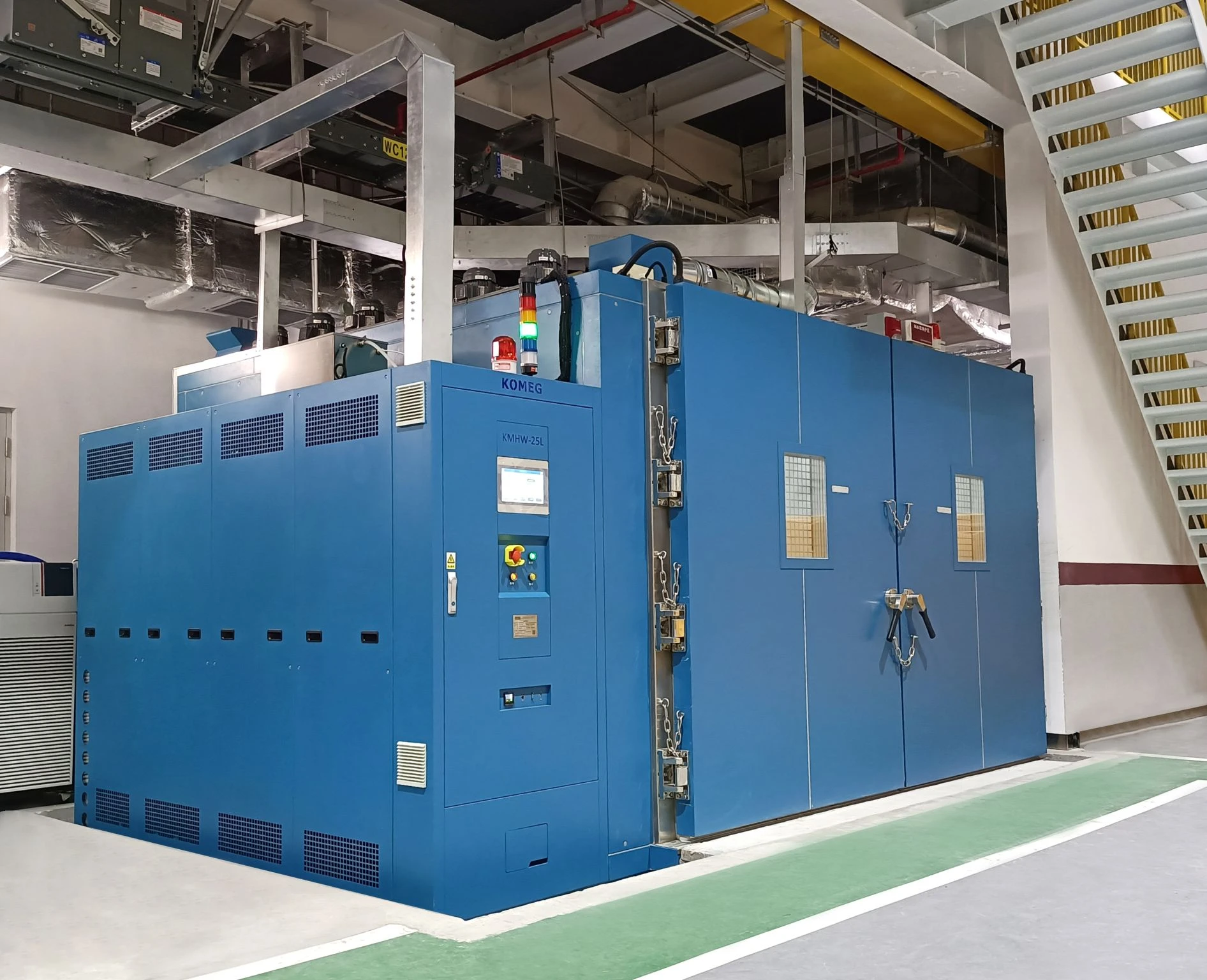
In industrial R&D and quality inspection, walk-in environmental chambers have become indispensable for large-scale product reliability testing. By simulating extreme temperature, humidity, vibration, and other environmental conditions, these chambers provide critical support for industries such as automotive, aerospace, and new energy. This article examines four key factors to consider when purchasing such equipment: technical specifications, structural design, safety mechanisms, and intelligent features.
1. Core Performance Specifications: Precise Simulation of Extreme Environments
1.1 Temperature and Humidity Range with Control Accuracy
- Temperature Range: High-end chambers should cover -70°C to +180°C, addressing scenarios from ultra-low-temperature storage to high-temperature aging. For example, battery testing requires validation of cold-start performance below -40°C, while aerospace components must withstand temperatures exceeding 150°C.
- Humidity Range: Typically spans 10%RH to 98%RH, with some models supporting low-humidity environments (e.g., 5%RH) for arid climate simulations or condensation-based techniques to achieve near-100%RH conditions.
- Control Accuracy: Temperature stability should be ≤ ±0.5°C with uniformity ≤ ±2°C; humidity stability ≤ ±2%RH with uniformity ≤ ±5%RH. For instance, one brand achieves ±1.5%RH humidity stability at 85°C/85%RH, surpassing industry standards.
1.2 Heating/Cooling Rates and Temperature Uniformity
- Rate Metrics: Standard chambers offer 1–3°C/min rates, but beware of misleading "average rate" claims. Premium models provide full-range temperature transition curves to ensure actual rates meet targets in critical zones (e.g., -40°C to +85°C).
- Uniformity Optimization: Forced-air circulation systems with ceiling-mounted multi-blade centrifugal fans ensure even temperature and humidity distribution. For example, a variable air volume (VAV) system adjusts airflow based on load, improving uniformity by 40%.
2. Structural Design: Customization and Modularity
2.1 Chamber Construction and Materials
- Modular vs. Welded Design: Modular chambers use prefabricated panels for easy expansion and relocation, ideal for evolving production lines. Welded designs offer superior structural integrity, withstanding harsher temperature ramp rates (e.g., 10°C/min) for military-grade testing.
- Insulation and Liner: High-performance chambers employ 100mm-thick polyurethane foam or fiberglass insulation paired with SUS304 stainless steel liners for corrosion resistance and easy cleaning. One model maintains an outer surface temperature of just -5°C at -70°C, reducing energy consumption.
2.2 Observation Windows and Lighting
- Window Design: Tempered glass observation ports (e.g., 370mm × 370mm) with electric heating prevent condensation in low-temperature tests, enabling real-time sample monitoring.
- Lighting System: Energy-efficient LED lights with motion sensors automatically activate during operation, minimizing power use.
3. Safety Mechanisms: Multi-Layer Protection for Personnel and Equipment
3.1 Electrical Safety
- Leakage Protection: Residual current circuit breakers (RCCBs) cut power when leakage exceeds 30mA.
- Overload Protection: Current transformers monitor motor loads, triggering alarms and shutdowns if exceeded.
- Power Supply Protection: Three-phase four-wire systems include phase sequence detection and undervoltage/overvoltage alarms.
3.2 Environmental Safety
- Over-Temperature Protection: Independent fuses for the test chamber and air duct systems halt operation if temperatures exceed safe limits.
- Compressor Protection: High/low-pressure switches, oil pressure sensors, and thermal protectors prevent refrigeration system failures.
- Emergency Exit: Internally operable safety locks ensure personnel can escape if trapped.
3.3 Specialized Protections
- Explosion-Proof Design: For battery testing, explosion-proof electrical components and gas concentration monitors mitigate fire risks.
- Smoke Detection: Built-in sensors automatically shut down chambers and trigger alarms upon detecting smoke.
4. Intelligent Features: Enhancing Efficiency and Data Value
4.1 Control Systems
- Programmable Touchscreens: Multilingual interfaces with network connectivity support 100 stored programs, 1,000-step cycles, and power-failure recovery. For example, a 5.7-inch color touchscreen with RS-232/RS-485/Ethernet ports enables remote monitoring.
- PID Control Algorithm: P.I.D.+S.S.R. coordination with auto-tuning ensures rapid stabilization of temperature and humidity.
4.2 Data Logging and Traceability
- Local Storage: High-capacity memory records test curves and data for up to 100 days.
- Export Functions: USB 2.0 or network interfaces generate ISO 17025-compliant reports.
4.3 Energy-Saving Technologies
- Variable-Speed Compression: Dual-stage compressors adjust cooling power based on load, reducing energy use by 30%+ versus traditional models.
- Heat Recovery Systems: Waste heat from refrigeration preheats incoming air, cutting heating energy demands.
When selecting a walk-in environmental chamber, buyers must evaluate performance specifications, structural design, safety features, and intelligent capabilities. Companies should align choices with testing requirements (e.g., temperature range, ramp rates), budget constraints, and scalability needs. As domestic manufacturers improve reliability in core components like compressors and sensors, their cost-effective solutions are gaining traction in premium markets.