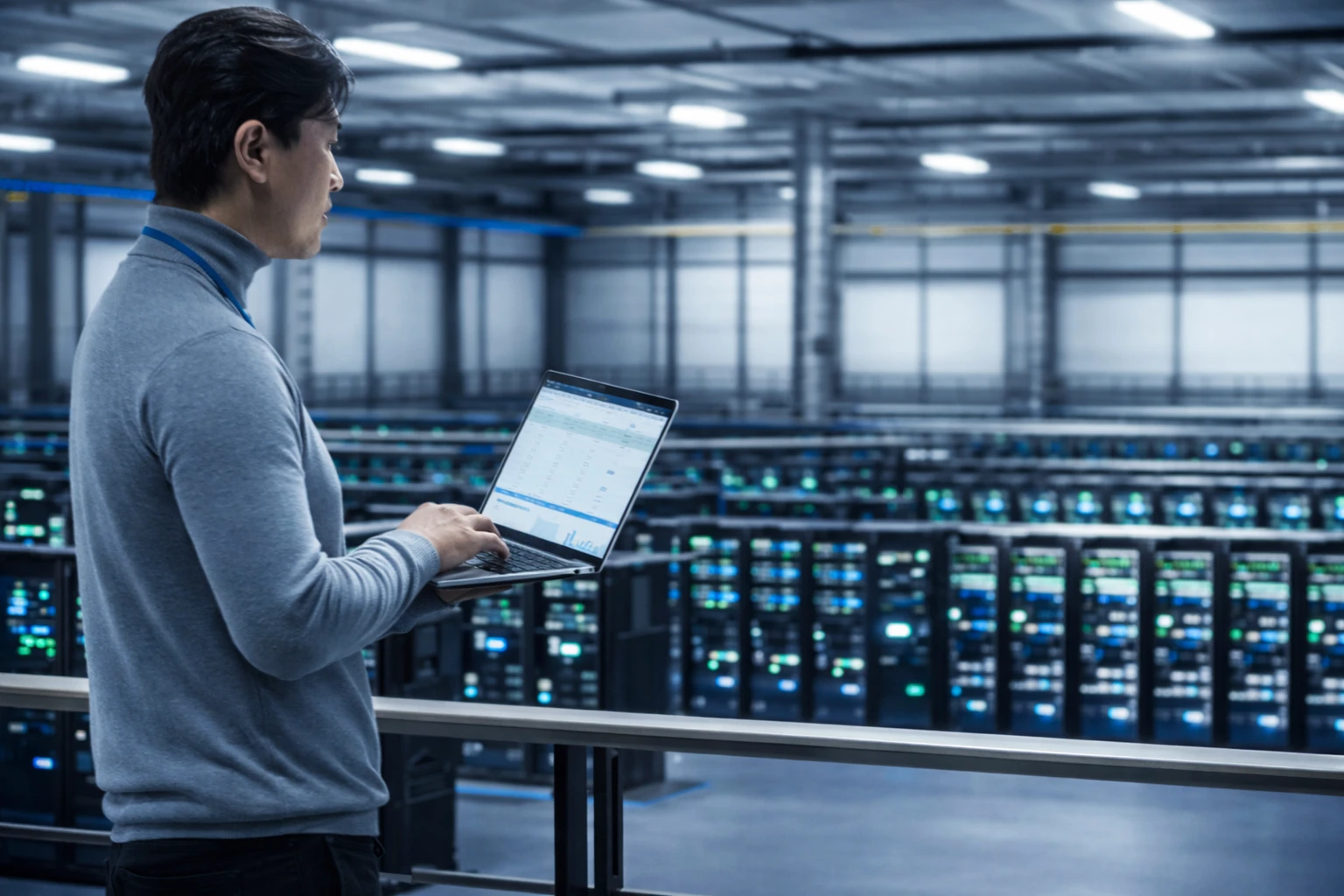
A build-to-suit colocation data center is a facility designed and constructed to meet the exact technical, spatial, and operational requirements of a single anchor tenant.
Unlike standard colocation where a business rents pre-existing space, this model involves a provider creating a custom environment from power density and cooling systems to physical layout and security controls specifically for one client’s current and future needs.
Enterprises choose this model when their infrastructure is too specialized, dense, or large to fit efficiently into generic data hall space.
It provides the control and customization of a private data center without the capital burden and operational complexity of building and staffing it independently.
The Driving Forces Behind Custom Builds
Standard colocation environments are designed for general use.
They offer balanced power, cooling, and layout to suit multiple tenants.
Problems begin when business requirements move beyond these averages.
For example:
-
High-frequency trading firms require extreme power density in limited space
-
Media companies need specialized network architectures for high-speed data movement
-
Government entities demand strict compliance and customized physical security
In these cases, adapting an existing space becomes inefficient and costly.
A build to suit colocation data center solves this by designing infrastructure around your needs instead of forcing your technology to fit a generic environment.
How a Build-to-Suit Project Unfolds
This model works as a structured partnership between the enterprise and the provider.
1. Strategic Planning
The tenant defines requirements such as:
-
total IT load (kW or MW)
-
rack density
-
redundancy levels (N+1 or 2N)
-
location and compliance needs
2. Design and Architecture
Engineers design the entire infrastructure including:
-
power distribution systems
-
advanced cooling solutions (often liquid cooling)
-
physical security layers
-
optimized layout for airflow and operations
3. Construction and Fit-Out
The provider builds the facility within an existing campus or as a new site.
This removes construction risk from the enterprise while aligning delivery with deployment timelines.
4. Operational Transition
Once complete:
-
the provider manages infrastructure (power, cooling, security)
-
the enterprise manages IT systems
A service level agreement ensures performance and reliability.
The Tangible Benefits for Scalable, High-Density Deployments
The advantages of this model become clear in scalability, performance, and cost control.
1. True Scalability Without Compromise
Standard colocation can limit growth. Expanding capacity may require moving across multiple spaces or facilities.
A build to suit colocation data center plans for growth from the beginning by reserving additional capacity.
Scaling becomes predictable and aligned with business timelines.
2. Native Support for High-Density Computing
Modern workloads like AI, HPC, and blockchain require 30–50 kW per rack.
Traditional data centers support far less.
Custom facilities integrate advanced cooling solutions like:
-
direct-to-chip liquid cooling
-
rear-door heat exchangers
This allows deployment of high-performance hardware without thermal constraints.
3. Predictable Financial and Operational Control
Building a private data center requires massive upfront capital and ongoing management.
This model converts that into a long-term operational expense.
You gain:
-
predictable costs
-
reduced operational burden
-
access to expert facility management
This balance of control and efficiency is a key reason enterprises adopt this approach.
Who Is the Ideal Candidate for This Model?
This solution is best suited for organizations with large-scale, long-term infrastructure needs.
Typical users include:
-
hyperscalers and cloud providers needing regional capacity
-
financial institutions requiring low latency and dense compute
-
government organizations with strict compliance requirements
-
AI and research enterprises running GPU-intensive workloads
-
large enterprises migrating from legacy data centers
If your infrastructure needs are measured in megawatts rather than kilowatts, this model becomes highly relevant.
Conclusion
For enterprises with high-density, specialized, or rapidly growing infrastructure needs, standard colocation often creates limitations.
A build to suit colocation data center provides a customized solution that aligns infrastructure with business requirements from day one.
It delivers the flexibility and control of a private facility while maintaining the cost efficiency and operational simplicity of colocation.
For organizations where infrastructure performance directly impacts business outcomes, this model offers a scalable and future-ready approach.
Frequently Asked Questions
Q.1: How does the cost compare to building your own data center?
Ans: It avoids upfront capital investment. Costs are structured as long-term operational expenses, reducing financial risk and improving predictability.
Q.2: What is the typical timeline for deployment?
Ans: Smaller projects may take 12–18 months, while large-scale builds can take 24–36 months depending on complexity.
Q.3: How is this different from a custom cage?
Ans: A custom cage modifies an existing space. A build-to-suit project designs core infrastructure specifically for one tenant.
Q.4: What happens after the contract ends?
Ans: Options include renewal or exit. The enterprise removes its equipment, and the facility may be repurposed.
Q.5: Who maintains the infrastructure?
Ans: The provider manages facility systems like power and cooling, while the enterprise manages its IT equipment.