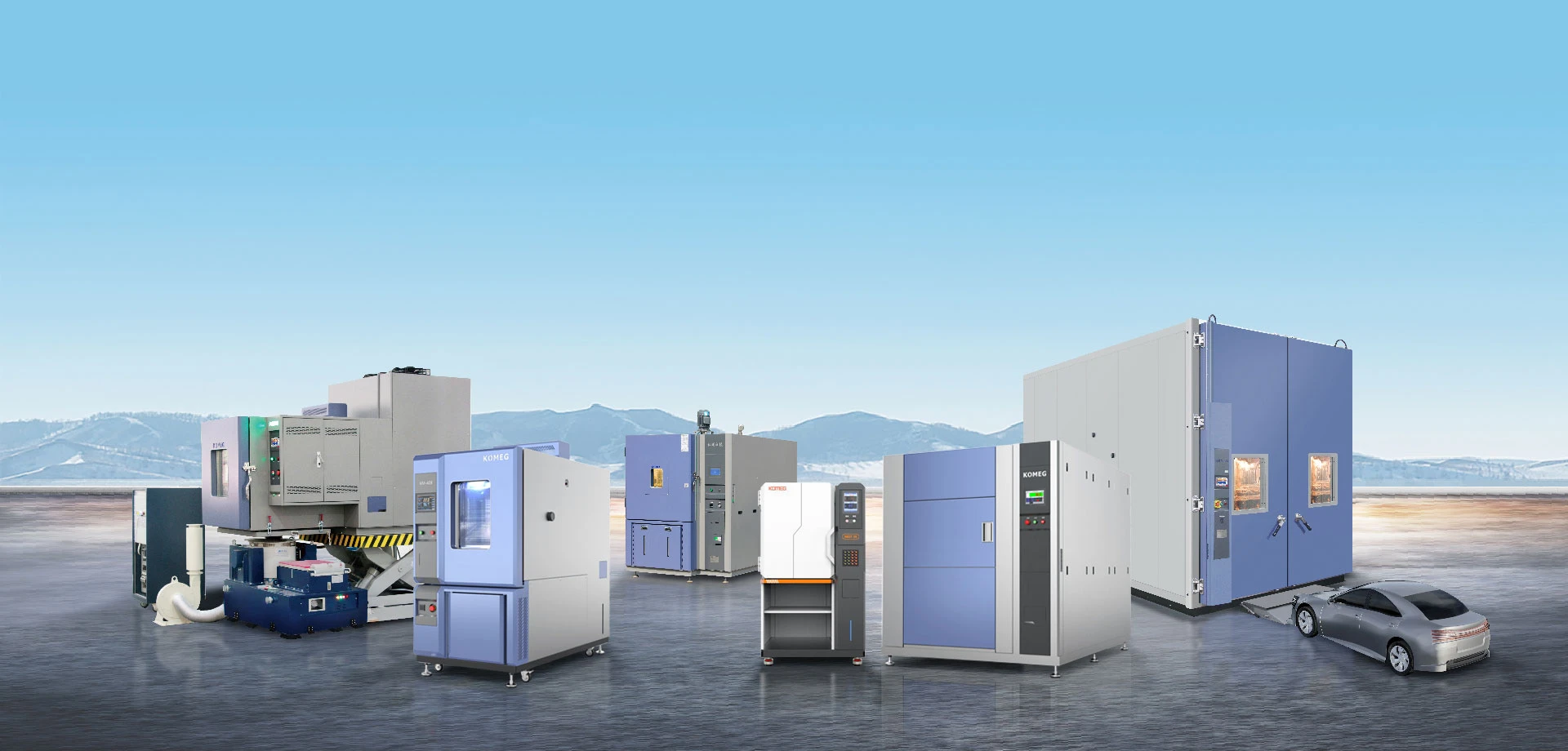
Walk-in Environmental Chambers (also referred to as Walk-in Test Chambers or Large-Scale Environmental Test Rooms) are large-capacity, high-precision environmental simulation devices designed to create controllable, stable, and repeatable temperature, humidity, and other environmental conditions within a spacious enclosed room. Unlike small benchtop or vertical test chambers, their core feature is a large internal space that allows for testing large-sized products, entire assemblies, or multiple products simultaneously, making them indispensable for industries that produce bulky equipment or require large-scale environmental testing.
The core functions of Walk-in Environmental Chambers revolve around large-scale environmental simulation, full-product performance testing, multi-sample simultaneous testing, and long-term stability testing. These chambers are capable of replicating a wide range of real-world environmental conditions, including extreme temperatures, high or low humidity, temperature cycling, and even combined environmental stresses. They are specifically designed to test the reliability, durability, and performance stability of large products or entire systems under various environmental conditions, such as those encountered during storage, transportation, and actual operation. By accommodating full-sized products, these chambers ensure that the test results accurately reflect the product’s performance in real applications, avoiding the limitations of testing small samples that may not represent the entire product’s behavior. Additionally, their large capacity allows for simultaneous testing of multiple samples or components, improving test efficiency, while their stable environmental control supports long-term testing cycles required for product shelf-life or durability evaluation.
In terms of technical performance, Walk-in Environmental Chambers are designed to balance large capacity with high precision. The temperature range typically spans from -70°C to +180°C (or wider for specialized models), with a temperature precision of ±0.1°C to ±0.5°C and temperature uniformity of ≤±1.5°C within the entire chamber space—critical for ensuring consistent test conditions across the large internal area. For humidity-controlled models, the relative humidity range is usually 10% to 98% RH with a precision of ±2% to ±3% RH and humidity uniformity of ≤±3.0% RH. Some advanced models also support rapid temperature transition rates (up to 5°C to 15°C per minute) for thermal cycle testing, catering to diverse testing needs. The chamber capacity varies significantly, ranging from 10 cubic meters to over 100 cubic meters, depending on the application requirements, with custom-designed models available for ultra-large products.
A standard Walk-in Environmental Chamber consists of five key integrated systems that work together to ensure stable, uniform, and controllable environmental conditions in the large space. The chamber body is a robust, double-layered structure with a SUS304 or SUS316 stainless steel interior (resistant to corrosion, wear, and thermal fatigue), a rugged exterior (usually made of cold-rolled steel with anti-corrosion coating), and high-density polyurethane or rock wool insulation. This insulation design effectively minimizes heat and humidity loss, maintains energy efficiency, and prevents external environmental interference, ensuring stable internal conditions even in large spaces. The air circulation system is equipped with high-power, high-efficiency fans and an optimized ducting layout (often with multiple air inlets and outlets) to achieve forced-air circulation, ensuring uniform distribution of temperature and humidity throughout the entire chamber. This eliminates local temperature or humidity gradients, which is particularly important for large-scale testing where consistent conditions across the product are essential.
The temperature control system of Walk-in Environmental Chambers uses high-power nickel-chromium electric heaters for heating and high-efficiency hermetic compressors (with cascade refrigeration systems for ultra-low temperature models) for cooling, enabling rapid and precise temperature adjustment even in the large chamber space. For humidity control (in humidity-equipped models), the system adopts steam humidifiers or ultrasonic humidifiers for humidification and condensation dehumidification or desiccant dehumidification for dehumidification, ensuring stable humidity control. The control system is equipped with a high-performance microprocessor (PLC) and a large touchscreen interface, adopting advanced PID algorithms for closed-loop control to precisely regulate temperature, humidity, and other environmental parameters. It supports programmable test profiles, allowing users to set custom test cycles, holding times, and parameter changes, as well as data logging and remote monitoring functions for convenient test management and data analysis.
Walk-in Environmental Chambers are highly customizable to meet the specific needs of different industries and applications. Common configurations include temperature-only models (for thermal testing), temperature-humidity models (for climatic testing), and thermal cycle models (for rapid temperature change testing). Some specialized models can also integrate additional environmental factors, such as vibration, dust, or altitude simulation, to conduct combined environmental testing. The chamber design often includes features such as large access doors (sliding or swing doors) for easy product loading and unloading, observation windows (with anti-condensation treatment) for real-time monitoring, and safety interlocks (e.g., over-temperature, over-pressure protection) to ensure operational safety.
These large-scale test chambers are widely used across industries that produce large or bulky products. In the automotive industry, they are used to test entire vehicles, automotive modules (e.g., engine systems, interior assemblies), and large components, evaluating their adaptability to extreme temperatures, humidity, and thermal cycles. In the aerospace and defense sector, Walk-in Environmental Chambers simulate the harsh environmental conditions encountered by aircraft, satellites, rockets, and military equipment (e.g., high-altitude low temperature, high humidity), testing the performance of large structures, avionics, and materials.
In the energy industry, they are used to test large-scale energy storage systems, solar panels, wind turbine components, and power equipment, ensuring their reliability under various environmental conditions. In the electronics industry, they accommodate large electronic cabinets, server racks, and industrial control systems, testing their stability and performance under temperature and humidity fluctuations. In the pharmaceutical and food industries, large walk-in chambers are used for stability testing of bulk drugs, vaccines, and food products, ensuring their shelf-life and quality under controlled environmental conditions. Additionally, in materials science and civil engineering, they are used to test large building materials, structural components, and composites, evaluating their durability and dimensional stability under extreme environmental stresses.
To ensure the accuracy and reliability of test results, Walk-in Environmental Chambers are designed to comply with major international testing standards, including IEC 60068 (Environmental testing), MIL-STD-810 (U.S. Military), ISO standards, and Chinese National Standards such as GB/T 2423 and GB/T 10586. Compliance with these standards ensures that test results are recognized globally, providing a reliable basis for product quality evaluation, certification, and market access. The design and manufacturing of these chambers also adhere to strict quality control standards to ensure their long-term stability and operational safety in large-scale testing scenarios.