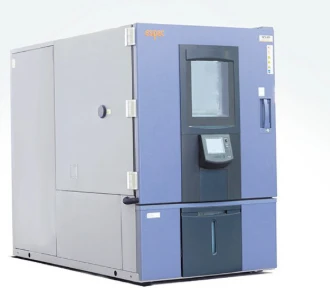
A Temperature and Humidity Test Chamber, also known as an environmental test chamber, is a specialized piece of equipment designed to simulate a wide range of temperature and humidity conditions. Its primary purpose is to test the performance, reliability, and durability of products, materials, or components under controlled environmental conditions.
Key Features and Functions:
- Precise Environmental Control:
- Temperature Range: These chambers can typically simulate temperatures ranging from extremely low (e.g., -70°C) to very high (e.g., +180°C), depending on the model and application.
- Humidity Control: They can also control humidity levels, often from as low as 10% RH (Relative Humidity) up to 98% RH, allowing for the simulation of dry or humid conditions.
- Uniformity and Stability:
- The chambers are engineered to maintain uniform temperature and humidity throughout the test space, ensuring that all samples are exposed to identical conditions.
- Advanced control systems minimize fluctuations, providing stable test environments crucial for accurate and repeatable results.
- Programmable Controls:
- Equipped with sophisticated controllers, often featuring touch-screen interfaces, these chambers allow users to program complex test cycles with varying temperature and humidity settings.
- They can simulate real-world conditions, such as diurnal cycles (day-night variations), rapid temperature changes, or steady-state conditions.
- Safety Features:
- Built-in safety mechanisms protect both the equipment and the samples. These may include over-temperature protection, humidity limits, and alarms for system failures.
- Some chambers are designed with explosion-proof components for testing flammable materials or batteries.
- Data Acquisition and Monitoring:
- Many chambers are equipped with data logging capabilities, allowing for the continuous recording of temperature and humidity during tests.
- Remote monitoring and control options enable users to observe and adjust test parameters from outside the chamber or even from different locations.
Applications:
Temperature and humidity test chambers are widely used across various industries for different purposes:
- Electronics and Electrical Components: Testing the reliability of circuit boards, semiconductors, and other electronic devices under extreme temperature and humidity conditions.
- Automotive Industry: Evaluating the performance of automotive parts, such as batteries, sensors, and interior materials, in conditions that mimic those found in vehicles.
- Aerospace: Assessing the durability of materials and components used in aircraft and spacecraft, which must withstand harsh environmental conditions.
- Pharmaceuticals and Biotechnology: Conducting stability testing on drugs and medical devices to ensure they remain effective under various storage conditions.
- Consumer Goods: Testing the resilience of products like textiles, packaging materials, and household appliances to temperature and humidity variations.
- Materials Science: Investigating the behavior of materials, such as metals, polymers, and composites, under different environmental conditions to predict their long-term performance.
Types of Chambers:
- Benchtop Chambers: Compact units suitable for testing small samples or components, often used in laboratories with limited space.
- Reach-In Chambers: Medium-sized chambers that allow users to reach inside for placing or retrieving samples, commonly used for quality control and research.
- Walk-In Chambers: Large chambers that can accommodate large products or multiple samples simultaneously, often used for testing vehicles, large equipment, or bulk materials.