Welding Electrodes Market Overview
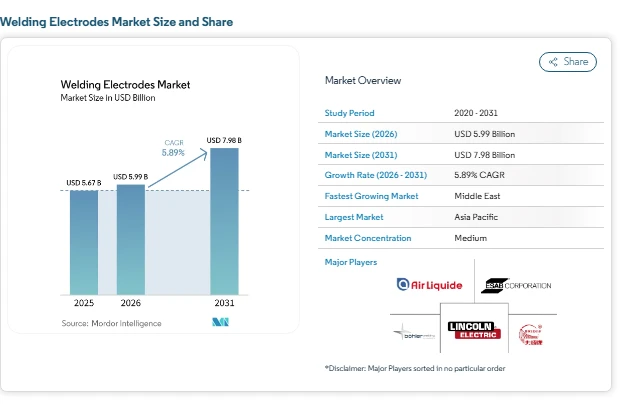
The welding electrodes market size is projected to grow from USD 5.67 billion in 2025 to USD 5.99 billion in 2026, and further reach USD 7.98 billion by 2031, registering a CAGR of 5.89%. This market forecast reflects consistent demand supported by both traditional fabrication work and specialized industrial applications. The market is showing steady progress as demand continues across construction, energy, and heavy engineering sectors.
The welding electrodes industry continues to hold relevance even as automated welding technologies gain traction. While automation is becoming more common in repetitive manufacturing processes, manual welding still plays an important role in critical and complex tasks. This balance is helping maintain steady welding electrodes market growth across industries that require precision, durability, and compliance with strict safety standards.
Key Welding Electrodes Market Insights
Specialty Electrodes Driving Demand
The demand for specialty electrodes is rising due to their ability to meet strict performance and safety standards in critical applications. Low-hydrogen electrodes, for instance, are essential in pressure vessels and structural welding because they minimize the risk of hydrogen-induced cracking. Nickel-alloy electrodes are increasingly used in LNG storage tanks and cryogenic systems, as they offer excellent toughness and corrosion resistance at extremely low temperatures. Additionally, industries such as power generation and petrochemicals are adopting these electrodes for high-stress environments, ensuring long-term durability and reliability. This growing reliance on specialized materials is helping offset the impact of automation in conventional welding processes.
Marine and Shipbuilding Applications
The shipbuilding sector continues to generate steady demand for welding electrodes due to the need for strong, corrosion-resistant joints in harsh marine environments. Electrodes with moisture-resistant coatings are particularly important, as they prevent weld defects caused by humidity and salt exposure. Repair and maintenance activities in existing fleets also contribute significantly to electrode consumption. Major shipbuilding nations are investing in advanced vessels, including cargo ships, naval vessels, and offshore platforms, which require high-quality welding solutions. This ongoing activity ensures a stable and consistent demand within the welding electrodes market.
Pipeline and Energy Infrastructure Expansion
The expansion of oil, gas, and LNG pipeline networks is a key factor driving the demand for welding electrodes. Cross-country and transnational pipeline projects require highly durable welds that can withstand pressure, temperature fluctuations, and environmental stress. Electrodes used in these projects must meet strict regulatory and safety standards, particularly for transporting hazardous materials. In addition, the global push for energy security and LNG supply diversification is leading to increased investments in storage terminals and distribution networks. These developments are boosting the demand for high-performance welding consumables across energy infrastructure projects.
Defense Manufacturing Stability
Defense manufacturing remains a reliable source of demand for welding electrodes due to its consistent funding and long-term project cycles. Applications include the production of armored vehicles, naval ships, submarines, and aerospace components, all of which require precision welding and high-strength materials. The sector often demands specialized electrodes that can handle extreme conditions and meet stringent quality standards. Unlike commercial construction or industrial sectors, defense spending is generally less sensitive to economic downturns, providing stability to the welding electrodes market. This steady demand helps balance fluctuations in other end-use industries.
Welding Electrodes Market Segmentation
-
By Electrode Type
-
Stick Electrodes (SMAW/Manual Arc Electrodes)
-
Coiled Wires (including MIG/MAG and TIG electrodes)
-
Bare Electrodes
-
Flux-cored Wires (FCAW)
-
Metal-cored Electrodes
-
Gouging & Hardfacing Electrodes
-
Others (Light Coated, Non-consumable Electrodes)
-
By Coating Type
-
Rutile
-
Basic / Low-Hydrogen
-
Cellulose
-
Iron-Oxide
-
Metal-Powder
-
Others (Acid-Coated, Special Coating)
-
By Material
-
Mild-Steel
-
Stainless-Steel
-
Cast-Iron
-
Aluminum & Alloys
-
Nickel & Specialty Alloys
-
By End-User Industry
-
Automotive
-
Aerospace and Defense
-
Construction
-
Shipbuilding
-
Energy and Power
-
Electronics
-
Others
-
By Geography
-
North America
-
South America
-
Europe
-
Asia-Pacific
-
Middle East and Africa
Key Players in the Welding Electrodes Market
-
Lincoln Electric Holdings, Inc.
-
ESAB Corporation
-
voestalpine Böhler Welding
-
Air Liquide Welding (Oerlikon)
-
Tianjin Golden Bridge Welding Materials Group
Conclusion
The market is expected to maintain steady progress, supported by consistent demand from infrastructure, energy, and industrial sectors. While automation continues to influence manufacturing processes, the need for manual and specialized welding solutions ensures that the welding electrodes industry remains relevant. The welding electrodes market forecast indicates stable growth, driven by niche applications such as LNG storage, pressure vessels, and marine construction. These areas require high-performance electrodes that meet strict quality and safety standards, supporting long-term demand.
Regional dynamics also play an important role in shaping the market trends. Asia-Pacific remains a leading region due to large-scale industrial activity, while the Middle East and Africa are gaining attention with increasing infrastructure investments. These shifts are contributing to the overall welding electrodes market growth. Moreover, the focus on integrated offerings and certified products is helping companies maintain their market share in a competitive environment. As industries continue to prioritize durability and compliance, the welding electrodes industry is expected to see consistent demand across both traditional and specialized applications.