Saudi Arabia Precision Irrigation Market Size and Forecast 2025–2033
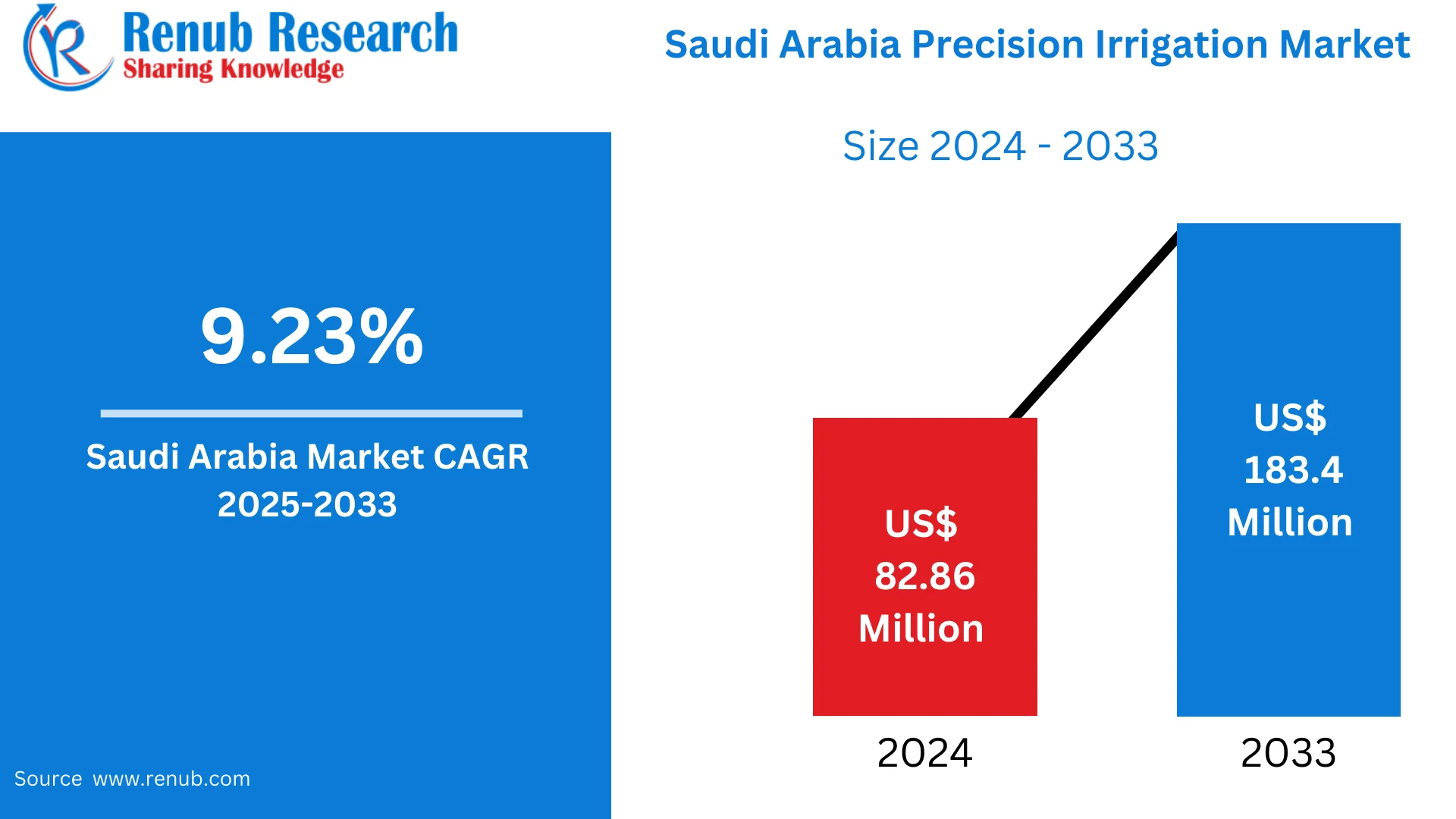
According to Renub Research Saudi Arabia Precision Irrigation Market is poised for impressive expansion, moving from US$ 82.86 million in 2024 to US$ 183.4 million by 2033, advancing at a CAGR of 9.23%. This exceptional growth is driven by the Kingdom’s pressing need to conserve water, increase agricultural productivity, and build a sustainable farming ecosystem despite its harsh desert climate. Precision irrigation has become one of the most critical agricultural technologies in Saudi Arabia, reflecting national priorities of food security, environmental stewardship, and technological modernization.
Overview of the Saudi Arabia Precision Irrigation Market
Precision irrigation refers to advanced farming systems that deliver water in controlled and efficient quantities using smart technologies such as sensors, GPS, automation, and data analytics. Instead of wasting water through traditional flooding techniques, precision systems ensure crops receive the exact amount of water at the right time. For a country like Saudi Arabia, where freshwater resources are limited and climate conditions remain extreme, these systems are essential to protect agricultural potential. Farmers are increasingly turning to smart irrigation tools to address drought cycles, improve yield quality, and optimize water usage. Technologies such as drip irrigation and automated sprinkler systems have become game changers in improving farm productivity and sustainability.
Download Free Sample Report:https://www.renub.com/request-sample-page.php?gturl=saudi-arabia-precision-irrigation-market-p.php
Key Growth Drivers Strengthening the Saudi Arabia Precision Irrigation Market
One of the strongest market drivers is water scarcity. Agriculture consumes more than 80% of Saudi Arabia’s water resources, putting enormous pressure on underground aquifers. Precision irrigation ensures reduced evaporation, controlled water distribution, and higher crop output per unit of water used. The urgency of conservation has encouraged both government and farmers to invest heavily in modern irrigation technologies. Additionally, Saudi Arabia’s participation in global environmental initiatives and climate conferences reflects its determination to ensure long-term ecological balance and resource protection.
Role of Government Policies and Vision 2030 Initiatives
Saudi Arabia’s Vision 2030 places agricultural innovation, food security, and sustainable resource management at the center of economic transformation. The government supports precision irrigation through financial subsidies, grants, and training programs encouraging farmers to transition away from water-intensive traditional practices. Major institutions collaborate with international organizations to deliver advanced agricultural training programs and digital farming integration. Through IoT devices, sensors, automated irrigation controllers, and smart platforms, Saudi agriculture is evolving toward data-driven water management, significantly boosting the adoption of precision irrigation systems throughout the Kingdom.
Expansion of High-Value Crops and Greenhouse Cultivation
The rise of high-value horticultural production, including vegetables, fruits, and specialty crops, has accelerated market growth. These crops demand precise water and nutrient control to maintain quality and yield. Greenhouse farming is expanding rapidly across Saudi Arabia as it provides climate-controlled environments for year-round cultivation. Precision irrigation ensures uniform nutrient delivery, minimizes wastage, increases profitability, and strengthens domestic food supply. Increasing consumer demand for fresh local produce, combined with strategic projects like high-tech greenhouses, reinforces the importance of precision irrigation in Saudi Arabia’s agricultural future.
Market Challenges Hindering Precision Irrigation Adoption
Despite its benefits, precision irrigation adoption faces hurdles. One of the primary challenges is high installation and technology costs. Advanced irrigation equipment, digital sensors, pumps, and maintenance require significant investment. For small and medium-scale farmers, this expense can be a barrier without financial support. Another challenge is the lack of technical expertise. Modern irrigation systems require knowledge of system design, soil-water dynamics, and data interpretation. Many farmers lack training, leading to underutilization or reluctance to adopt new technologies. Expanding professional training, technical support, and local manufacturing solutions is essential to overcoming these challenges.
Growth of Precision Sprinkler Irrigation in Saudi Arabia
Precision sprinkler systems hold major relevance, especially for large desert farms cultivating wheat, barley, and fodder crops. Advanced center pivot and lateral move sprinkler systems ensure uniform water distribution across expansive fields, significantly minimizing water loss. These systems now integrate automation and soil moisture sensors, enabling farmers to make informed watering decisions. Although sprinklers consume slightly more water than drip systems, their scale efficiency and suitability for large fields make them a dominant segment in Saudi Arabia’s precision irrigation landscape.
Rapid Adoption of Drip Irrigation Systems in Saudi Arabia
Drip irrigation stands as the fastest-growing precision irrigation category in the Kingdom, particularly popular in high-value crop farming and greenhouse agriculture. By delivering water directly to plant root zones, drip systems drastically reduce evaporation and runoff. Additionally, they support fertigation, allowing farmers to distribute nutrients efficiently along with irrigation water. Government funding, improved technology accessibility, and increasing awareness have boosted the practicality of drip systems. Their ability to enhance productivity while conserving water positions drip irrigation as a cornerstone of sustainable agricultural development in Saudi Arabia.
Rising Adoption of Precision Irrigation in Vegetable Farming
Vegetable farming in Saudi Arabia is expanding rapidly to support national food security initiatives. Crops such as tomatoes, cucumbers, peppers, and leafy greens demand accurate irrigation to ensure quality and consistency. Precision irrigation supports balanced moisture levels, optimized nutrient delivery, and reduced resource wastage. The growing preference for locally produced, fresh vegetables has driven farmers to adopt advanced irrigation technologies that ensure reliability and profitability, strengthening the vegetable sector’s contribution to the national agricultural economy.
Increasing Use of Precision Irrigation in Vineyards and Orchard Crops
Saudi vineyards and orchard farms emphasize precise water management to maintain fruit quality, size, and sugar levels. Drip irrigation systems prevent water stress and reduce fruit damage while enhancing crop performance. As Saudi Arabia focuses on cultivating high-value agricultural products to cut import dependency, vineyards and orchards are receiving increased investment in automated irrigation and smart monitoring systems. These advancements significantly enhance efficiency, profitability, and long-term sustainability.
Dominance of the Agricultural Sector in Precision Irrigation Demand
Agriculture remains the largest consumer of precision irrigation technology in Saudi Arabia. Most arable land lies within arid zones, making water-efficient solutions indispensable. A wide range of crops—from cereals and fodder to fruits and vegetables—benefit from advanced irrigation tools. Integration of IoT sensors, remote monitoring, and satellite data enables precision agriculture, supporting smart farming and improved operational efficiency. This modernization ensures higher yields while securing long-term agricultural sustainability.
Growth of Residential and Urban Precision Irrigation Usage
Beyond farming, precision irrigation is expanding into residential landscaping and urban green spaces. Rising urbanization, premium housing developments, and environmental awareness contribute to the growing use of automated irrigation in gardens, parks, and recreational landscapes. Smart sprinklers and home irrigation systems allow households to maintain greenery while minimizing water wastage. Government initiatives promoting sustainable water consumption further encourage this trend, positioning the residential precision irrigation sector as a steadily growing market segment.
Key Regional Markets Including Dhahran, Jeddah, and Dammam
Several Saudi cities represent strategic hubs for precision irrigation adoption. Dhahran shows rapid growth driven by agriculture and landscaping needs, supported by strong government investment and research support. Jeddah’s urban expansion and surrounding agricultural regions create strong demand for drip irrigation and sustainable landscaping solutions. Dammam also plays a vital role, balancing agricultural requirements with urban green development. These cities collectively contribute significantly to the nationwide expansion of precision irrigation technologies.
Market Segmentation and Leading Players in the Saudi Precision Irrigation Market
The Saudi Arabia Precision Irrigation Market is segmented by type into sprinkler irrigation, drip irrigation, and other systems. By crop category, it includes field crops, vegetables, vineyards, orchards, and specialty crops. Application segments include agricultural fields, greenhouse farming, turf irrigation, residential landscaping, and other uses. Major regions driving market demand include Dhahran, Riyadh, Khobar, Jeddah, and Dammam. Key industry leaders include Jain Irrigation Systems Ltd, Lindsay Corporation, The Toro Company, and Valmont, each contributing through innovation, technological expansion, and strategic development initiatives.