Business Process Outsourcing Market Overview
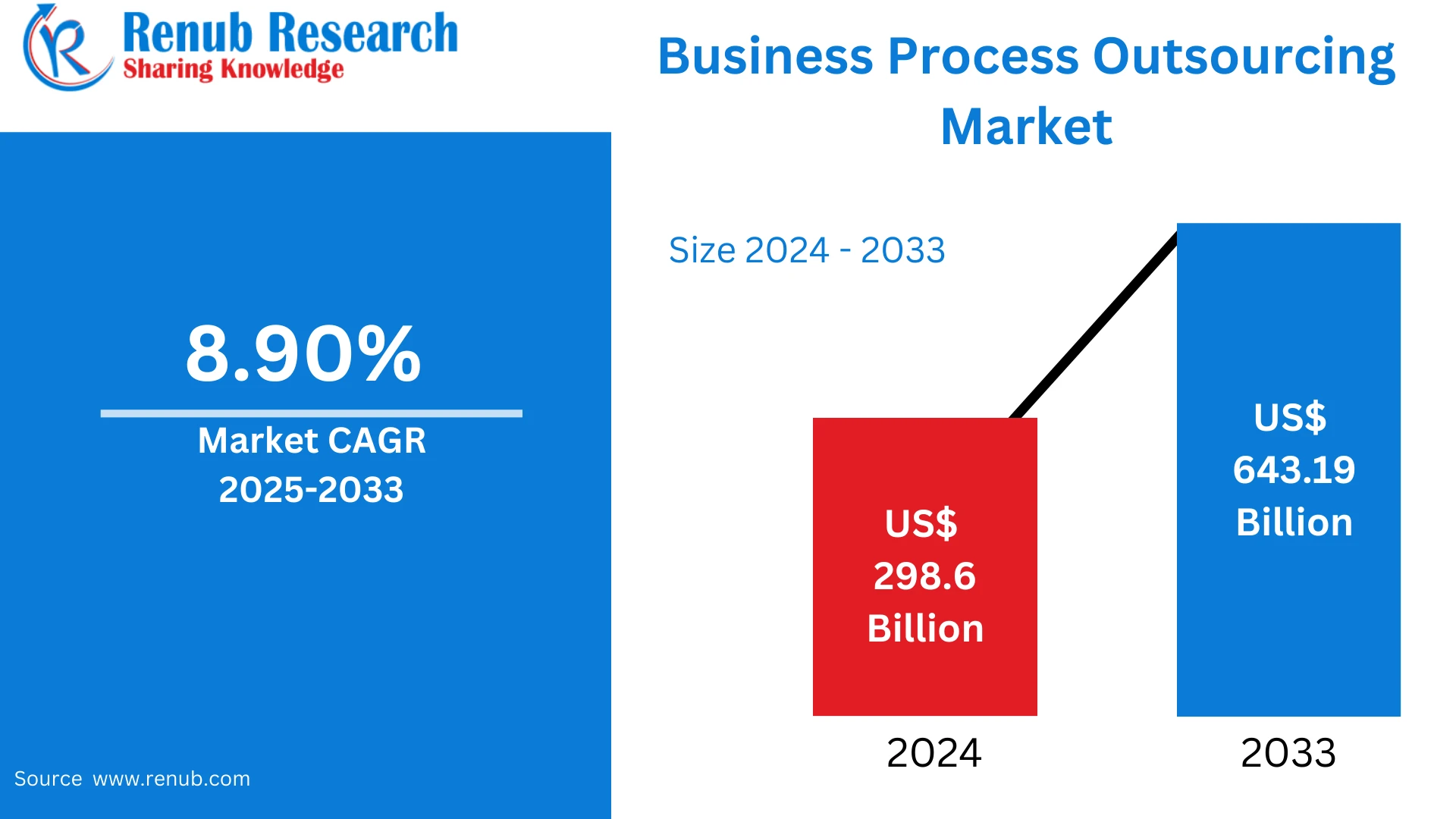
According To Renub Research Business Process Outsourcing (BPO) market has become a critical component of modern business strategy, enabling organizations to optimize operations, reduce costs, and improve efficiency. In 2024, the global BPO market was valued at approximately USD 298.6 billion and is projected to reach nearly USD 643.19 billion by 2033, growing at a CAGR of 8.90% during the forecast period from 2025 to 2033. This strong expansion reflects the increasing tendency of enterprises to outsource both routine and specialized processes in order to remain competitive in a rapidly evolving business environment.
Business Process Outsourcing involves delegating specific business activities to external service providers, allowing companies to focus on strategic growth areas. Services range across customer support, finance and accounting, human resources, IT services, procurement, logistics, and knowledge-based functions. As businesses navigate cost pressures, workforce challenges, and accelerating digital transformation, BPO has evolved from a tactical cost-saving measure into a long-term strategic partnership model.
Download Free Sample Report:https://www.renub.com/request-sample-page.php?gturl=business-process-outsourcing-market-p.php
Business Process Outsourcing Market Outlook
The outlook for the BPO market remains highly positive, supported by globalization, rapid digital adoption, and increasing demand for operational agility. Companies are increasingly leveraging BPO to access specialized skills, advanced technologies, and scalable service models without heavy capital investment. The market is commonly segmented into back-office services, such as payroll, accounting, and data processing, and front-office services, including customer service, sales, and technical support.
Different outsourcing models cater to varying organizational needs. Offshore outsourcing offers significant cost advantages, nearshore outsourcing balances affordability with cultural and time-zone alignment, while onshore outsourcing prioritizes communication efficiency and data security. Key industries driving demand include banking, insurance, telecommunications, healthcare, retail, and e-commerce. These factors collectively position BPO as an essential driver of efficiency and innovation across global enterprises.
Growth Drivers in the Business Process Outsourcing Market
Demand for Cost Efficiency and Operational Flexibility
One of the primary drivers of BPO adoption is the persistent need to reduce operational costs while maintaining service quality. Outsourcing non-core functions enables organizations to save on labor, infrastructure, and technology expenses. BPO providers, particularly in cost-competitive regions, offer economies of scale that help businesses achieve significant financial efficiencies.
In addition to cost savings, BPO provides operational flexibility. Organizations can scale services up or down based on demand without long-term commitments. This adaptability enhances resilience and supports rapid responses to market fluctuations, making outsourcing especially valuable during periods of economic uncertainty and industry disruption.
Increased Focus on Core Business Functions
As competition intensifies, companies are placing greater emphasis on core competencies such as innovation, customer engagement, and strategic planning. By outsourcing routine or specialized tasks, internal teams can dedicate more time and resources to high-value initiatives. BPO vendors bring domain expertise, standardized processes, and best practices that often improve accuracy, speed, and compliance.
Outsourcing functions such as IT, finance, and human resources not only enhances efficiency but also provides access to advanced tools and global expertise. This strategic realignment contributes to improved productivity and stronger long-term business performance.
Technological Innovation and Automation Integration
Technological advancements have significantly reshaped the BPO industry. The integration of robotic process automation, artificial intelligence, machine learning, and cloud computing has enhanced service delivery across multiple functions. Automation reduces manual intervention, minimizes errors, and accelerates turnaround times.
AI-powered solutions, including intelligent chatbots, predictive analytics, and automated workflow management, are increasingly embedded in BPO offerings. These innovations enable organizations to modernize operations without substantial capital investment, further driving demand for technology-enabled outsourcing services.
Challenges in the Business Process Outsourcing Market
Data Security and Compliance Concerns
Despite its benefits, BPO adoption faces challenges related to data security and regulatory compliance. Outsourced processes often involve handling sensitive financial, personal, or healthcare information. Data breaches, unauthorized access, or non-compliance with regulatory frameworks can result in significant financial and reputational damage.
Organizations must ensure that BPO providers implement robust cybersecurity measures, employee training programs, and regular compliance audits. These concerns are particularly pronounced in highly regulated industries such as finance and healthcare, where data protection is paramount.
Communication Barriers and Service Quality Issues
Effective communication is essential for successful BPO relationships, yet it remains a common challenge, especially in cross-border outsourcing. Differences in language, time zones, and cultural norms can lead to misunderstandings, delays, and inconsistent service quality.
Although collaboration tools and digital platforms help bridge these gaps, maintaining transparency, alignment, and performance consistency across geographically dispersed teams requires ongoing management and clearly defined service-level agreements.
BPO in Customer Service and Support
Customer service remains one of the largest segments of the BPO market. Organizations outsource call centers, technical support, and digital customer engagement to provide round-the-clock assistance while controlling costs. BPO providers leverage multilingual teams, customer relationship management systems, and AI-driven tools to enhance responsiveness and personalization.
As customer expectations continue to rise, outsourcing strategies are shifting from purely cost-driven models to value-oriented approaches that emphasize customer satisfaction, loyalty, and long-term engagement.
BPO in Human Resource and Payroll Services
Human resource outsourcing includes payroll processing, recruitment, onboarding, benefits administration, and compliance management. These services help organizations navigate complex labor regulations, particularly in multinational operations. HR BPO providers offer scalable platforms and compliance expertise that reduce administrative burdens and improve workforce management.
The growing prevalence of remote and hybrid work models has further increased demand for flexible, technology-enabled HR outsourcing solutions, making HR BPO a key pillar of modern workforce strategies.
BPO in IT and Technical Support
IT outsourcing is one of the fastest-growing segments within the BPO market. Organizations increasingly rely on external providers for infrastructure management, cybersecurity, cloud migration, and application support. This approach provides access to specialized technical expertise while minimizing capital expenditure.
From help desk operations to advanced network monitoring, IT BPO services enable businesses to maintain system reliability, enhance security, and remain technologically competitive in an increasingly digital environment.
United States Business Process Outsourcing Market
The United States continues to be a leading market for BPO services, driven by strong demand in finance, healthcare, IT, and customer experience management. Companies utilize a mix of onshore, nearshore, and offshore models to balance cost efficiency with data security and service quality.
Advanced analytics, cloud adoption, and automation are shaping the evolution of BPO services in the U.S., while strategic partnerships and acquisitions strengthen the overall market ecosystem.
France Business Process Outsourcing Market
France’s BPO market is expanding steadily as organizations seek to streamline operations amid rising labor and operational costs. Adoption is particularly strong in human resources, customer support, and IT services, with a strong emphasis on regulatory compliance and data privacy.
European and nearshore providers are often preferred, reflecting regulatory considerations and cultural alignment. Government initiatives supporting digital transformation further encourage BPO adoption across public and private sectors.
India Business Process Outsourcing Market
India remains a global leader in the BPO industry due to its large, skilled, and English-speaking workforce. The country excels in IT services, customer support, and finance outsourcing, attracting clients from across the world.
Indian BPO providers are increasingly adopting automation, artificial intelligence, and analytics to deliver higher-value services. Continued investment in digital infrastructure and skill development supports India’s central role in the global BPO ecosystem.
Saudi Arabia Business Process Outsourcing Market
Saudi Arabia’s BPO market is gaining traction under national economic diversification and digital transformation initiatives. Government and private sector organizations are outsourcing customer service, IT support, and human resource functions to enhance efficiency and reduce operational costs.
Growing demand for Arabic-language services, combined with investments in digital infrastructure and regulatory reforms, positions Saudi Arabia as an emerging BPO hub in the Middle East.
Business Process Outsourcing Market Segmentation
The BPO market is segmented by service type, outsourcing model, enterprise size, end-use industry, and geography. Key service types include finance and accounting, customer services, sales and marketing, knowledge process outsourcing, human resources, procurement, logistics, and training services.
Outsourcing models include offshore, nearshore, and onshore arrangements, catering to diverse organizational needs. Both large enterprises and small to medium-sized businesses utilize BPO solutions across industries such as IT and telecommunications, BFSI, manufacturing, healthcare, retail, and government.
Competitive Landscape and Key Players
The global BPO market is highly competitive, with numerous multinational service providers offering end-to-end outsourcing solutions. Leading companies compete on service quality, technological innovation, geographic reach, and industry expertise. Prominent players include Accenture, IBM, Cognizant, Concentrix, Wipro, Genpact, and Amdocs. These organizations focus on automation, digital platforms, and strategic partnerships to strengthen their market positions.
Future Outlook of the Business Process Outsourcing Market
The Business Process Outsourcing market is expected to experience sustained growth through 2033 as organizations continue to prioritize efficiency, flexibility, and digital transformation. The shift toward value-added and technology-driven services will redefine traditional outsourcing relationships.
As artificial intelligence, analytics, and automation mature, BPO providers will play an increasingly strategic role in enterprise transformation. With businesses seeking resilience and customer-centric operations, BPO will remain a vital element of global business strategy in the years ahead