Power batteries serve as the engine equivalent for gasoline vehicles and the primary power source for new energy vehicles. Power battery modules are assembled by “packaging” individual cells. Power batteries are primarily categorized into battery packs, modules, and cells.
Within the power battery sector, dispensing machines play a crucial role in cell encapsulation and battery pack assembly processes.
1.Battery Packs
Battery packs typically consist of battery modules, thermal management systems, battery management systems (BMS), electrical systems, and structural components.
Application of dispensing &potting machines in power batteries
a.Battery cell bonding and encapsulation
Power batteries operate in demanding environments where high temperatures, vibrations, and compression impose stringent requirements on cell encapsulation:
High reliability: Cells must be securely fixed to prevent displacement-induced short circuits or poor contacts.
Sealing: Effective isolation from moisture and air to prevent cell oxidation and swelling.
Thermal management: Rapid heat dissipation via thermal conductive adhesives to maintain stable battery performance.
Traditional cell bonding relies on manual dispensing or semi-automated equipment, which present significant drawbacks. Manual dispensing is inefficient, with inconsistent adhesive volume and poor uniformity; semi-automated systems depend on fixed molds, making them inflexible for producing different cell models.
b.Power battery shell sealing – potting machine
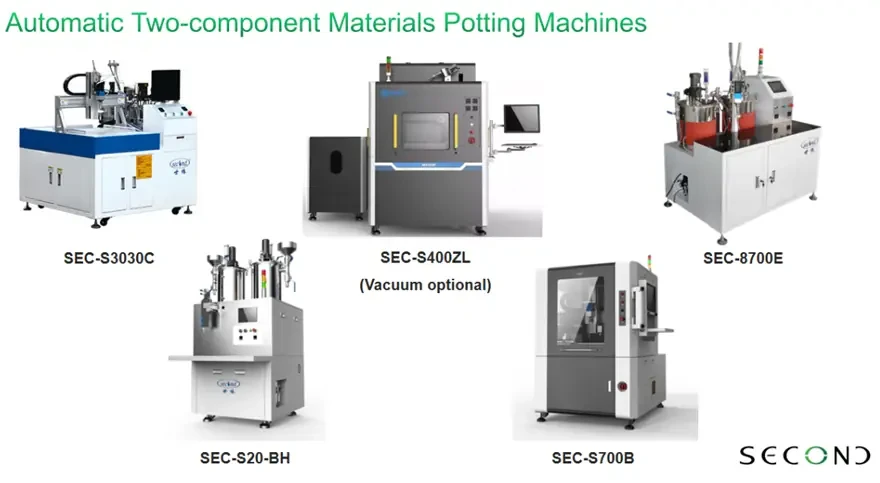
Power battery shell sealing requires a battery potting machine. By injecting sealant, moisture, dust, and other contaminants are effectively prevented from entering the battery interior, avoiding internal short circuits and other faults. This enhances the protection rating of power batteries, meeting the operational requirements of electric vehicles in various harsh environments.
Taking the sealing of a power battery’s top cover as an example, polyurethane or silicone material must be uniformly applied to the metal-plastic joint surface with positioning accuracy of ±0.02mm. The adhesive layer thickness must be controlled within 0.1-0.3mm. This precision dispensing effectively prevents electrolyte leakage while withstanding mechanical stress from vehicle vibrations.
Sealing & Leak Prevention: vacuum injection technology eliminates air bubbles, ensuring battery casing achieves IP67 sealing standards. Compatible with CTP/CTC module-free designs.
e.Supporting functionality
Thermal Optimization: Thermal paste application improves heat transfer efficiency between battery components, helping regulate temperature, prevent overheating, and enhance battery performance and lifespan.
Noise reduction & vibration Damping: Utilizing materials like foamed silicone in battery modules through dispensing reduces vibration and noise, enhancing system stability.
Looking ahead, as the new energy sector continues to evolve, dispensing and potting machines will see increasingly widespread and sophisticated applications. Concurrently, driven by technological advancements and intelligent systems, these machines will advance toward greater automation and intelligence, providing robust support for the new energy industry’s growth.
https://secondintelligent.com/product/dispensing-vacuum-potting-machine-sec-s400-zl/