Chemical Logistics Market Overview
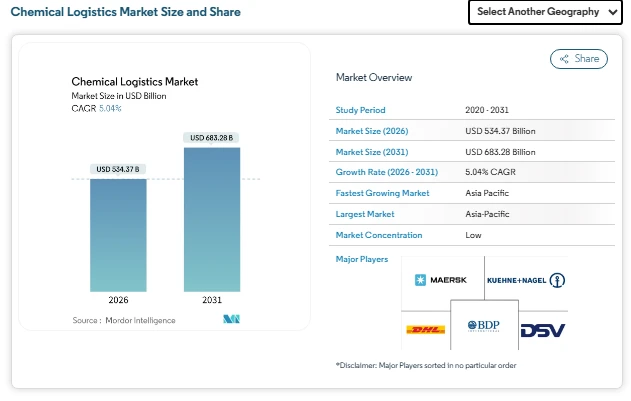
The chemical logistics market size is estimated at USD 534.37 billion in 2026 and is projected to reach USD 683.28 billion by 2031, registering a CAGR of 5.04% during 2026–2031. This market forecast reflects rising demand from manufacturing hubs, pharmaceutical supply chains, and specialty chemical producers that rely on secure, compliant movement of materials. Growth in the Chemical logistics industry is supported by the expansion of chemical output in emerging economies and the need for reliable distribution networks in mature markets. As production locations diversify, companies require logistics partners capable of handling complex regulations, hazardous classifications, and temperature-sensitive cargo. These factors are strengthening the market share of providers offering integrated services across transport, warehousing, and inventory management.
At the same time, sustainability requirements and digital supply-chain visibility are influencing operational choices. Multimodal transport options, particularly rail-sea combinations, are gaining preference due to lower emissions and cost efficiency compared with road-only routes. Such developments are central to ongoing chemical logistics market growth, as manufacturers prioritize both compliance and efficiency across long distances.
Chemical Logistics Market Insights
Compliance and Safety Requirements
Strict regulations governing hazardous materials are a defining feature of the market trends landscape. Rules related to packaging, labeling, documentation, and handling are becoming more stringent across regions, increasing the complexity of operations. Smaller logistics firms often struggle to meet these requirements, leading to consolidation within the industry as larger players expand their networks and capabilities. Compliance is not limited to hazardous cargo. Non-hazardous chemicals also face growing scrutiny regarding environmental impact, traceability, and worker safety. This regulatory environment is pushing logistics providers to invest in specialized equipment, certified personnel, and monitoring systems, reinforcing the importance of reliability in the chemical logistics market growth.
Growth of Multimodal Transport Networks
Multimodal transport is emerging as a major contributor to market growth. By combining rail, sea, and road transport, companies can optimize cost, reduce transit risk, and lower emissions. Rail-sea routes, in particular, are delivering significant environmental benefits compared with road transport alone, making them attractive for large-volume chemical shipments. As global supply chains become more interconnected, logistics providers that can manage transfers between modes efficiently are gaining competitive advantage. This shift is also expanding the geographic reach of the chemical logistics market share, enabling producers to serve distant markets without relying solely on trucking networks.
Digital Visibility and Operational Efficiency
Digital tools such as simulation models, tracking systems, and predictive analytics are improving supply-chain transparency. These technologies help companies monitor cargo conditions, anticipate disruptions, and maintain regulatory compliance. Enhanced visibility is especially valuable for temperature-controlled chemicals and high-value specialty products. The adoption of digital systems is strengthening service quality across the industry, allowing providers to differentiate themselves through reliability and real-time information sharing. As customers demand greater transparency, digital capabilities are becoming a standard expectation within the Chemical logistics share.
Rising Demand for Specialized Services
Premium segments of the market are increasingly focused on temperature-controlled transport, secure storage, and value-added handling services. Pharmaceuticals, cosmetics, and specialty chemicals often require precise environmental conditions throughout the supply chain. Meeting these needs involves specialized containers, monitoring equipment, and trained personnel. Such high-specification services offer stronger margins compared with standard freight operations, encouraging logistics companies to expand their specialized capabilities. This shift toward advanced service offerings is a key element of evolving chemical logistics market size.
Market Segmentation of the Chemical Logistics Market
By Service
-
Transportation
-
Warehousing, Distribution & Inventory Management
-
Other Services
By Transportation Mode
-
Road
-
Rail
-
Sea/Ocean
-
Air
By End-User Industry
-
Pharmaceutical
-
Cosmetics & Personal Care
-
Oil & Gas
-
Specialty Chemicals
-
Other End-users
By Hazard Class
-
Hazardous Chemicals
-
Non-hazardous Chemicals
By Temperature Control
-
Temperature-Controlled
-
Non-Temperature-Controlled
By Geography
-
North America
-
South America
-
Asia-Pacific
-
Europe
-
Middle East and Africa
Key Players in the Chemical Logistics Industry
-
Deutsche Post DHL Group
-
Kuehne + Nagel
-
BDP International
-
DSV
-
A.P. Moller – Maersk
Conclusion
The outlook for the market remains positive as global trade flows continue to expand and chemical production shifts toward new regions. Rising safety standards, environmental considerations, and supply-chain complexity are making professional logistics services indispensable for manufacturers. These factors support long-term market growth and reinforce the importance of reliable partners within the chemical logistics industry.
Multimodal transport solutions, digital visibility, and specialized handling capabilities will play central roles in shaping future market trends. Providers that combine compliance expertise with cost efficiency are likely to strengthen their market share, particularly in high-value segments such as temperature-controlled distribution. Overall, the chemical logistics market forecast points to sustained demand driven by industrial expansion, regulatory enforcement, and the need for secure global supply chains. As companies seek to balance efficiency with safety and sustainability, the industry is expected to remain a critical backbone of international trade for years to come.